Laura Elkin alerts us to The Millions on the future of book reviewing.
Meanwhile, today on my author blog I have my own review ( a rave one) of Dear Everybody by Michael Kimball.
And I must say I'm pretty thrilled that the Pulitzer Prize has gone to a book of short stories, Elizbeth Strout's Olive Kitteridge.
Thursday, April 23, 2009


Sunday, April 19, 2009
You Can Censor Comics But You can't Stop the Comedy
Katy Evans-Bush on a cartoonist facing a two-year prison sentence in Cairo for writing the first graphic novel in Arabic. The trial was set for yesterday, but was adjourned for a reason providing some comic leavening:
the judge charged the vice officer who originally reported the novel a fine of 50 EGP for not showing up during the hearing session after being summoned by the court for testifying.
Monday, April 13, 2009
Kiddies' History
In her Observer TV review on Sunday Kathryn Flett echoed something Adrian Slatcher and I were saying recently over a drink:
It's more than interesting, this tendency to turn the past to sepia, as we've discussed before. There's a parallel paradoxical tendency to paint the past in brighter-than-suitable colours, which I feel however comes from the same, somewhat worrying cultural impulse, and which I found in the programme notes for the production of Macbeth I saw at the Royal Exchange last week:
Honestly, I know this play through and through - I've studied it, I've taught it in schools (even so, I'm not precious about it, I'm always up for new insights) - but I just couldn't follow, so distracted was I by working out the modern parallels, and the flashing lights (which as a migraine sufferer I had to close my eyes to, missing some crucial moments), and the weird experience of listening to apparently garbled (shouted) speeches ringing with phrases which were so familiar to me and the meaning of which I thought I knew...
Director Matthew Dunster made some interesting revelations to Kevin Bourke in the Manchester Evening News:
From Life on Mars to the recent Red Riding our screens are now regularly suffused with 1970s Hovis-coloured shades of greige ... where were the men in tightly fitting polycotton shirts repeat-patterened with drawings of vintage Rolls Royces? You never see them on TV, but they were all over men's backs like a virulent strain of psoriasis.Yes, and what about the pinks shirts too, and the purple trousers and the red-and-yellow tartans, the hippy multicolours, and, towards the end of the decade, the womens' orange jumpsuits?
It's more than interesting, this tendency to turn the past to sepia, as we've discussed before. There's a parallel paradoxical tendency to paint the past in brighter-than-suitable colours, which I feel however comes from the same, somewhat worrying cultural impulse, and which I found in the programme notes for the production of Macbeth I saw at the Royal Exchange last week:
In Britain we have a very clear idea of what childhood during wartime is like: the excitement of air raids and hiding in shelters; hearing and being able to identify a dozen different models of aeroplane as they pass by; playing around in the debris and finding souvenirs; proudly boasting about fathers and older brothers in the armed services, smart and heroic in uniforms; being herded off into the countryside as evacuees and finding imaginary countries in wardrobes.I got that far and I thought: 'Tell that to the seventy-odd-year-olds in the audience!' In fact, it seems on reading further that the author is agreeing with me: his point is that this is an illusion, and he goes on to state that 'writers in particular have given us a skewed picture of childhood during wartime' (and there is of course that dig at C S Lewis). But the piece here is sloppy and muddled and indeed colludes with that rosy picture of life for children in wartime Britain. As a point of fact, the falsely rosy view he describes is mainly derived from postwar children's comics, though he doesn't say so. He says: 'The softening filter of nostalgia has meant that whole generations of wartime children grew up remembering 'the good old days' and the Blitz spirit.' Who is he referring to here? There was only one generation of wartime children, after all, and it is 'whole generations' who have followed. He must therefore mean the latter: we generations who were brought up on the myths. But he muddies this by his use of the word 'remembering' (we can't remember what we haven't actually experienced) and of the phrase 'wartime children'. Thus a reader not seeing the flaws in this sentence (and indeed reading quickly at the theatre, as one does) will come away with the impression that wartime Britain was not so traumatic for children as to prevent them forgetting that it was bad at all - which was enough to make my companion, who was born during the war, throw down the programme in disgust and indeed some upset. But then perhaps that is indeed what the author of this piece is saying, since he then goes on to conclude:
Compare this to children living through wars elsewhere and... well, there's no comparison.Well, it's just a theatre programme, you might say, and the standard of those is often pretty dubious, but when you consider that this production would be aimed at the scores of schoolchildren studying Macbeth for exams, you'd think a little more responsibility was in order. And I'd say the same for the production itself. This was a production screaming RELEVANCE - to Iraq, Afghanistan and Bosnia, with the soldiers in modern combat gear and operating modern warfare technology, and to the schoolchildren themselves, with the witches transformed into the demonic wraiths of female children raped and murdered in war. This last, by which a subsidiary theme of the original, that of the effect of war on innocents, is made a central one, is not the only way that the production radically skews the play. I'm getting pretty sick of Shakespeare productions in which actors say their speeches as if they have no idea what they mean and simply can't wait to get to the end, and compensate by shouting them, and, with the exception of a beautifully judged performance by John MacMillan as Malcolm and a (less satisfactory) one by Hilary Maclean as Lady Macbeth, this happens here. But it's made much worse by the fact that the complex psychology of the main characters is subsumed in this production's pursuit of spectacle. Macbeth is a deeply psychological play about the pull between personal ambition and guilt, which both of the Macbeths suffer, but not here: the coke-sniffing Lady Macbeth takes one frenetic angry note throughout, and Macbeth's conversion from coward to tyrant to troubled soul is, well, laughable - and the audience did indeed laugh at him at one moment during the scene where Banquo's ghost appears at the feast.
Honestly, I know this play through and through - I've studied it, I've taught it in schools (even so, I'm not precious about it, I'm always up for new insights) - but I just couldn't follow, so distracted was I by working out the modern parallels, and the flashing lights (which as a migraine sufferer I had to close my eyes to, missing some crucial moments), and the weird experience of listening to apparently garbled (shouted) speeches ringing with phrases which were so familiar to me and the meaning of which I thought I knew...
Director Matthew Dunster made some interesting revelations to Kevin Bourke in the Manchester Evening News:
It’s not, I put to Matthew, a play any director undertakes lightly.“I probably did, actually,” he replies, confoundingly. “I was asked to do it and I said I’d love to do it, just because I wanted to have a go at it. I wanted to have a go at it in a very populist, contemporary, theatrical way ... one of the problems with Macbeth is that people do tend to come at it with this heavy weight and one of my bugbears with Shakespeare is it carries so much intellectual baggage with it. I thought, ‘I just want to make a really good show'.
"I’ve taken not scissors but a big pair of garden shears to it!,” he laughs... Where we think [Shakespeare] would benefit from our contemporary eyes saying ‘we don’t need that, that’s no use to us’, we’ve just got rid of it."
That would be the complex psychology of the tyrant, then. And, er, that's not relevant to Iraq...?
Not so much a case of teaching Granny to suck eggs, I'd say, but of teaching Granny to suck eggs when you don't even know what eggs are...
Amazon Censorship
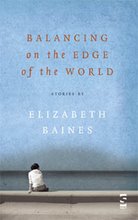
On Thursday last week the ranking disappeared from my Amazon page for my story collection, Balancing on the Edge of the World. Well, no one can call me paranoid: I just decided that they must have removed the ranking facility altogether (and I was busy so I didn't bother to check anyone else's). Then on Saturday it appeared again and I decided it had just been a glitch.
But what do I discover today but that Amazon have apparently removed the ranking facility from all books with 'adult' content. Seems that in response to a massive protest Amazon are now saying that it was just a glitch but here's the reply which Mark Probst received from Amazon when he inquired:
It is of course a matter of extreme concern that an organization with the power of Amazon could practise such censorship, and I urge you to sign the petition set up to protest.
Here's a post by Anne Brooke on the Vulpes Libris blog, which supplies more details.
But what do I discover today but that Amazon have apparently removed the ranking facility from all books with 'adult' content. Seems that in response to a massive protest Amazon are now saying that it was just a glitch but here's the reply which Mark Probst received from Amazon when he inquired:
In consideration of our entire customer base, we exclude “adult” material from appearing in some searches and best seller lists. Since these lists are generated using sales ranks, adult materials must also be excluded from that feature. Hence, if you have further questions, kindly write back to us.The most outrageous aspect of this is that by 'adult' Amazon seems to mean 'gay and lesbian', so that classic gay and lesbian books without the inclusion of explicit sex have had their ranking removed while books including explicit hetereosexual sex have been left alone. (God knows what happened with mine: did they take another look at the one erotic story in my book and decide that because it was heterosexual sex it was OK after all?)
Best regards,
Ashlyn D
Member Services Amazon.com Advantage (Quoted from Mark Probst’s Blog)
It is of course a matter of extreme concern that an organization with the power of Amazon could practise such censorship, and I urge you to sign the petition set up to protest.
Here's a post by Anne Brooke on the Vulpes Libris blog, which supplies more details.
Friday, April 10, 2009
Short Stories on the Up
I was going to post about a couple of recent Guardian articles which seem to indicate a resurgence of interest in the short story, but Tania Hershman has beaten me to it with an excellent post on the Short Review blog, which I do recommend you read.
What she doesn't mention there is that this resurgence is reflected by the judges of the Orange New Writing prize, who have commended Tania herself for her wonderful collection, The White Road and Other Stories! Very many congratulations to Tania!
What she doesn't mention there is that this resurgence is reflected by the judges of the Orange New Writing prize, who have commended Tania herself for her wonderful collection, The White Road and Other Stories! Very many congratulations to Tania!
Thursday, April 09, 2009
A Different Kettle of Fish?
Sometimes, when there are other, more desperate things going on, one is tempted into thinking that writing about literary things is a little effete. But then the way we use language is at the root of everything, as Orwell taught us, and a letter to The Guardian yesterday from Professor John Veit-Wilson reminds us of an earlier use of the word 'kettling' for containing crowds:
The word was used in 1942 about the practice of the Nazi government in Warsaw when they "shut us [the Jews] up in a manageable area - the 'Kettle' - and combed through our helpless crowd", as John Hersey's fictionalised account of the Ringleblum archives reported in 1950.
Perhaps those who have little sense of history or political philosophy are unaware of the connotations of the term, but for the rest of us this police practice is one more sign that the government of covert forces behind it are putting into place, little by little, whatever would be needed at some future stage for totalitarian control.
Sunday, April 05, 2009
How to Dress for Safety
A PS to yesterday's post:
So, city workers were advised to dress down to avoid being targeted by G20 protesters. Perhaps others should have been advised to dress up to avoid being targeted by riot police.
So, city workers were advised to dress down to avoid being targeted by G20 protesters. Perhaps others should have been advised to dress up to avoid being targeted by riot police.
Saturday, April 04, 2009
Kettles, Cages and Clean-ups
I'm sorry to have been silent for a while. I got stuck inside my own head, the way you sometimes do as a writer, and got to that stage where I just needed to get out and away and look at the outside world instead. So I borrowed someone's London flat and went walking and here are some of the things I saw:
A clean-up operation on the River Lee:

Some very nice polite schoolboys:

Environmental protesters on a bus stop in Bishopsgate:

Lib Dem Shadow Climate Change Secretary Simon Hughes and an environmental campaigner:

Some dancing environmental campaigners:

The City of London police in formation across Bishopsgate:

A very nice polite policeman:

The kettle in Threadneedle St not yet steaming:

Every exit barred:

Business as usual on the Millennium Bridge:
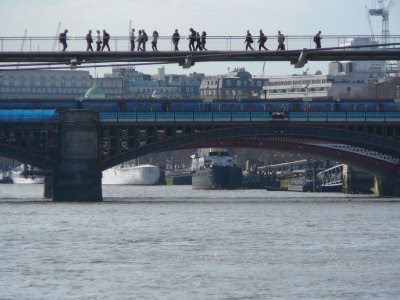
Three hunched figures and beds like cages in the Tate Modern:

John Siddique launching his Salt poetry collection, Recital: An Almanac under a beautiful moon at the National Portrait Gallery:

A lovely part of the (I presume) cleaned-up Regent's Canal:

Some more caged creatures:

Some free birds in a cultivated park:

A clean-up operation on the River Lee:

Some very nice polite schoolboys:

Environmental protesters on a bus stop in Bishopsgate:

Lib Dem Shadow Climate Change Secretary Simon Hughes and an environmental campaigner:

Some dancing environmental campaigners:

The City of London police in formation across Bishopsgate:

A very nice polite policeman:

The kettle in Threadneedle St not yet steaming:

Every exit barred:

Business as usual on the Millennium Bridge:

Three hunched figures and beds like cages in the Tate Modern:

John Siddique launching his Salt poetry collection, Recital: An Almanac under a beautiful moon at the National Portrait Gallery:

A lovely part of the (I presume) cleaned-up Regent's Canal:

Some more caged creatures:

Some free birds in a cultivated park:

Sunday, March 22, 2009
The Low Concept of High Concept
Well, doh! I've only just found out what 'high concept' means, though I guess if I'd known it was a marketing term I'd have twigged: it doesn't mean, as I thought, subtle and sophisticated, but quite the opposite: it means clear and simple in concept, as well as recognizable (which means I guess I misunderstood some of the discussion at the Huddersfield Literature Festival last week, where the term was used.) Here's a Waxman Literary Agency blogger writing about the fact that books need to be 'high concept' to sell:
And we know where this can lead for fiction.
For writers who are drawn to the obscure and the un-covered, who think “but no one has ever written about this! why write about things people already know?” I hear you–this feels remarkably like commercial pandering. But I would encourage you to think about three things: 1. it is all in the execution but no one will ever see your execution if your premise doesn’t catch their attention; 2. it’s hard to be attentive to things we don’t recognize on at least some level; and 3. who do you write for? If it’s for readers, think about it not as selling out, but about seducing people into your world, giving them a point of entry that lets them feel comfortable. High concept is all about the touch of recognition that makes readers ready to go along on your ride.Well, this seems to me only sensible, as I've said on many an occasion, but there is one aspect of the Waxman blog post I find unsettling, which emerges in this sentence:
If the idea you're kicking around is really high concept, it should feel natural to come up with a one or two sentence affair that conveys the general premise of the work.Run that by me again: If the idea you’re kicking around is really high concept. Ah, so it's not after all the pitch that has to be high-concept, as the blogger has up to this point been implying, but the original idea in the first place. And there are ideas that are intrinsically 'high-concept' and there are ideas that are not. It's not after all, a matter of 'seducing people' or 'giving them a point of entry' into something more subtle. It's not that, as I'm always saying, with clever marketing you can sell anything. Some ideas are just too subtle after all.
And we know where this can lead for fiction.
Thursday, March 19, 2009
The Wrong Question
Here's a telling little snippet from an interview with Paulo Coelho by Hannah Pool in The Guardian. He is talking about his novel The Alchemist which has sold 35m copies:
It was published, it did not sell, and then the publisher said, "This book is never going to sell." ... However, I was so convinced that it was a great book that I started knocking on doors. [Now] The Alchemist is the most translated book by a living author.What do we conclude from this? Perhaps that whether a book 'will sell' is the wrong question. It is the one which publishers are of course always asking, but what it most often seems to mean is Will this book sell itself? This seems to me the great inconsistency in an industry which is supposed to have bought in wholesale to the concept of marketing. As any real marketer knows, nothing sells itself: customers have to be wooed; conversely, with clever marketing you can sell anything, as the 'door-knocking' snakeoil salesmen knew only too well. Perhaps the question should be rather: Do we believe in this book enough to bother to move hell and high water to sell it? But then for that to happen, the power in publishing houses would have to move back to the editors and away from the accounting - oh, sorry, so-called marketing departments...
Wednesday, March 18, 2009
Final Leg of my Virtual Book Tour
The final leg of my virtual book tour is up today on the blog of Tania Hershman, author of the inventive science-inspired collection of stories, The White Road . Promotion over, folks - though it has actually been more than just that, an opportunity for some in-depth discussion about the nature of fiction, the writing process and the writing life.
Sunday, March 15, 2009
Will Who?
I like what Robert McCrum says in relation to the Cobbe portrait of Shakespeare:
The speculation about the life will rage until the crack of doom. The work remains.
The Logic of Literary Agents
After last week's 'Queryfail' on Twitter, in which literary agents spilled the beans about the daft and desperate query letters they receive, The Guardian reported yesterday uber-agent Jonny Geller as saying this:
That's a bit daft, isn't it? Or maybe it's the desperate logic of agents who feel they need 'help' in discouraging authors from sending unsolicited stuff in the first place...
(Can't find the Guardian link, I'm afraid.)
'The fact is that publishers, and lots of agencies, have stopped accepting unsolicited manuscripts, so how is a writer meant to get into publishing? I can understand [authors'] frustration [with Queryfail], but I think the more help given the better.'Now let me get this straight. Prospective authors need help in writing the letters that 'lots of agencies' won't even consider nowadays?
That's a bit daft, isn't it? Or maybe it's the desperate logic of agents who feel they need 'help' in discouraging authors from sending unsolicited stuff in the first place...
(Can't find the Guardian link, I'm afraid.)
Thursday, March 12, 2009
Fact v Fiction and the Myersons
What to say about the gaping hole of pain which is the current Myerson family debacle? My stomach lurched when I read Jake Myerson's account in the Daily Mail, I cried when I watched Julie squirming under Paxman's unforgiving treatment, struggling to put her point across while clearly racked by both guilt and a frightened sense of injustice. My stomach turned over again when I read all the finger-pointing by journalists and the public alike: bad mother; spoilt brat.
How many of us can put up our hands and say we weren't troubled and troublesome teenagers? Not me, certainly. How many of those of us who have been parents can say we haven't made mistakes? Not I, mate. It's no coincidence that many of my radio plays and much of my prose are about the repercussions that adult behaviour can have on children's lives.
'I had to write about it,' Myerson told Paxman, and Paxman reacted with his trademark mix of regular-bloke disbelief and supercilious contempt, and the rest of the world threw up their hands in horror with accusations of selfishness (and Myerson retreated into her now familiar justification that she had to tell the world about skunk).
But the point is this: we writers have a constitutional urge to write about what moves and troubles us and seems to us of dire importance (and I'm betting that this is something Jake Myerson understood when he apparently assented to the book's publication, which makes it all a much greyer area than people seem to assume): without that urge, books would be dead things that moved no one and affected nothing.
But this is the problem: the people we are in the throes of such crises are not the people we will always be. We are not the incontrovertible 'fact' of ourselves. It seems to me that Myerson's biggest mistake was to write the book as fact and not as fiction. You can see why she did, if she felt an urgency to expose the problem of skunk, and given the supremacy of 'fact' over fiction in our culture. But it's hard not to see the tragedy for this family as the ultimate fallout from this pernicious contemporary cultural phenomenon.
How many of us can put up our hands and say we weren't troubled and troublesome teenagers? Not me, certainly. How many of those of us who have been parents can say we haven't made mistakes? Not I, mate. It's no coincidence that many of my radio plays and much of my prose are about the repercussions that adult behaviour can have on children's lives.
'I had to write about it,' Myerson told Paxman, and Paxman reacted with his trademark mix of regular-bloke disbelief and supercilious contempt, and the rest of the world threw up their hands in horror with accusations of selfishness (and Myerson retreated into her now familiar justification that she had to tell the world about skunk).
But the point is this: we writers have a constitutional urge to write about what moves and troubles us and seems to us of dire importance (and I'm betting that this is something Jake Myerson understood when he apparently assented to the book's publication, which makes it all a much greyer area than people seem to assume): without that urge, books would be dead things that moved no one and affected nothing.
But this is the problem: the people we are in the throes of such crises are not the people we will always be. We are not the incontrovertible 'fact' of ourselves. It seems to me that Myerson's biggest mistake was to write the book as fact and not as fiction. You can see why she did, if she felt an urgency to expose the problem of skunk, and given the supremacy of 'fact' over fiction in our culture. But it's hard not to see the tragedy for this family as the ultimate fallout from this pernicious contemporary cultural phenomenon.
Wednesday, March 11, 2009
Prose fiction v drama and adaptation: new leg of my virtual book tour
The penultimate leg of my virtual book tour, Around the Edges of the World, is now up. Crime-thriller writer Debi Alper asks me about the different processes in writing prose fiction and drama, and about the special problems of adapting one's own work from the first of these forms to the second.
Saturday, March 07, 2009
An Apology
My apologies: I took from Alexander Chancellor's article yesterday that Julie Myerson's new book The Lost Child was a novel. It's not in fact - it's even subtitled A True Story, I discover. This raises different and even more urgent issues, of course, about the morality of such memoirs, which, bogged down with script-reading, article-writing etc I'm afraid I don't have time to tackle just now. However there's a sensible-looking article about them in today's Guardian (which I also havent yet had time to read) by Ian Jack, once editor of the great journal of reportage, Granta.
Friday, March 06, 2009
Fact versus Fiction
As I have endlessly discussed on this blog, it's generally wise to resist public hunger to know the real-life sources of one's fiction, because for one thing, it can lead to mistaken biographical readings of the work as a whole, and for another, any sensible novelist is aware that once she has sent real life through the mangle of her own perceptions and the transformative process of fiction, it's become something else altogether and can no longer be claimed as factual truth. And such discussions do a great disservice to fiction, which is more than the sum of its parts - real life and imagination - and something more powerful altogether. Breaking it down into its 'components' is to reduce it and deny its transcendence.
It seems, however, that novelist Julie Myerson has not only admitted to the real-life trigger for her latest fiction, but is herself making the category error usually made by a naive public, and claiming that the troublesome drug-addicted boy in her latest novel is indeed her own son.
But one wonders what pressures she has been put under to do this (James Frey hovers virtually at my shoulder) with a public hungry for fact in fiction. She's getting plenty of publicity out of it, after all...
It seems, however, that novelist Julie Myerson has not only admitted to the real-life trigger for her latest fiction, but is herself making the category error usually made by a naive public, and claiming that the troublesome drug-addicted boy in her latest novel is indeed her own son.
But one wonders what pressures she has been put under to do this (James Frey hovers virtually at my shoulder) with a public hungry for fact in fiction. She's getting plenty of publicity out of it, after all...
Wednesday, March 04, 2009
Literary Friends and the Spectre of Nepotism
Virtual book tours. Great publicity tools (I think, or at least hope, after all the work I'm putting into mine!), and more: opportunities for in-depth literary discussions; certainly I'm finding my own to be. But from under my Fictionbitch hat I don't find them unproblematic.
Today my tour goes to the blog of novelist and short-story writer Charles Lambert (where he asks me about my political consciousness - with a small p - as a writer, the differences between writing for a radio and a short story audience, and the reasons for the variety of the stories in my collection). Charles Lambert, I am pretty thrilled to say, is complimentary about my work, and the reasons I'm so thrilled are that I admire his writing greatly in turn and see in it some resonances with my own, and also - perhaps because of those resonances - he pays me the particular compliment of understanding my work on such a level that he is able to invite me to discuss the issues that are most important to me as a writer.
But here is the problem. What does this look like from the outside? Especially if you know the other, extraneous circumstances: we are published by the same publisher; we became friends via our blogs (and more latterly FaceBook); we have met twice, if briefly, at our publisher's book launches. And last year I hosted his book tour, expressing my admiration for his collection, A Scent of Cinnamon, and on another occasion wrote very positively about his novel, Little Monsters. Isn't this just a question of literary buddies bulling each other up? How can the outside observer take seriously any positive critical comments? This is of course the time-honoured complaint against reviewers, but the situation here is even more potentially dubious, since - although, as I say, I have discovered they can be far more - virtual book tours are fundamentally promotional tools.
Here at Bitch Towers I have historically distanced myself from promotion, and for this reason I tend to host book tours on my other, 'cuddlier' blog, as one publisher recently called it, and to promote there the books of my friends.
But the fact that is often overlooked is that our good opinions of the books of our literary friends most often precede our real-life friendships with them, and that the friendships only arise precisely because of literary resonance. One's writing, after all, is an expression of one's personality, and more often than not if I have been moved or impressed by a person's writing, then the odds are that when we meet in the flesh we will get on together and consequently become friends. Yet once we are friends, others may suspect that our claims for each others' work are not to be trusted.
This whole problem rears its ugly head when it comes to seeking cover quotes for a book, which I'm currently doing and which I wrote about last year, charting my somewhat ridiculous bid to avoid all accusations by searching for a quote from someone I didn't know.
Today my tour goes to the blog of novelist and short-story writer Charles Lambert (where he asks me about my political consciousness - with a small p - as a writer, the differences between writing for a radio and a short story audience, and the reasons for the variety of the stories in my collection). Charles Lambert, I am pretty thrilled to say, is complimentary about my work, and the reasons I'm so thrilled are that I admire his writing greatly in turn and see in it some resonances with my own, and also - perhaps because of those resonances - he pays me the particular compliment of understanding my work on such a level that he is able to invite me to discuss the issues that are most important to me as a writer.
But here is the problem. What does this look like from the outside? Especially if you know the other, extraneous circumstances: we are published by the same publisher; we became friends via our blogs (and more latterly FaceBook); we have met twice, if briefly, at our publisher's book launches. And last year I hosted his book tour, expressing my admiration for his collection, A Scent of Cinnamon, and on another occasion wrote very positively about his novel, Little Monsters. Isn't this just a question of literary buddies bulling each other up? How can the outside observer take seriously any positive critical comments? This is of course the time-honoured complaint against reviewers, but the situation here is even more potentially dubious, since - although, as I say, I have discovered they can be far more - virtual book tours are fundamentally promotional tools.
Here at Bitch Towers I have historically distanced myself from promotion, and for this reason I tend to host book tours on my other, 'cuddlier' blog, as one publisher recently called it, and to promote there the books of my friends.
But the fact that is often overlooked is that our good opinions of the books of our literary friends most often precede our real-life friendships with them, and that the friendships only arise precisely because of literary resonance. One's writing, after all, is an expression of one's personality, and more often than not if I have been moved or impressed by a person's writing, then the odds are that when we meet in the flesh we will get on together and consequently become friends. Yet once we are friends, others may suspect that our claims for each others' work are not to be trusted.
This whole problem rears its ugly head when it comes to seeking cover quotes for a book, which I'm currently doing and which I wrote about last year, charting my somewhat ridiculous bid to avoid all accusations by searching for a quote from someone I didn't know.
Tuesday, March 03, 2009
Grim Rewards
In the second issue of the online Manchester Review from Manchester University, Colm Toibin reveals in an interview with M J Hyland that the best enjoyment he gets out of writing is the money. In a straw poll of authors conducted in response by The Guardian today (and which doesn't seem to be replicated in the online version of the Guardian article) most agree with his assessment that writing novels is actually pretty gruelling - Will Self is a notable exception - though Joyce Carol Oates points out pretty sharply that
Which is why, of course, the publishing industry has most of us over a ruddy barrel.
...most literary writers don't write for money. A prose fiction writer's hourly wage, broken down into units, would be in the modest range of the US minimum wage of the 1950s - approximately $1 dollar per hour.But then it's clear that even if it weren't for the money, Toibin would still be writing, like all of us unremunerated authors. He'd never quit, he says, writing is essentially a neurosis, an obsession.
Which is why, of course, the publishing industry has most of us over a ruddy barrel.
Subscribe to:
Posts (Atom)