Macmillan New Writing. Cause of well documented controversy. No advances for writers, but, according to the
website, books by talented new writers who 'otherwise might fail to get into print'.
A potentially dangerous statement to make, this last, you might think, but now they've made it, let's examine it via the one the Bitch has now read, Roger Morris's Taking Comfort.
Here's the blurb through which you approach the book:
It's Rob's first day in his new job. On the way into work, he sees a student throw herself under a tube train. Acting on an impulse, he picks up a file she dropped as she jumped. Over the next few days, he's witness to other disturbing events, some more serious than others. From each one he takes a 'souvenir'. As his behaviour becomes increasingly obsessive, he crosses the line between witnessing disasters and seeking them out, and events begin to spiral out of control.
Hm. Sounds a bit like a thriller and not, therefore, quite The Bitch's cup of tea, a very different sort of thing from the brilliant psychological story by the same author,
The Symptoms of his Madness Were as Follows which she once published in
metropolitan, her literary magazine. Though that, too, was about a man with an obsession... So let's give it a go.
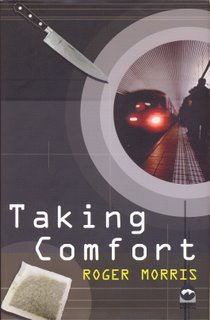
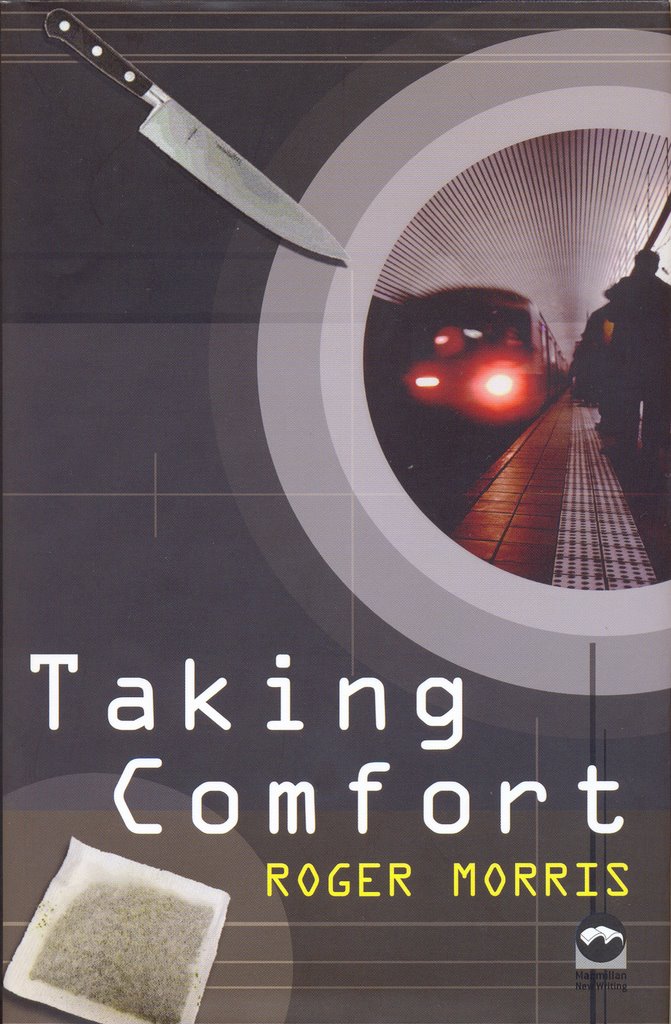
The bookseller holds it up (The Bitch has had to order it) and the dustcover confirms the impression: those dun greys, those fine lines like the crosshairs of a gun's sighting, that view of the tube station similarly circled, the blood-red lights of the train intimating violence and death, that minimalist collage of what seem like mystery/thriller clues: the knife, so iconically thrillerish, pointing towards that unsettling scene, but then the stranger teabag with its cosier Agatha-Christie-type connotations. The typeface: angular and sans serif mainly, though curiously not entirely, but on the whole at odds with its message 'Taking Comfort' - though, The Bitch thinks, carrying home the black shiny Waterstone's bag, comfort is perhaps what people read thrillers for: the comfort of the familiar mode, the comfort of violence packaged and dealt with and formulated - precisely the things which make her impatient with the genre.
She gets home. She sits down. She opens the book up, and she knows straight away that this is something else. Nothing formulaic at all, but something original and exciting; it's a book which deals, yes, with the violence and the existential fear which imbue every thriller, but its real task is to question our contemporary psychological reality, and the way it does this is by attention to LANGUAGE.
Language is where this book is at. Rob, the book's main character, (like Morris himself) works in marketing. He weighs words, he knows the weight of words, and we learn to weigh them with him as the book plugs us directly into his psyche. The novel begins as Rob makes his way to his new marketing job carrying his new briefcase, a Di Beradino classic, its marketing copy running in his head:
Robust stitching and lined with a cotton material Flapover conceals triple sectioned interior pus pockets on front Size 44 x 33 x 14cm
He is a marketing man. He can appreciate the abrupt punctuation-free poetry of that copy.
He is a marketing man. A phrase which recurs, a litany inside Rob's head, like other phrases, and phrases in the heads of other characters, replicating the psychology by which we maintain our tenuous hold on reality, and our sense of safety. The Bitch appreciates the poetry of this prose.
Furthermore, the novel is concerned with the way in which, in our commercial yet post 9/11 world we assuage our existential dread with objects:
In his hand, you have to imagine how it feels, the Di Beradino classic briefcase... The whole focus of his being is in the grip of his hand around that hard leather handle, in the way the seam stubs into the underbellies of his fingers, in the swing of the handle in its sold brass satin finished fittings. In the sense he has of its contents and how they influence the swing and how that swing uplifts him.
This is how we 'take comfort', how all of the novel's characters take comfort, pinning their fears and desires on certain objects - Rob's wife Julia on her particular brand of cooking knife, the Sabatier Au Carbone 8 inch Carbon Steel Chef's Knife (the knife on the dustcover), the receptionist on her Twirl mug - their psyches/identities and the objects becoming intertwined. And the form of the book replicates this perfectly, each short chapter being named for a branded object, and each moving forward the action through a character's relationship with that object.
It is Rob's intimate understanding of all this, as a marketing man, which sets him on the obsessive object-collecting course which will lead towards terror...
And as the Bitch is reading, she becomes aware of her own implication in these things. She remembers how she felt about the shiny black Waterstone's bag as she brought the book home. How she loves those bags, their glossiness, the depth of their blackness, the way they slip on the surface of the books inside them, and the freight of memory they carry, all those author readings when Robert Topping was at Manchester Waterstone's...
And the hardback book now in her hand. Taking Comfort. There's a lovely weight to it, solid without being heavy, it kind of anchors comfortably in her hand. And the cover, a matt ground with the picture and objects picked out in a shiny texture, and the dustcover very nice substantial paper, weighted in place around the contours of the book, with a comforting silky feel to the touch. The flyleaf a classy heavy paper in navy. In fact, the book is beautifully bound, just like books used to be, and the creamy paper is more than satisfying to turn and of a texture which makes the print easy to read. And there's a dark-blue ribbon marker which The Bitch can't help sometimes handling, and at its end a ridge of glue to stop it unravelling, a little nub which is somehow satisfying to rub across the cushion of your thumb. As an object this book is a beautiful thing, freighted, weighted, with this meaning: that this novel has been published with thought and care - is it too much to say even with love? - by people who understand it and want to do it justice, and have thought about how to carry its meanings in a concrete dimension.
And then The Bitch begins to notice imperfections which, freighted with this meaning, are touching, almost moving: on page 23 of her copy a small portion of the print is smudged, which makes her think of the guys at the printer's working on this book - all the work that has gone into this book! - and the care which has meant that there are no other smudges; and then she comes upon a pair of pages which have creased, ever so slightly, in the folding process, and the even fainter imprints of those creases on the adjoining pages, and she thinks of the people working those folding machines, and of the fact that however mechanised the printing process nowadays, it's still such a searingly human endeavour...
Yet none of this distracts her from the words of the novel; strangely, but not so strangely, the novel and these thoughts enhance each other. And as she reads compulsively on - this is a book The Bitch can't put down - and the events, as the blurb promised, spiral, she finds that she is fingering the final pages, and maybe she wouldn't have noticed she was doing it but for the fact that she finds these pages won't open at the bottom, they're not properly cut. And it even occurs to The Bitch that this could be a deliberate marketing ploy, but whether or not it is, it adds to her sense of excitement, as well as flooding her with thoughts of former times when the pages of books, routinely, had to be cut, and in a very concrete way this places this book, so supremely about our contemporary existence, in the tradition of great writing in which it belongs.
So. This is a book which opens up your perceptions, challenges your assumptions and makes you think about language. Does this mean, as Macmillan say, that 'it might otherwise have failed to get into print'? Well, if The Bitch's own experience as a writer is anything to go by, she thinks, yes, probably. It is clearly the thriller aspect of the book, though, which Macmillan have decided to stress in the marketing, and as I said in an
earlier post, with the right marketing you can sell anything. I hope I'm right, because this book deserves to be read, and people deserve the chance to read it.