Tuesday, May 19, 2015

Edge Hill Prize shortlist 2015

It's that time of year again: the shortlist for the Edge Hill Prize for a short-story collection has been announced, and I didn't even get around to commenting on the long list.

As usual, the long list is dominated by independent publishers, with 9 of the 26 titles coming from Celtic publishers - no less than 5 of those from Ireland - and the established London houses fielding a mere 4 between them. Two books from big publishers, however, make it to the shortlist of 6, along with one from Scotland (Freight), one from Ireland (Doire), and one each from independents Seagull and Salt, based in Kolkata and Norfolk respectively:

Waiting for the Bullet, Madeleine D'Arcy (Doire)
The Redemption of Galen Pike, Carys Davies (Salt)
Infidelities, Kirsty Gunn (Faber)
Life-Like, Toby Litt (Seagull)
Any Other Mouth, Annaliese Mackintosh (Freight)
The American Lover, Rose Tremain (Chatto and Windus)

I've never thought to wonder previously about gender representation on previous shortlists and long lists for this prize, but as one of my Facebook commenters pointed out, this shortlist includes only one man, reflecting perhaps the fact that the long list is weighted towards female authorship, which possibly indicates that women currently dominate the short-story scene.

Heavyweights Hilary Mantel and A L Kennedy miss out, which is interesting: personally, I liked Mantel's book, although as critics pointed out, it did have the air of stories written over a long period and thus lacked the cohesiveness that this prize is specifically looking for in a collection. Cohesiveness certainly characterises all of the books on the shortlist. Annaliese Mackintosh's confessedly autobiographical and amazingly energetic collection obsessively circles the same moments and operates more as a short-story cycle; Toby Litt experiments cleverly throughout his collection with different forms, but overall it is a kind of jazz riff featuring connected characters. Kirsty Gunn's beautifully written stories are tightly bound by voice, theme and sensibility, as are Madeleine D'Arcy's and those of Carys Davies whose collection has the mythic quality she has made all her own. And while the stories in Rose Tremain's collection are strikingly varied in subject matter, and sometimes voice, a sense of her steady authorial sensibility makes these a strength.

I can't imagine who is going to win...


Monday, May 18, 2015

The conditions needed for writing


I can't write at the moment, and here's why. The room in which I like to write is an attic room, under the sloping ceiling with no space between me and the actual roof. As I work I can hear the pigeons trotting across the slates just above me, and their cooing is a soothing background soundtrack. I feel so at peace there, so removed from the hum-drum world down below and free to sink into other worlds. I know it's a cliche, the writer in the garrett, and it's often presented as a writer's hardship (having to live in a garret, which is traditionally associated with poverty), but our garret is an extra, and I know I'm lucky to be able to work there. However, since it's directly under the roof it's been vulnerable to leaks, and I have often also sat writing with water dripping - and more recently pouring - into a bucket. So now the roof is being mended, the view from the window is blocked by scaffolding, my partner John is working on the window frame, since it went rotten while we didn't consider it worth decorating up there, and everything's covered with drapes. I feel bereft: I had to abandon the desk hastily, because the roofers began earlier than I had expected, and it's a struggle to get back up there to get things I need for writing but had forgotten, as, on the stairway just outside, the old skylight is being replaced and the stairwell is blocked with tarpaulins. And anyway I can't write.


I don't think it's just the sound of hammering above, and battens being thrown down all around; it's also to do with my displacement from my nook. I've puzzled about why, since I've written in so many other places: I've lived in so many other places, for a start, and I've written in basements and shared bedrooms; I've written in other places in this house, on the table I'm sitting at now in our living room, and on the landing, even, with all the doors shut, when I've needed insulation from the sound of other people's roofs and building work being done. I've often written very successfully while travelling alone on trains, usually with the excitement of a brand-new idea, and I think that's a clue, travelling alone being not only stimulation but a kind of mental insulation: a removal from the day-to-day, and a throwing back of oneself onto one's own resources and insights. It's a question, in the main, I've found, of carving out a kind of physical-mental space, a corner of the room, say, where these particular thoughts and inspirations happen. So why can't I do it now? After all, the roofers aren't here at weekends, or when it's raining, as it is at this very moment, and anyway I could take my writing pad and laptop off to a quiet cafe and work there.

I think it's to do with the particular work I want to tackle next, and it makes me realise something about the process of writing, at least as it works for me, as well as having implications, I think, for the kind of fiction our distracting culture makes difficult. What I want to tackle next is a story of very deep emotional turmoil and betrayal, and I know I can't do it - not properly, not with justice - unless I feel utterly calm and sorted and on top of everything. I know that, if I'm not, the story could overwhelm me, and I could fail to achieve a light enough touch for the story not to be overwhelming for the reader. I'm too locked on to it now to turn in the meantime to anything less complex or shorter, but I can't start it in odd moments of peace, as I know it's going to need an immersive and uninterrupted effort.

Seems to me, then, you need to be untroubled to write tragedy well, and you need peace to write of turmoil - not to mention the private income or decent remuneration that can provide them.

Crossposted to my author blog.

Tuesday, May 05, 2015

Guest post: Penelope Farmer on ageism in traditional publishing and the e-publishing answer


Penelope Farmer is the author of numerous books for children and adults, including the classic and loved children's novel Charlotte Sometimes, so famous and loved that it was turned into a hit song by the pop group The Cure. One might have assumed that someone with such a track record would never end up without a publisher, yet this is the situation in which Penelope found herself, much to the frustration of her agent who had a new novel by Penelope that she loved and was dying to sell. Here Penelope talks about the present-day forces that led to such a situation, and the solution that her agent found in helping to bring her sweeping new novel, Goodnight Ophelia, to public attention. The thoughts and memories of a woman dying from a disease that could have been prevented had she known her true parentage, it's both a fascinating study of a complex character and an impressive survey of the history of a whole generation brought up with the unacknowledged tragic effects of war. And in spite of its subject matter, it's sprightly and uplifting - in a way that the marketing folk of traditional publishing were apparently unable to see.


Old writers may not die; they may even keep on writing. What they don’t get is published any more unless their names come with big sales figures attached. 

This old writer – me – has published more than thirty books over the years, for adults and children, most of them commissioned. One – Charlotte Sometimes – has been in print since it was published in 1969, helped by being turned into a song by the Cure: an accolade that led around 1996, to my standing in Earls Court Arena waving back at a vast audience of cheering Cure fans. Maybe I should have foreseen that this would be my high spot as writer, before the downhill slide caused by the ditching of the Net Book Agreement. Everyone said its demise would do for mid-list writers like me. And they were right. 

I compounded the problem, of course, by never writing the same book twice. I can’t blame either publishers or readers for liking familiarity; I gulp up successive books about the same detectives myself.  But that’s boring for the writer – me. I compounded problems still further by failing even to produce a novel after 1993. My life having fallen apart, I assembled three autobiographical anthologies instead, all published, but hardly best sellers, and then, as foolishly, turned down a commission to write another children’s book, opting instead to produce a book about several weeks spent as a writer in residence at a hostel for people with mental problems. The ruling on this book by the marketing men - against the wishes of an eager would-be editor  – was ‘who wants to read about the nitty-gritty of mental illness’: this my first encounter with the very different publishing world from the one I’d hitherto enjoyed of being nurtured by fond editors; a world in which sales and marketing rules.

I think I realised that publishing the new novel I did at last get round to would be troublesome. But I’m a writer, I write; when the name ‘Ophelia’ swam into my head, in 2008, I scribbled down endless notes and set to work.  The first line ‘There can’t be many people, especially of my age, who find out who they are via Wikipedia’ came into my head about six months later. And there I was with a book about a woman whose conception out of the chaos caused by Hitler even before his war broke out led to her being brought up by a stepfather without any real idea of the whereabouts of her parents – and in the case of her father even who he was. A kind of genealogical whodunit, you could say. I suppose that in publication terms I did not make it easy for myself by setting the story of her life around her dying – from an illness which she might have survived had she known her parentage: But it did not turn out a gloomy book, surprisingly, and I was pleased with it. And so were my agents: to the extent of employing an editor to help me polish it and to the extent, in due course, of going into self-publishing and producing it themselves, after the normal publishers returned a series of rave rejections - ‘ I love this book’ – ‘a lovely, lovely novel’ – ‘a wonderful read’ etc - followed by almost certainly sales generated doubts. ‘It’s not clear how we could re-establish this author’ (translation: too old: too low sales). Or ‘The book is ‘too reflective’ – ‘too quiet’ – the translation here, I daresay, ‘no dramatic ‘hook’ - the considerable drama in my book evidently too local to count.

A very usual story, alas. Agents are constantly failing to sell books that they love, that publishers would have jumped on a few years back, because of assessments made on non-literary grounds, by young men who are making mere guesses at future trends – often forgetting, seemingly, that a large proportion of novel readers are women over fifty. Who might well enjoy such ‘page-turning’ novels as mine: if they were offered them. 

Hence my agents’ venture into the world of ebooks and self-publication, via a specialist packager who does the business far more professionally than authors ever could, not least in finding professional artists to design a cover: and thence via Amazon’s services to self-publishing writers. The advantage for the agent is that they get their authors out there without it costing them much, their costs probably recovered by a percentage on sales – provided the author works hard on her own account. For this is the author’s disadvantage. Though the agent’s input relieves her of the stigma of vanity publishing the rest is up to her. She has to pay for the design not least, an essential cost for print on demand copies. And thereafter she has to do her own publicity: chasing up editors for reviews – writing round book websites to get them to review it, so on and so forth. Some authors are good at self-promotion. More like me are not.  Drafting the endless emails necessary is like shouting in a soundproofed room. I did manage to get interest from one excellent website, Vulpes Libres, which not only gave me a very good review but also an interview. And that seems subsequently to have persuaded Amazon to do a special promotion – offering the book at a much reduced price; of course. (What that will or won’t bring in terms of sales has yet to be seen – they reserve the right but to do no promotion at all but still reduce the price. That’s Amazon for you.)

The irony of course is that Amazon, with its brutal discounts, was my nemesis in the first place. Nor do I care for its failure to pay tax and still less for its treatments of its workers. And here I am dismounted from the moral high horse onto a less than dignified – and certain less moral - donkey – gratefully – sort of – accepting its services. But what else can a poor author do? Stay unpublished?

The main problem remains as ever: visibility: something publishers provide. Their salesmen tout the books round booksellers. They send copies for review to the media, they offer authors as speakers at literary festivals; they put them in for literary prizes. Authors have none of these advantages. Self-published books may of course be taken up by orthodox publishers, if they see money in it (I did apologise to my agent for having presented her with Goodnight Ophelia rather than 50 Shades of (bloody) Grey. ‘I would have rejected it if you had,’ she said which was comfort of sorts, I suppose.) But the chances of such ennoblement are vanishingly small. My agent’s suggestion of offering myself to book blogs was one way out of this impasse - some of them do appear to have very large readerships. Though this may not look much like visibility, someone of my generation may well underestimate the power of the Internet compared to more conventional media: and at the very least such exposure may sell a few more copies – the review in Vulpes Libris seems to have had some effect.  Facebook and Twitter are other options – but so far tweeting and updating my Facebook status has not got me very far.  (17 followers anyone? Pathetic.)


I suppose I could review myself on Amazon; some authors do – some even rubbish their competitor meantime. But no I can’t bring myself to do that. Yet.

Goodnight Ophelia by Penelope Farmer is published on CreateSpace Independent Publishing Platform. 2015. ISBN-13: 978-1496111968. 264pp. Also available as an ebook, published by C&W.

Thursday, April 30, 2015

The Life of the Mind

Our reading group discussion of John William's once-neglected but revived and recently bestselling novel, Stoner.

Our archive discussions can be found here and a list of the books we have discussed, with links to the discussions, here

Friday, April 10, 2015

Reading a novel through history

Our reading group discussion of the best-selling novel Mrs Hemingway by Naomi Wood, in which we ponder whether the fame of a real-life story can get in the way of its novelistic depiction.

Our archive discussions can be found here and a list of the books we have discussed, with links to the discussions, here

Wednesday, March 04, 2015

The medium and the message


There's a question that nearly always comes up in interviews and Q&As: What do you write with: a pencil or pen or straight onto the keyboard? When I first heard this question it struck me as an irrelevant one: what did it matter, wasn't the work, the end result, the thing that mattered, not the mechanics by which it was set down? But then of course in order to answer the question I had to think about why my personal preference was to write my first drafts by hand. The reason, I realised, was that I felt there to be some kind of connection between the brain and hand: it was like drawing, drawing the pictures in my head, only with the shapes of the letters and the words; it was a way to get the proper shape and the feel of things - a more bodily, visceral connection to the story than I could ever get with the tips of my fingers on a keyboard. And the reason I liked to use a fountain pen was that the liquid flow of the ink somehow helped to make the words and the pictures flow. I hadn't always used a fountain pen, though: before someone bought me one for Christmas one year, I used any old biro to hand, and for a long time I was far less fussy about the kind of paper I wrote on than I ended up being. And others wrote straight onto the computer. So surely it was a matter of habit and personal preference, and therefore of no real wider interest in the question of how to write?

One thing that swapping to a fountain pen did for me was to make my handwriting neater. Writing by hand for years with your mind on the story and not on your handwriting makes your handwriting terrible, or it did mine. The nib forced me to be more controlled than the slippy ballpoint or rollerball could, and created subtler, more differentiated letter shapes. But there came a time - about eighteen months ago - when even my fountain pen couldn't make my writing neat enough for me easily to read back what I had written. Eighteen months ago I sat down to write a novel. On the second day I looked at what I had written on the first, and I could make neither head nor tail of it without doing a scrutinising, translating job. Hardly conducive to an overall view and fluid leaps of the imagination. How was I going to get any sort of flow? Apart from which, if I did ever manage to get to the end, how long would it take me to transfer the thing to the computer, if I couldn't even read what I'd written?

In fact, although once upon a time I'd write everything this way, I was by now writing everything apart from fiction straight onto the computer. It started, as far as I remember, with blogging, and I soon moved on to writing everything beside fiction - reviews, articles, reports - that way. Was I just being superstitious about fiction, clinging superstitiously to old habits? After all, I was very used by now to forming ideas via my fingertips directly on the screen. And it wasn't as if I didn't, after all, ever write fiction on the computer: unless I needed to do radical rewrites, once I'd transferred the first draft to the computer, all further work on a piece was indeed done on the computer. It's often pointed out - though perhaps less than it was at one time - that once a piece of writing is on the screen it looks authoritative, finished, which leads to a temptation not to rewrite and edit. But didn't I edit endlessly on the computer? And I thought of the way that my old method doubled the time it took to make a first draft - writing it once, then typing it all over again. So I abandoned my pen, and because the novel was, I knew, going to be short and linear, I wrote it - my first time ever with fiction - straight onto the computer. It felt like utter liberation. I felt I had dispensed with an old, useless time-consuming habit.

Well, this winter I came to work on the novel again, and I saw: it was rushed. It was fluid enough, too fluid: it was short of those beats, those pauses and longeurs that take you emotionally into the characters' psyches and the drama of the situation. There was too much telling - fine, well-expressed telling - but, simply, not enough feeling. I could see: I had brought to it the wrong mentality altogether: the summing-up, intellectual mentality, the quick-fire making of abstract connections, the explicitness of article-writing, that mentality with which my fingers, clattering across the keyboard, are so used now to being in touch. I had lost the slow emotional burn, the subtle implication, and the visceral feel of fiction.

I have had to rewrite it, and, guess what, I had to do whole chunks of it by hand. Only by writing by hand could I properly sink into the world I needed to create, and once I did that, in fact, the connections and meanings grew. Perhaps it's simply a matter of time: it takes longer to write legibly by hand that it does to type, and there's more time for the pictures and feelings to form. But I think I actually paused more, spent more time dreaming, dreaming about the story between putting the words down. And that's the crux, perhaps. Article-writing is purely thinking, and fiction-writing is chiefly dreaming. Article-writing requires an incisive, controlling mentality; fiction-writing requires a kind of loss of self, a giving oneself up, a receptivity. I know others don't suffer this associative dichotomy - and surely the children now starting with computers in their cradles won't - but for me, for the present at any rate, while my article-writing mind can fly with my fingers over the keyboard, my fiction-making dreams must travel down my arm to the pen in my hand. (And I'm trying to write more neatly!)

Crossposted to my author blog.

Thursday, February 12, 2015

Two more reading group discussions

The latest in our reading group discussions, in one of which we pondered the effect of time on our perception of books, and in the other were too dazzled by a current Folio-Prize shortlistee to think of such a thing.

The Sportswriter by Richard Ford

All My Puny Sorrows by Miriam Toews

Our archive discussions can be found here and a list of the books we have discussed, with links to the discussions, here

Monday, December 22, 2014

Resisting writing into expectation

Great news yesterday that my story 'Looking for the Castle' is to be included in Unthology 7, due from Unthank Books in the summer. Editor Ashley Stokes had been deciding between two of my stories and this is the one he has finally plumped for, and I'm pleased, as it's by far the more complex of the two, another of the stories in which I've tried to do something more ambitious in the short story form than previously. ('Clarrie and You', which Unthank also published [Unthology 5] was another). One of the strange paradoxes of my writing life is that sometimes the things I've found easiest (and quickest) to write have been the easiest to publish or broadcast, and have received the most acclaim. Sometimes, I know, this is just because the thing happened to work right from the start, and the ease of conception comes out in the writing, but there's often the sneaking suspicion that the ease comes from, not exactly superficiality, but familiarity: a reliance on tried and tested short-story codes. In these instances I feel that the reason the thing was so easily accepted was because I was writing into a borrowed reality - other people's, rather than my own. Then I feel I've cheated myself and my deeper aim in writing, which is precisely to question the ready-made realities.

The short story form is famously capable of exposing ambiguity and uncertainty, but there's also a danger of using its compactness to shut things down, to present a satisfying (but ultimately stifling) take on the world. In 'Clarrie and You' I wanted to show precisely how any 'take' on the world can be mistaken, and in order to do that I had to include a convoluted plot including a secret, a real challenge for the short story form. 'Looking for the Castle' is similar, but this time it's not a secret creating a false view but the difficulties of memory and lack of understanding. It was one of the hardest of my stories to write, and I'm hugely grateful to both Gerard Donovan, who judged the 2014 Short Fiction Prize and chose it as runner-up, and now to Ashley Stokes, for seeing what I was trying to do.

Crossposted to my author blog.

Friday, November 28, 2014

A question of culture?

We wondered if we were suffering cultural blindness when we read Turbulence by Chico Buarque in our reading group.

Our archive discussions can be found here and a list of the books we have discussed, with links to the discussions, here

Tuesday, October 21, 2014

Reading group: Voyage in the Dark by Jean Rhys

Unanimous praise for this book in our reading group, and a pondering on the fact that it hasn't been more popular.

Our archive discussions can be found here and a list of the books we have discussed, with links to the discussions, here

Tuesday, October 14, 2014

The BBC National Short Story shortlist: my assessment of the stories

Further to my earlier post about the BBC National Short Story shortlist, here are my thoughts now that I've actually read and listened to the stories, and also to the Radio 4 interviews with the authors.

Because of other commitments, I listened to one of the stories before I read it, and vice versa with the others, so I'm not sure it's possible to make true comparisons between the stories, since, as Radio Producer Michael Fox commented to me on Facebook, reading and listening are very different experiences, and I'd say it's likely that the experience of a story you have first becomes the primary one, affecting your later experience of the same story in a different medium. Here goes, however.

I have to say that not one of the five stories left me emotionally moved or aesthetically admiring as winning and shortlisted stories of earlier years have done - say, Kate Clanchy's 'The Not-Dead and the Saved', Jon McGregor's 'Wires' or Sarah Hall's 'Butcher's Perfume': these were stories I found moving precisely because they are dynamic and innovative at the level of language and/or structure. Every one of this year's crop was written by an author known so far for novels rather than for short stories, and this seemed to be reflected in stories that, in the majority, were not language-dense. At least three of them operated, on first impression, more on the level of plot than on that of language or innovative structure and used a predominantly conventional 'tale-telling' mode or tone.

One of the least conventionally 'tale-telling' in authorial tone was 'Miss Adele Amidst the Corsets', by Zadie Smith. This was the story I first encountered on the radio. Ironically, as the Radio 4 interviewer pointed out, Smith is a writer of pretty hefty novels, and she has only just begun writing stories. She expressed in her interview a delight with the opportunity that a short story provides to be more glancing and implicit, to get away from explication and a knowing authorial third-person. However, the implicitness of her story as it was broadcast, a story about an ageing Brooklyn drag queen stepping into a shop to buy a corset and into a maelstrom of racial prickliness - did not reside in linguistic or structural patterning so much as the dramatic mode which in fact Smith uses in her novels, a prose heavy on dialogue and action in which the meanings are conveyed implicitly in the actions and the junctions between the speeches. While we were not always told what was going on in the characters' minds, and had to infer it from their speeches and actions, there was nevertheless in the broadcast that strong sense of an author pulling the strings and forcing the characters together for her own indisputable ends/meanings, which Smith with characteristic frankness identified in her own novels. The broadcast version of the story, in its essentially dramatic mode, while showing the subtlety and uncertainty of social interactions, is unquestioning about the nature of reality - in other words, realist, something which seems echoed in its title, which, however McSweeney-ironic, could smack of the patrician and old-fashioned.

On the other hand, when I listened to the broadcast I was actually confused about those authorial meanings: as the reading unfolded I was clear that something subtle and uncertain was going on between the characters, but I wasn't clear what, and although by the end I knew there had been a misunderstanding, I was left feeling that I'd missed something about its precise nature, and why it had happened, and also wondering if the narrative treatment of Miss Adele's ultimate distress were simply melodramatic. The reading by Noma Dumezweni was excellent: she did great service to the dramatic mode, brilliantly realizing the voices for which Smith has such a wonderfully acute ear, and the whole thing was indeed vibrant and concrete with a sense of social reality. Dramatically-constructed stories, as I have said previously on this blog, seem best suited to radio broadcast, but inevitably a reader of the dialogue on the page approaches the story without this help, and I wondered whether someone doing so would have had quite this satisfying and immediate sense of vibrancy. However, reading the text later showed me that the radio broadcast had indeed ironed out something quite crucial. Inevitably, all of the stories were cut to fit the 35-minute slot, and not only did I now find that linking moments clarifying the situation on a simple factual level had been excised from the broadcast version of this story, but there is, I discovered, a recurring structural element outside the action and dialogue that operates with the essential short-story implicitness for which Smith was aiming, but which was cut. Every so often the prose, located in Miss Adele's viewpoint, takes on a free indirect mode in which we are carried back via her intimate memory to her childhood, memories which are overlaid on the current situation and which, by implication, colour Miss Adele's view of it and of the other characters, and motor her own responses. In a few brief (unfortunately easily excised) strokes this gives Miss Adele a whole painful deep history, clarifies the way she is dealing with the present situation and the responses of others to her, and makes her consequently far more moving. It gives the story an interiority and a deeper, resonant and more satisfyingly psychological meaning than the more 'out-there' pantomime style of the broadcast conveys, makes it less realist and indeed less linear. There is a kind of disruption in this leitmotif (so you can see why it might have been ironed out) - it disrupts the otherwise stage-set realism of the story - but it's an important, aesthetically dynamic disruption, essential to the story's meaning which was lost in the simplification and emollience of broadcast.

Smith's story wasn't the only one of the five suffering from this kind of flattening via broadcast. It seems to me that a competition that invites stories of up to 8,000 words - which is long for a short story - yet shoehorns the winners into a 35-minute broadcast slot creates a troubling dynamic, and it's perhaps disturbing that, in a venture dedicated to nurturing the short story as a form, the means of dissemination of the winners suppresses those very characteristics of subtlety and liminality of which the short story is uniquely capable - and when, if a story is truly successful, every word should count.

Precisely the same thing happened with Tessa Hadley's story 'Bad Dreams'. As was pointed out in her interview, of the five shortlistees she has the strongest track record of short-story writing, and I felt that this showed in the economy and mode of her story, which depended entirely for its meaning on this kind of leitmotif patterning. 'A child woke up in the dark', the story begins, and later a new section begins: 'Her mother woke up early, in the dawn' - an echo which not only signals a connection between what has happened to the child in the meantime and the mother's situation or consciousness, but in its changed diction alerts us to consequence, and to something changed or about to. As the shortest, Hadley's was the story that was least cut, but those cuts were, I think, devastating. It's a story about those things in our consciousness we suppress, those things we either don't see or refuse to see about our relationships and our lives, and what carries this meaning with resonance, and indicates by metaphoric implication why the odd things that happen in the story happen, is a riff on invisibility and the inability to see in the dark, most of which was stripped right out for the broadcast. I read the story before I listened to it, so it's not really possible for me to say what impression I'd have got if I'd heard it first, but I suspect a lot was lost. A literal and prosaic reading of the story might lead one to make such deletions - after all, we know it's dark, the first sentence tells us! - but a good short story doesn't just operate on that banal level of information, and those rhetorical devices of repetition and variation carry the psychological and existential dimensions of a story, and hence its emotional impact.

It's tempting as a consequence to dismiss this competition as being in thrall to commercial pressures for realism and simplicity, but the fact is that at the London Short Story Festival in June, Di Spiers, one of the judges and indeed BBC Radio Books Editor, expressed a frustration with the widely-held view (previously expressed on this blog) that the stories best suited to radio are conventional, and that conventional stories are thus best suited to this competition. She wished they received more innovative submissions, she said, and indeed I think this is reflected in the fact that Lionel Shriver's 'Kilifi Creek' was chosen as this year's winner. Although it's clogged with abstract circumlocution, and everything is spelled out - no glancing implications here - and although this was one story where, in my view, the huge cuts for broadcast improved it no end, it was actually interestingly experimental in its conceit, and in spite of the conventionally authorial tale-telling voice, not in the least realist; in fact it was anti-realist. Focusing (pretty uneconomically, in my view) on a moment in a woman's past when she almost drowned, and then moving on to consider how that moment plays out in her later life and consciousness, the story ponders questions about chance, reality and our grasp on that reality that did intrigue me in spite of my dislike of the pretentious and, in my view, self-regarding authorial tone.

I did find the two remaining stories conventional and realist, however. Rose Tremain's 'The American Lover' moved back and forth between the past and the present as a woman injured in a road accident recalls her youthful affair with an older man and traces the route from that to her present situation, but within the flashback sections the prose descends into a stark tale-telling mode (this happened, then that happened), with little subtext or resonance, that failed to keep my attention or to make for me convincing connections between those past events and the present. Although one can make a logical argument for those connections, which Tremain did indeed do in her interview, within the story they weren't organic, and it felt to me that the woman's accident was not the inevitable consequence of the early events, but could have happened anyway or indeed could have not happened. In her interview, like all of the shortlistees, Tremain was asked how autobiographical the story was. In my view that's a question that, for literary as well as personal reasons, shouldn't be asked of an author in public, and here it contributes to a suspicion of populism, a pandering to the populist tendency to read fiction as autobiography. But in Tremain's case it was illuminating: yes, the early part was autobiographical, she confessed. We can conclude (in fact, I think she may have actually said) that the woman's injury wasn't, that this had been devised as a symbol of the emotional damage at the heart of the story, and it felt to me just that: something artificially added on and not earned by any deeper resonance elsewhere in the story. This - very much the longest story in the bunch - was another where the cuts often actually improved the prose, removing repetitions that added nothing to the story's deeper meaning and thereby improving the pace. Even so, once again there were omissions that did detract from the story, once again removing crucial elements that carried the meaning. The 'present-day' level of the story takes place in 1974, and references to the miners' strikes, omitted from the radio version, may have seemed, on a prosaic reading, to be dispensable (and maybe even unsuited to a tale rooted in sixties sexual freedoms and callousness), but they create a contrasting atmosphere that underlines, on an important emotional level, the story's concern with emotional hardship, dissolution and strife. In one scene omitted from the broadcast, the protagonist receives a slap on the face from a nurse and '...the mark became a bruise and the bruise took a long time to fade', one moment in the past time-level that is truly emotionally resonant, symbolic of lasting emotional damage. This was cut for the broadcast, leaving the story even less resonant for me than the text version had been.

Francesa Rhydderch was the one less-well-known of the five, graduate of a BBC creative writing course, and although I'm very keen to see non-'celebrity' authors making it to the shortlist in this competition, I'm afraid her story did seem to me that of someone still learning the art. Her story, set in the 1920s in a small town in Wales, deals with events when a professor comes to lodge in the house of a taxidermist and the effect he has on the taxidermist's daughter. It seemed to me to suffer from a thematic uncertainty that was underlined in the promotion. Listening to her radio interview, I heard that the story was about several things: taxidermy as an interesting and detailed subject in its own right, death, resurrection, the position of women in 1920s Britain and 'the process of creation', but there was no mention of the one thing the general publicity tells us it's about, ie a young girl's sexual awakening. In her interview Rhydderch spoke of 'putting two things together' (the memory of the young girl's brother killed at the Somme, and taxidermy). I can see that in theory the process of taxidermy might be a symbol for keeping lost or dead ones alive, but this notion wasn't in my view borne out by the workings of the story, in which the man whose province is taxidermy won't use the dead brother's name and replaces his presence in his room with the results of his craft, while the character who is keeping the son's memory alive, the daughter, is for the main bulk of the story excluded from the taxidermy processes (this was the part of the story that concerned women's status), taxidermy being for her a focus of exclusion and denial, and in one crucial scene, of discomfort. In fact, a contradictory notion to that of taxidermy as loving resurrection is perhaps suggested (and vividly prefigured in an early reference to the mother's almost savagely gutting a goose): that the heartlessness of the professor was symbolised in the emptiness of the eviscerated taxidermy specimens. Furthermore, it is the taxidermy chemicals that the daughter uses to try and commit an act of poisoning. Neither did I find, beyond this mechanical plot connection, any organic or thematic connection between either the brother's death or taxidermy with the other strand, that of the daughter's sexual interest in the professor. I was unconvinced by her attempt at poisoning and remain to this day unsure of whom she was chiefly trying to poison (the professor, for betraying her with her mother, or her mother for having sex with the professor, or both). Much was made in the interview of Rhydderch's research into taxidermy, as if this were the core of the story, but, significantly, scenes describing the processes were drastically cut for the broadcast of the story, including the very passage we heard, uncut, during the interview. This was another long story (over 6,500 words), and it was interesting that Rhydderch said she'd felt that the 8,000 word allowance of the competition gave her an opportunity to 'cover more bases' and (ironically, in view of the fact that I found the character's motives unclear) to go into more depth. I found the result unfocussed and loose, and in fact the radio editing did much to correct some infelicities of prose. All of the five stories but Smith's were set wholly or chiefly in the past, but in spite of Rhydderch's statement that she doesn't want her stories set in the past to be thought of as historical, and wants rather to achieve for them a 'modern emotional idiom', (and in spite of the interviewer's strong agreement that this story was indeed timeless), I found her story the most historical in tone and atmosphere. I'm not sure therefore that, in the context, I understand her phrase, and the fact that her fairly ordinary characters living in rural Wales in the 1920s dine on goose with 'Jerusalem artichokes, glazed parsnips and ... celeriac mash' (a line judiciously cut for the broadcast) seemed to me, hailing as I do from rural Wales, nothing more than an anachronism.

In conclusion, I'd say that there are strange tensions created by the parameters of this competition. One could view the fact that longer stories are encouraged for submission and seem to be favoured in the judging as implying that the judges are admirably above the requirements of radio, and that the subsequent need to squash the stories into less than 35 minutes (intros, credits and music taking up at least a couple of minutes) (I'd say around 4,000 words) is an unfortunate byproduct of their literary freedom. However, the suspicion arises that longer stories are simply favoured as they can be sure to fill up the slot and can always be cut (and, although no minimum word limit is stated, it doesn't look in that case as if stories shorter than 4,000 would have stood much chance). Yet, as I have said, the essence of the short story is economy: the best short stories are often indeed much shorter than 4,000 words, and a good short story should be difficult, if not impossible, to cut without serious loss. There's a novelistic feel to this shortlist, not simply because the authors are also novelists, and although it succeeds splendidly in drawing public attention to the short story as a form, it fails to showcase properly its unique possibilities, or the ways in which those are indeed being explored by writers in the UK today.

Saturday, October 04, 2014

Real books TV

I got so fed up with dumbed-down TV books programmes I just about stopped watching them - well, I wasn't even sure there were any, any more - but on Tuesday evening I chanced on BBC's The Secret Life of Books, an episode presented by the ever-incisive Bidisha, and found it a revelation. In an exceptionally thoughtful programme, Bidisha re-examines Jane Eyre, recounting the differences in her attitudes to the book as a teenager (when, like so many, she saw it chiefly as a romantic love story with a fine and triumphant heroine) and as an adult (when she saw Jane as subservient to Rochester and racist in her blindness to the rights of Bertha, the wife incarcerated in the attic), and then setting out to examine these attitudes through discussion with others. Arguing her adult view with Rebecca Fraser, author of Charlotte Bronte: A Writer's Life, who stoutly and convincingly defends Jane as a mould-breaking heroine, Bidisha is left with her view of Jane as a woman adjusted, but still unable to accept Jane's, and the author's, attitude to Bertha, seen as Other and conveniently disposed of at the end of the novel. Until, that is, she talks to academic Terry Eagleton, who convinces her that this must be seen in the context of the prevailing attitudes of Charlotte's time.

What was so refreshing and satisfying about the programme was its unashamed intellect, the way it created a narrative out of an intellectual journey. Clearly, there was staging in the presentation of this intellectual journey - Bidisha would have already completed it before the programme was put together - but for once it was a TV staging that was intellectually useful. I do hope it points the way for book programmes to come.

Bidisha didn't mention Jean Rhys's Wide Sargasso Sea, which critiques Jane Eyre by taking Bertha's point of view. For anyone interested, our reading group discussion of Rhys's novel is here.

And, also for anyone interested, my own story 'That Turbulent Stillness' is a tongue-in-cheek examination of the teenage reaction to the Brontes that Bidisha describes. It's published in Red Room: New Short Stories Inspired by the Brontes, ed. A J Ashworth (Unthank books).

Thursday, September 18, 2014

BBC National Short Story shortlist

I knew in mid-August, when I received an email from Booktrust's publicist, intended to get me excited as a blogger about the announcement of the shortlist for the BBC National Short Story award a month later, that of course once again I had failed to make it. The email clearly meant that the shortlist had been chosen and shortlistees informed - the publicity machine and publication and recordings requiring at least a month's preparation. Actually, I never expect to get anywhere in this competition, and most years I think wearily, 'Is it really worth my bothering to go through the motions?' And the main thing that puts me off is the bit on the form where you have to say whether you are the author or the author's publisher entering the story. I always wonder: why is this distinction made such a fuss of? Why are publishers allowed to enter stories on behalf of authors? The entries aren't anonymous (you have to declare your most recent publications - or your publisher has to); if you're a sifter, or a judge, how likely are you to overcome the temptation (conscious or unconscious) to be influenced by the endorsement of an established publisher? One year, I asked my hard-pressed small publisher to enter me: she generously and readily agreed, but I know it was a huge hassle on top of all her other work, and I didn't feel it was fair to do it again (I suppose the big publishers have publicists etc to deal with all the form-filling bother), and I'm left thinking every year: do I even stand a chance whatever the standard of my story?

Well, I guess one should reserve judgement unless one knows the ins and outs of the process, but this year's shortlist - Zadie Smith, Lionel Shriver, Rose Tremain, Tessa Hadley and the one less-well-known author Francesca Rydderch - even had chair of judges Alan Yentob being asked on Front Row last night if the reputations of the authors had influenced the judging. Of course Yentob denied it: these were simply the best stories, he insisted, and said (I think - I was driving as I was listening) that one might well expect such proven masters of fiction to produce brilliant stories, which is undeniably true.

But the press release I received makes me uneasy. We are told in the accompanying email that the shortlist is 'glittery', and the press release refers, in popular-culture terminology, to an 'all-star lineup', as well as stressing as a virtue the fact that some of these authors have been shortlisted previously. It's understandable: I know from my own time as an editor of a literary magazine the temptation - indeed necessity - of drawing readers (to serious literature) with big names and suggestions of glamour, and I'd like to think that that's all that's going on here, and that those in a position to promote the short story as a form aren't ending up sacrificing it on the altar of 'celebrity' or the status quo.

Friday, August 29, 2014

Two reading group discussions

Here are the reports of our last two reading group discussions (with injections of my own subsequent thoughts on the second):

Ironweed by William Kennedy

and

The Grass is Singing by Doris Lessing

Our archive discussions can be found here and a list of the books we have discussed, with links to the discussions, here

Sunday, August 10, 2014

Reader inequality in our technological world

So there's a book I want. Quickly. I'm away from home, in Wales at my writing retreat. There's no phone line, no internet at the house but I have the marvel of the dongle - well, marvellous when it works, that is, which it often doesn't, apparently due to atmospheric conditions. (Sometimes it works when we're inside a cloud, though, and sometimes it doesn't when the sky is clear, so maybe it's a question of user overload as well.) But anyway, on this particular day when I want the book, it's working and I go to Amazon and click, hey presto! And then the next day I realise what an idiot I've been: one-click sends my book to my home address in Manchester, and I won't be home for another six days. So, because I need the book so quickly, I swallow the extra expense and order it again, this time making sure I give my address here in Wales. Round about the same time I get an email from Amazon telling me that my first order has been delivered. So I wait to hear that my second delivery, to the Welsh address, will follow quickly after. I do get an email telling me that my order is being processed but then: nothing. Finally, two days after I placed the order, I get an email telling me that the book will be delivered in Wales on Saturday morning (yesterday) - four days after I placed my order. Saturday morning I watch out for the sight of the red postal van crawling up the mountain towards me. It never comes. Sunday today, and I'm still without the book while it sits unread in my hall in Manchester. And I'm going back to Manchester early tomorrow anyway...

I don't know if this is an ominous sign of the Post Office slowly withdrawing its services from outlying areas, but it sure seems to indicate that when it comes to the difference between town and country, technology doesn't create the democracy that's so often claimed for it...

Tuesday, August 05, 2014

Review: All My Puny Sorrows by Miriam Toews

Remember those days, long before your teachers ever asked you to write about literature, long before you ever read a review, long before that whole critical apparatus struck up in your brain, when a book was simply an experience that grabbed you, took you over emotionally and bodily, so you came out at the end drenched in its world, not thinking but feeling, a bit changed and simply better for having read it? Well, that's what All My Puny Sorrows by Miriam Toews (Faber) has done for me, a confessedly autobiographical novel about the suicide of a father and sister, conveying a passionate sorrow yet bouncing throughout with wisecracking wit. I have no doubt that it's absolutely brilliant, but I don't want to start thinking about why, don't want to have to detach myself in that way and turn into an object for examination something I think of as an experience through which I laughed out loud while simultaneously tears ran down my cheeks and into my lap.

And I'm not sure I could say why it's so brilliant: there's a kind of alchemy in the way Toews melds tragedy and comedy as messed-up narrator Yoli (Yolandi) visits her hospitalised elder sister Elf (Elfrieda), a beautiful and brilliantly successful pianist who yet has tried to take her own life as their father did before her, and as Yoli struggles to give her sister the will to live and looks into their Mennonite childhood for the sources of her depression.

And I'm not sure taking the novel apart helps, or even quoting from it although I long to: perhaps it's better to tell you that when I sat reading it (snuffling and dabbing and nose-blowing and cracking out laughing) and gulped out hilarious bits to my partner he looked at me with stony-faced puzzlement, but that when he then read the book he too was laughing out loud (and shedding secretive tears). It's the very tragic context in which the sometimes wild, sometimes deadpan wit occurs that gives its punch, socking a life-affirming shock amidst the sorrow; and there's a two-way current: the affirmation throws into greater relief the heartbreaking situation and Elfie's denial of life (well, OK, maybe I am thinking about how it works now). It's a truly poignant doubleness that is summed up thus as Yoli sits talking to her cousin Sheila, whose sister Leni also committed suicide:
...Sheila and I sat on her bed and talked about our sisters, Leni and Elf, and their unfathomable sadness, and about our mothers, Lottie and Tina, and their perpetual optimism.
It's Toews' voice and way of looking at the world that rip through the tragedy, finding an aching hilarity and saving humanity and community in the midst of the direst situations. As the grieving and desperate Yoli and her mother fly to the funeral of a dear aunt (who has gone and died in the midst of it all) and discuss how they can save Elf, the following hilarious situation arises:
Then a man in the aisle began to complain that somebody's kid had bit him in the ass when he'd stood up to get something from the overhead bin. It was true, I'd seen it, a three-year-old was marching up and down the aisles, bored out of her mind, and suddenly came face to ass with the guy and just opened her mouth wide, chomp, and the guy screamed, he hadn't known what hit/bit him and the little girl stood there with her arms folded across her chest while her mother apologized profusely in a posh British accent, ordering the kid to say she was sorry. I won't, insisted the little girl, also with a lovely accent, and the mother said you will and the girl said I won't, you will, I won't. Finally the guy whom she'd bitten said it really wasn't a big deal, just a big surprise, that's all, and let's be done with it. But the mother was relentless, kept insisting that her kid apologize, you will, you absolutely will, until a whole bunch of people from seats 14A to 26C all yelled out she won't!
OK, I'm quoting now, but hey, read the book and get the full force of that in its context.

Yoli keeps looking for answers. Is it some chemical imbalance in Elf's brain? she wonders, plumbing the medical staff for reasons. Is it their family history within a repressive Mennonite community? Is it the tragedy of that community's history? Yolis' grandfather, she tells us, survived a massacre in the Bolshevik Revolution of 1917 by hiding in a manure pile and was then sent  with other Mennonite survivors to Canada.
When my mother went to university to become a therapist she learned that suffering, even though it may have happened a long time ago, is something that is passed from one generation to the next to the next, like flexibility or grace or dyslexia. My grandfather had big green eyes [as does Elf], and dimly lit scenes of slaughter, blood on snow, played out behind them all the time, even when he smiled.
'Are Mennonites a depressed people,' Yoli asks, 'or is it just us?' She doesn't alight on an answer, but the book (OK, now I'm thinking about it) moves towards one. It begins with an image of the house Yoli's father built with his own hands being towed away due to pressures from the Mennonite community, after which he spends the rest of his life sitting in his new house staring across at the empty space left behind. Loss of home and cohesive community are at the root of it all, and the motif keeps recurring. 'I'd like to take Elf back to Toronto,' she says:
I'd like for us all, my mother, my sister, my kids, Nic [Elf's devoted husband], Julie [Yoli's best friend and cousin], her kids - even Dan and Finbar and Radek [Yoli's exes and/or on-off partners] - to live in a tiny isolated community in a remote part of the world where all we have to look at is each other and we are only ever a few metres apart. It would be like an old Mennonite community in Siberia but with happiness.
Another patient on the psychiatric ward tightly clutches her handbag which carries only her house key, warning people not to steal it from her, unknowing or denying that her son has sold her house behind her back. An image too of beleaguered pioneers recurs. 'Our platoon had taken another unexpected hit,' Yoli says at one tragic moment, and when the worst finally happens: 'It was time to circle our wagons. We've lost half our men and supplies are dwindling and winter is coming', and the novel ends with a positive assertion of home and community.

Yoli's life is a mess, her humour is sometimes wild, and the prose moves at breakneck speed. But there is nothing slapdash or uncontrolled about this book. It's acutely structured and every word counts. The survivors in Yoli's family survive through that pioneering spirit and the saving grace of language and wit. This novel, with its mordant and skewering wit, is indeed a triumphant circling of the wagons.

Thursday, July 24, 2014

13th International Conference on the Short Story in English, Vienna, July 2014


The biennial Conference on the Short Story in English brings practitioners and academics together, and I've often wished I could attend: being a full-time writer can be a pretty lonely business, and if you're not connected to a university, as I'm not, it can sometimes feel as if you're writing into a vacuum, unsure of the relevance or validity to the wider world of what you're trying to do. Ironically, however, a writer not affiliated to any university hasn't much chance of being funded for conferences (the Arts Council and the Welsh Academy to which I belong don't recognise conferences for funding purposes), and I've never been able to afford to pay for it myself. This year, however, I was invited to read and so I dug into my savings and went. It did indeed turn out to be a boost to my confidence in my concerns and aims as a writer.

There were so many events running simultaneously, including readings by writers and papers from academics, that one constantly had to make difficult choices, and I think this did create a bit of a divide. Although I wanted to support my writer friends and to hear and meet those I'd so far only read or heard of, I tended to choose panels over readings, as I was keen to know the latest thinking on the short story.

The buzz-word, I quickly discovered, is 'liminality': the general focus was on the short story as a prime locus of ambiguity and disorientation, and immediately I was fired up, since the preoccupation in my recent short stories has indeed been with uncertainty and fluidity (something that I find general readers sometimes struggle with, but which I'm constantly seeking ways to make palatable to them, as I passionately feel it's a truth about experience that we ignore at our peril). It was interesting too, to find literary studies being linked to Cognition Theory and studies of the brain which prove the role of reading in firing 'empathy neurones', and thus, as one speaker pointed out, of the importance of fiction, currently downgraded in our educational systems.

Panel highlights for me were:
  • An exceptional panel in which Ailsa Cox talked about the figure of the author in Alice Munroe's stories - another thing I've been preoccupied with recently in my writing: the role of the presence of the author in a short story - and Michelle Ryan-Sautour about the complex and problematic way in which it operates in Angela Carter's 'Black Venus.'
  • A panel on 'Death, Violence and the Art of the Short Story' in which Sabrina Voeltz spoke about the American death penalty and Joyce Carol Oates' 'Death Watch', and Michael Trussler used Nathan Englander's 'What We Talk About When We Talk About Anne Frank' to consider issues of difficulties of articulation, in particular of the Holocaust.
  • A very enjoyable and moving panel for me (Welsh-born to a Welsh mother and Irish father) in which Ray French, who shares exactly the same background, and Kath Mckay talked about conflicted identity in second-generation Irish writing, and Moy McCrory considered the figure of the Banshee and its implications for the role of women in literature.
  • A plenary session on Epistemology, Cognition and the Short Story. Especially interesting to me was Carmen Birkle's paper on The Epistemology of the Medical Gaze in 19th-Century American Short Fiction, since the medical gaze and its assumption of knowledge and power is precisely the subject of my novel The Birth Machine.
I attended two stimulating workshops, one run by Clark Blaise in which we looked at texts including Hemingway's 'Cat in the Rain' and talked about the short story, and a second in which Vanessa Gebbie provided inspiring exercises to kick-start the creative spark in writers feeling blocked. I did go to some readings, and was moved by Robert Olen Butler's story 'Mother in a Trench', swept away by the wit and energy of Ida Cerne, tickled by the sly wryness of Alan McMonagle and moved by Paula McGrath's second-person story.

An anthology of stories by writers participating in the conference, including my own story, 'Where the Starlings Fly', edited by conference director Maurice A Lee, is available here.


Many thanks to Sylvia Petter, co-director of the conference, for inviting me to read and for organising such a stimulating week.

Thursday, June 05, 2014

Eimar McBride wins Baileys Women's Prize for Fiction.


Very many congratulations to Eimear McBride for winning the Baileys Women's Prize for Fiction with her wonderful language-busting, hugely moving and truth-telling debut novel, A Girl is a Half-Formed Thing.

I had been hoping to bring you an interview with her, as the BWPFF very kindly offered me the chance to spend a few moments with the winner (about which I felt very privileged), but unfortunately, as I had not been on the original guest list and the event was full to capacity, I couldn't be accommodated in the end. I was hoping that it would be McBride I'd be talking to, as her book was certainly my own personal favourite. I hadn't read any of the six books before the shortlist was announced, and hers was the one I reached for first. It's my kind of book: intensely involved with language (indeed creating its own innovative language) and psychology, and with the interface between the two. I wasn't that hopeful, though: personal and impassioned in tone, it made, I found, a distinct contrast to the other five books, all of which are fairly traditional, if complex, in narrative mode, in general coolly or carefully narrated and grounded in historical or political research. I thought that this indicated a judging panel biased towards the latter qualities, with McBride added in as a token experimentalist, and I'm thrilled that this didn't turn out to be the case.

This is no traditional story-telling. There is a story, and a compelling one, that of the unnamed narrator's development from her time in the womb to the point just before her death in her early twenties, a life overshadowed by her brother's brain tumour and physical and sexual abuse which lead to her own self-destructive behaviour. But the mode of telling, an address to the brother, with its broken sentences and associative language (here's the beginning: 'For you. You'll soon. You'll give her name. In the stitches of her skin she'll wear your say') brings more than just a story; it brings the state of mind created by that story, morphing and glittering with multiple facets in a way that traditional story-telling struggles to achieve. The bones of the story may be grim, but the headstrong, wisecracking personality of the narrator and the iconoclasm of her language ('a right hook of a look in the eye') transcend that grimness with a huge rush of energy, and the way that McBride captures the nature of experience in the moments before conventional language closes it down is exhilarating.

Do read it if you haven't. (The beginning is probably the hardest bit, and you soon engage with the mode, I found.)

I could hardly, on this blog, not touch on the much-commented fact that A Girl is a Half-Formed Thing languished unpublished for 9 years, turned down by many publishers as unmarketable, and was only in the end published (by the small Galley Beggar Press) as a result of a chance conversation. Many have expressed the hope that the success of this book - it's also won the Goldsmiths award for innovative fiction, and was shortlisted for the Folio Prize - will prompt a sea-change in publishing, a new acknowledgement on the part of publishers of the intelligence of readers of which McBride spoke in lasts night's interviews. John Self pointed out astutely on Twitter, with a little prick of this balloon, that had the book been taken up by larger publishers it probably wouldn't have been entered for these prizes (but would have had to give way to more obvious choices). And it's salutary to read today's account by Sam Jordison (one of Galley Beggar's founders) of how even he might have ended up not publishing this novel. Would he, he wonders, have persevered to find the book's 'dark magic' if it had ended up in the huge pile of submissions that the book's success has brought to Galley Beggar, and which all publishers eventually must deal with?

Monday, May 26, 2014

The mother's to blame

Now and then one is pulled up short by the sexism inherent in the odd literary-critical comment. It may of course be that I'm true to my blog name and a total bitch, and my female characters follow suit, but my breath has been taken away on a couple of occasions by interpretations of the female character in my story 'Compass and Torch' which is on the AQA GCSE syllabus, most recently by the BBC Bitesize website page designed to help students revise the story.

The story concerns an eight-year-old boy and his father, who don't see each other very often, as the father and the boy's mother are separated, setting out awkwardly and self-consciously together on a camping trip on which a lot consequently rides in terms of cementing, indeed repairing, their precarious relationship. As they unpack the car there are two flashbacks, located in the child's consciousness, featuring the mother, the first when he overhears her talking to her live-in boyfriend about the coming trip and about the father's general conduct as an absentee father, and a second one in which the father picks the boy up for the trip from the mother's home.

BBC Bitesize tells us that the mother

is presented as an angry and embittered person. Her anger is spoken to her current partner, Jim, and is directed against her former husband whom she regards mockingly as having made a poor effort to act as a father to his son. "There was a choke in her voice now, and suddenly a kind of snarl: 'You wouldn't expect him to start now, would you - accommodating his child into his life?'" (ll. 24 - 26)

Well, OK, the mother is angry. But angry why and in what way? I'd say she's chiefly angry about what she sees as the father's inability to be a better father, both as an absentee parent and previously, before the parents separated - there is italicisation that isn't replicated on the Bitesize site on both the word now implying a previous, similar situation, and on life, implying an inability by the father to adapt to fatherhood. This last, the father's inadequacy, is something that the incidents on the camping trip go on to support, but the critic implies it is just the mother's view: he says she 'regards' the father as putting on a poor show as a father. One can extrapolate that this, the mother's sense of the father's inadequacy, was one of the reasons for the breakdown of the parents' relationship in the first place, and thus that the mother's comment on the irony (ie if he didn't do it when they were together, how is he going to do it now?) indicates that her anger is also about the irony of the general situation. Nevertheless her anger  - I don't think it's just anger, but I'll come to that - is directed towards a particular (and very important) issue, the fact that her son and his father aren't close.

However, the wording of the Bitesize commentary implies something different. She is an angry 'person' we are told, implying a general anger typical of her personality, with a possible resulting implication that she doesn't have justification for anger on this particular occasion. There is something pejorative about this in itself, and once 'angry' is paired with 'embittered', a word generally used pejoratively (it generally implies an unjustified, self-centred resentment), we can be in no doubt about the critic's negative view of the mother. Thus he (I'm kind of assuming the critic is a he, but I may be being entirely unjust) sees the mother's ironic comment as 'mocking', with its hints of cruelty and a position of cool superiority. This last runs completely counter to my own view of the situation and my literary intentions. I see all of the characters, including the mother, as caught up in a painful situation and suffering. The mother, as I say, is not simply angry. There is a 'choke' in her voice, which surely - well, I intended it anyway - implies that she is beginning to cry. One of the things I am trying to say in this story is that it's just about impossible to shield children from their parents' unhappiness. So when the boy comes downstairs and hears his mother saying this thing about his father he is not only upset on behalf of his father, but also catches his mother's unhappiness. He hears the choke in her voice, and 'the light seeping through her fuzzy hair made the bones of his shoulders ache'. The BBC Bitesize tutor/critic does note that the mother tries to shield the boy from what she has been saying about the father, but does not seem to see that this is one of the ironies on which the story pivots: the mother stops (and is alarmed and ashamed that the boy may have heard) because she wants the child to have good relationship with the father. In fact, the critic states that the most obvious judgement of the mother's sudden silence and change of manner is that the mother is being 'hypocritical', and agrees with that judgement, before going on to state that, actually, I present it as 'more complex'. The mother's 'behaviour', he/she tells students, 'is what adults do when they try to protect their children from the ugly truths of the adult world.' This is a vague phrase, including no sense that the mother is trying to hide not only the discord between herself and his father but also her own unhappiness from a child she understands will in turn be made unhappy by both of these things ('wrenching a look of bright enthusiasm onto her face'). It is the boy's happiness she is concerned with here.

But no. According to the critic, the mother is thinking of herself and lacks concern for the boy. (It is interesting that he uses the word 'behaviour', implying that she is not well-behaved.) It is true that the boy knows what the mother will be saying, which means that he has heard her saying it in the past. Rather than seeing this (as I intend) as proof of the enormity of the problem to the mother and the household, which will inevitably filter through to a child constantly alert to his parents' broken relationship, the critic sees it as proof of the mother's lack of concern for the boy. 'The mother is also presented as selfish' we are told in no-uncertain bolds. She cries, for goodness' sake, when the boy and his father are leaving! (Crying's no amelioration after all - it's a sin!) (Well, actually, she doesn't just cry - she is once again trying to stop herself doing so but the child sees that 'her eyes are bulging and wobbly with tears'). To the critic this indicates not the extent of her distress, but a selfish dereliction of maternal duty, and it is this, specifically, that to the critic 'spoils [the boy's] enjoyment of the weekend', rather than (as I see it) the child's more general apprehension of the adults' pain and the father's inability to relate to him. He ends his revision note on the mother by stressing the use in the story of the word 'unforgivable' to describe the mother's warning to the father not to camp too near an edge, and the implication, which the boy picks up - and which distresses him - that the mother doesn't trust the father with the boy. He seems to overlook the fact that, since the flashback is contained within the boy's point of view, this is just the boy's - momentary - judgement of his mother. As far as I am concerned it's an instance of the complicated emotions all parties experience in such situations - after all, in the next instant the boy feels he doesn't want to leave his mother and doesn't want after all to go with his father. But as far as the critic is concerned, it's my overall judgement of the mother (which he seems to justify by calling 'unforgivable' an 'adult' word), and it's clearly his. Clearly, in this critic's view, mothers are not allowed the human emotions of unhappiness and anger. Any failure to shield their children from their emotions is simply unforgivable, and any attempts they may have made to so before failing need not be acknowledged. A less-than-perfect mother is a Bad Mother. (In the light of all this, a pretty pejorative halo surrounds the critic's reference to the mother's 'current' relationship, and a feckless woman moving from partner to partner is potentially conjured.)

This is sexism, and this is what young people studying this story for this exam are being taught by the BBC.

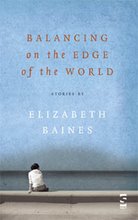
You can read 'Compass and Torch' on East of the Web (where it was first published), and it's included in my collection Balancing on the Edge of the World (Salt).

(I'm crossposting this to my author blog, Elizabeth Baines.)