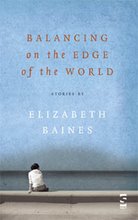
The shortlist is as follows:
Tuesday, May 20, 2014
Edge Hill Prize shorlist
The Edge Hill Prize shortlist echoes the pattern of the longlist, with five of the six finalists published by small presses. A Celtic flavour shows up even more strongly at this stage, with two Welsh publishers, Parthian and Seren, and the very new Northern-Irish Whittrick press represented. Of the authors, one is Welsh, two are Irish and one Scottish. Represented here too are those publishers appearing on the longlist as true champions of the short story with multiple entries: of the small presses, Parthian and Salt and of the mainstream, Cape.
The shortlist is as follows:
David Rose, Posthumous Stories (Salt)
Rachel Trezise, Cosmic Latte (Parthian)
Bernie McGill, Sleepwalkers (Whittrick Press)
Jaki McCarrick, The Scattering (Seren Books)
John Burnside, Something Like Happy (Jonathan Cape)
The shortlist is as follows:


Wednesday, May 07, 2014
It depends what you know about a book before you read it
Our reading group discussion of Bainbridge's Harriet Said, her first-written novel but not her first published. An interesting case, we found, of the difference that being told the background to a novel makes to one's experience of reading it, which has implications for the power of blurbs and publicity.
Monday, May 05, 2014
Do we need to worry or not?
There's been much reaction on the web to Will Self's Guardian article concerning the death of the serious novel in our digital age, most of it negative, with many commenters objecting that on the contrary, the internet has promoted the serious novel. However, I'm surprised that people can have managed to take such a clear message from the article (ie that the serious novel really is dead, once and for all): I've always been an admirer of Self's views and his clarity of mind, but I've read this article twice now, and I still can't find a clear thread, or be absolutely sure of Self's ultimate view of the situation. It should be noted that it is in fact an edited version of the Richard Hillary lecture he'll deliver tomorrow, so his argument will have been truncated, but it does seem to me that, rather than a successful analysis of the current situation (which in a time of such rapid technological change is probably impossible), it's more an expression of our uncertainty and anxiety about it.
Self does assert categorically that 'the literary novel as an art work and a narrative art form central to our culture is indeed dying before our eyes.' He goes on to 'refine his terms', as he puts it: he doesn't mean 'the kidult boywizardsroman' and the 'soft sadomasochistic porn fantasy' which he notes are in 'rude good health'; he is talking about
He takes for granted that in the age of soundbites and instant access to information, people are more impatient with certain kinds of difficulty, plumping for entertainment rather than serious engagement with the complex or the unfamiliar, a view that seems borne out by the fact that the larger publishers are increasingly unprepared to publish such fiction. But as Self himself indicates, the current state of book publishing is an economic effect of the new technology as well as late-20th-century capitalism and such developments as the abolition of the Net Book Agreement. It's not necessarily indicative of a sea-change in the attitude of the public towards reading (though we shouldn't discount its possible effects on that). Self harps back to a golden age (ie when he was a young man in the early 80s) when 'the literary novel was perceived to be the prince of art forms, the cultural capstone and the apogee of creative endeavour'. He immediately qualifies this, however: 'This is not to say that everyone walked the streets with their head buried in Ulysses or To the Lighthouse, nor do I mean to suggest that in our culture perennial John Bull-headed philistinism wasn't alive and snorting' (by god, he has a good turn of phrase!), before going on to claim contradictorily:
I'm not so sure about that: I spent my teenage years in a small northern town, and for a lot of that time I sensed that quite a number of people around me righteously thought me an uppity snob (as well as air-headed) for my difficult-novel reading, and that I needed to be taken down a peg or two. He sees what he calls the 'serious' novel becoming 'an art form on a par with easel painting or classical music: confined to a defined social and demographic group', but having taught in secondary schools and married into a typical northern working-class family, I'm not sure that challenging fiction has ever really been much else. As Self himself points out, general literacy in the West is a historically recent phenomenon, and after referring to his youth as a golden age in reading, he reveals that his agent, placing his first novel, told him to accept its publication as a paperback original, as it was 'nigh-on impossible for new writers to get published - let alone paid'; in other words, those economic sea-changes were already taking effect in publishing, altering the revered physical character of new books and causing what Self calls 'the concertinaing of the textual distribution into a short, wide pipe'.
Self sees 'serious' novels as needing in the future to be subsided, but the truth is, I think, that the more challenging fiction always has been. Once upon a time publishers with money were prepared to subsidise it for a minority audience, but in this age of rampant commercialism they're no longer prepared to. In response, we see the rise of small publishers prepared to pick up the slack, but there remains the serious problem of adequate remuneration for writers, necessary if we're to keep a serious literary culture going. Self is almost bitter about the current solution found by most writers, teaching on the burgeoning Creative Writing courses, 'care homes' to accommodate 'writers who can no longer make a living from their work' and where PhD students with unpublishable novels aspire to be paid in turn for the 'midwifery of still-born novels.' And yes, as Self says, and as I've often commented here, the whole buzzy culture of the internet is destructive of the kind of privacy and solitude that is essential for both the reading and writing of serious novels.
So yes, there's a big problem, but we can't assume that technology won't overcome it. Self would probably call me a naive 'populist Gutenberger' for saying so, and yet he declares that as a practical novelist he doesn't feel depressed about it all, and, unaccountably in view of his gloomy prediction, concludes with a statement that he feels 'safe ... to go on mining'.
Self does assert categorically that 'the literary novel as an art work and a narrative art form central to our culture is indeed dying before our eyes.' He goes on to 'refine his terms', as he puts it: he doesn't mean 'the kidult boywizardsroman' and the 'soft sadomasochistic porn fantasy' which he notes are in 'rude good health'; he is talking about
The capability words have when arranged sequentially to both mimic the free flow of human thought and investigate the physical expressions and interactions of thinking subjects; the way they may be shaped into a believable simulacrum of either the commonsensical world, or any number of invented ones; and the capability of the extended prose form itself, which, unlike any other art form, is able to enact self-analysis, to describe other aesthetic modes and even mimic them.I don't argue with most of this as a definition of literary fiction, but I'm not sure what he means by a novel's ability to 'enact self-analysis'. Perhaps he is talking merely about the intellectual content and verbal and structural patterning of any serious work of prose fiction, but I suspect he is really thinking of a very specific kind of novel, postmodern and self-referential, indeed the kind of novel he writes himself, especially as he then goes on to introduce the notion of 'difficulty' as an aspect of the serious novel. What about those novels that fulfil all the other criteria in the passage above with no difficulty or challenge for the reader? Are they not 'literary'? So it's never clear precisely in this discussion whether we're talking about a particular type of serious novel or something wider. 'The advent of digital media is not simply destructive of the codex, but of the Gutenberg mind itself', he says, but this is a point which (if true) must surely apply to books of any form in any medium.
He takes for granted that in the age of soundbites and instant access to information, people are more impatient with certain kinds of difficulty, plumping for entertainment rather than serious engagement with the complex or the unfamiliar, a view that seems borne out by the fact that the larger publishers are increasingly unprepared to publish such fiction. But as Self himself indicates, the current state of book publishing is an economic effect of the new technology as well as late-20th-century capitalism and such developments as the abolition of the Net Book Agreement. It's not necessarily indicative of a sea-change in the attitude of the public towards reading (though we shouldn't discount its possible effects on that). Self harps back to a golden age (ie when he was a young man in the early 80s) when 'the literary novel was perceived to be the prince of art forms, the cultural capstone and the apogee of creative endeavour'. He immediately qualifies this, however: 'This is not to say that everyone walked the streets with their head buried in Ulysses or To the Lighthouse, nor do I mean to suggest that in our culture perennial John Bull-headed philistinism wasn't alive and snorting' (by god, he has a good turn of phrase!), before going on to claim contradictorily:
However, what didn't obtain is the current dispensation, wherein those who reject the high arts feel not merely entitled to their opinion, but wholly justified in it.
I'm not so sure about that: I spent my teenage years in a small northern town, and for a lot of that time I sensed that quite a number of people around me righteously thought me an uppity snob (as well as air-headed) for my difficult-novel reading, and that I needed to be taken down a peg or two. He sees what he calls the 'serious' novel becoming 'an art form on a par with easel painting or classical music: confined to a defined social and demographic group', but having taught in secondary schools and married into a typical northern working-class family, I'm not sure that challenging fiction has ever really been much else. As Self himself points out, general literacy in the West is a historically recent phenomenon, and after referring to his youth as a golden age in reading, he reveals that his agent, placing his first novel, told him to accept its publication as a paperback original, as it was 'nigh-on impossible for new writers to get published - let alone paid'; in other words, those economic sea-changes were already taking effect in publishing, altering the revered physical character of new books and causing what Self calls 'the concertinaing of the textual distribution into a short, wide pipe'.
Self sees 'serious' novels as needing in the future to be subsided, but the truth is, I think, that the more challenging fiction always has been. Once upon a time publishers with money were prepared to subsidise it for a minority audience, but in this age of rampant commercialism they're no longer prepared to. In response, we see the rise of small publishers prepared to pick up the slack, but there remains the serious problem of adequate remuneration for writers, necessary if we're to keep a serious literary culture going. Self is almost bitter about the current solution found by most writers, teaching on the burgeoning Creative Writing courses, 'care homes' to accommodate 'writers who can no longer make a living from their work' and where PhD students with unpublishable novels aspire to be paid in turn for the 'midwifery of still-born novels.' And yes, as Self says, and as I've often commented here, the whole buzzy culture of the internet is destructive of the kind of privacy and solitude that is essential for both the reading and writing of serious novels.
So yes, there's a big problem, but we can't assume that technology won't overcome it. Self would probably call me a naive 'populist Gutenberger' for saying so, and yet he declares that as a practical novelist he doesn't feel depressed about it all, and, unaccountably in view of his gloomy prediction, concludes with a statement that he feels 'safe ... to go on mining'.
Saturday, May 03, 2014
Edge Hill Prize long list
I was busy when the Edge Hill Prize long list was announced recently, but I now have time to consider it and its implications. Once again the prize committee have done us the favour of longlisting all eligible titles, thus giving us an idea of the current state of short-story publishing.
As last year, small press entries far outnumber those from larger publishers, but the list is even more weighted towards the former. Entries are up on last year (44 this year; 37 last year) and in spite of the increased overall number, total number of entries from larger publishers stays the same (only 8), and the number of large publishers entering is down (4 as opposed to 5).
Once again the Celts come up trumps, with 6 Irish publishers entering a total of 8 books, 3 Welsh (Parthian alone fielding 4 books), and 2 based in Scotland including the established Canongate. Only 2 of the independent presses are based in London or internationally, and 9 are based in the English regions.
The increased number of entries could indicate greater publisher awareness of the prize (there are many small publishers this year I've never head of), or that indeed more short story collections are being published (or both). In any case, it's interesting to see science fiction and fantasy featuring on this list, hailing from not only that established veteran of genre, Gollancz (at least I'm assuming their 2 entered books are genre), but also small presses dedicated to the genre, Yorkshire-based PS Publishing and Michigan-based Subterranean. Also interesting is the presence of a publisher, Spinetinglers Elite, appearing to be an author-packaging service for self-published authors, based in Northern Island, and, also based in Northern Ireland, the 'mostly digital' Whittrick Press.
Champions here, along with Parthian, are Salt, with likewise 4 entries. It's a shame to see Comma, the publisher dedicated entirely to the form, fielding only one book, and I suspect this is an effect of cuts in funding *. Surprising too that for the second year running Faber has no entries, and I hope that doesn't mean that, in the current economic climate, Faber, that home of literary excellence, is losing its commitment to the form. Cape, however, with 3 entries, preserves its reputation as the large publishing-house promoter of serious short-form fiction.
*Edited in: Comma lets us know in the comments below that the fact that they have only one single-author collection to field this year is just a result of the way their publishing programme has fallen out. Comma is a great publisher of translated short stories, on which they have concentrated this year, along with anthologies. They say that next year they'll be doing more single-author collections, which is great to hear.
As last year, small press entries far outnumber those from larger publishers, but the list is even more weighted towards the former. Entries are up on last year (44 this year; 37 last year) and in spite of the increased overall number, total number of entries from larger publishers stays the same (only 8), and the number of large publishers entering is down (4 as opposed to 5).
Once again the Celts come up trumps, with 6 Irish publishers entering a total of 8 books, 3 Welsh (Parthian alone fielding 4 books), and 2 based in Scotland including the established Canongate. Only 2 of the independent presses are based in London or internationally, and 9 are based in the English regions.
The increased number of entries could indicate greater publisher awareness of the prize (there are many small publishers this year I've never head of), or that indeed more short story collections are being published (or both). In any case, it's interesting to see science fiction and fantasy featuring on this list, hailing from not only that established veteran of genre, Gollancz (at least I'm assuming their 2 entered books are genre), but also small presses dedicated to the genre, Yorkshire-based PS Publishing and Michigan-based Subterranean. Also interesting is the presence of a publisher, Spinetinglers Elite, appearing to be an author-packaging service for self-published authors, based in Northern Island, and, also based in Northern Ireland, the 'mostly digital' Whittrick Press.
Champions here, along with Parthian, are Salt, with likewise 4 entries. It's a shame to see Comma, the publisher dedicated entirely to the form, fielding only one book, and I suspect this is an effect of cuts in funding *. Surprising too that for the second year running Faber has no entries, and I hope that doesn't mean that, in the current economic climate, Faber, that home of literary excellence, is losing its commitment to the form. Cape, however, with 3 entries, preserves its reputation as the large publishing-house promoter of serious short-form fiction.
*Edited in: Comma lets us know in the comments below that the fact that they have only one single-author collection to field this year is just a result of the way their publishing programme has fallen out. Comma is a great publisher of translated short stories, on which they have concentrated this year, along with anthologies. They say that next year they'll be doing more single-author collections, which is great to hear.
Sunday, April 27, 2014
Pelicans to fly back

I find it exciting that Penguin are to bring back their non-fiction imprint, Pelican. How can they have gone, cheap books to feed the intellectual hunger of the masses? What does it mean that they did? And what does it mean that, as reported by Paul Laity in the Guardian, some of the early Pelicans sold 250 million copies in total, print runs of 50,000 being standard, whereas 'these days a publisher would be delighted if such a book made it up to 2,000 copies'? That by the end of the eighties, when Pelicans disappeared, we had become a culture hooked on entertainment rather than intellectual inquiry, or that, with more people going to university and a proliferation of media, we had other ways of getting our intellectual fulfilment? Penguin believes there's still that hunger and still a need to fulfil it with cheap books. I can vouch for that last. I had been to university, and I had even studied philosophy, but I'll never forget the night I was babysitting and learned for the first time about Hegelian dialectic (and was absolutely hooked), from a Pelican which has long gone now - I suspect one of the kids has gone off with it.
Those above are the Pelicans we have left. Notice we have two copies of the Uses of Literacy; we usually give away books we've doubled up on, but neither of us will part with our copy. That copy of mine with the Lowry on the front is forever linked in my mind with the view from the desk where I wrote my Education Diploma dissertation - luminous green leaves coming out in the very high trees, and two wood pigeons trying to make a nest which kept dropping to bits on the ground - and with the feeling the book had left me with: that my whole sense of the world had been adjusted and confirmed, and that everything at last made sense.
Saturday, April 26, 2014
Novels about writing.
It's interesting that, as John Dugdale says in today's Guardian Saturday Review, 'literature about literature' is booming. It's not only the novels openly depicting the great writers, of which there has been a spate lately, he says, but fictions depicting more generally the world of writing and writers, such as Hanif Kureishi's recent The Last Word and a forthcoming novel by that wonderful writer Edward St Aubyn about the world of literary prizes. Last year, of course, Nicholas Royle published his much admired novel about the world of University Creative Writing (in which yours truly - or rather an approximation of yours truly - makes a couple of cameo appearances).
I think it's no surprise, and I've never understood the prejudice against it. 'Oh God, novels about writing!' a literary agent once commented to me with a groan - though I don't think he was expressing a personal prejudice, rather a general industry perception at the time of the unsaleability of such books. It was a wrong perception, I think, and one based in a view of writers and the public as Us and Them.
I don't think for a moment the public sees it like that. I remember as a child from an ordinary background avidly reading novels with an eye on the notion of becoming a novelist myself: I didn't feel the least different from the novelist I was reading and his or her world: the greatness of the writing drew me right into his or her psyche, and I identified, not just with the characters, but with the writer, and any novel about writing would have really pressed my button. And how many people, ordinary people, have you heard casually mentioning they could write a novel/wouldn't mind writing a novel one day? Plenty have said it to me: it's usually the first thing they say after they learn I'm a writer - milkmen, shopkeepers, the lot. And what about the plethora of Creative Writing students? Most of the casual commenters won't bother, and aren't even saying it seriously, but it shows that the whole idea of novel-writing is interesting to them and that they certainly haven't written it off as something that excludes them. Apart from that, though, story-telling is hard-wired in us; we're all story-tellers and we all tell stories all the time - to entertain, to promote or save ourselves or others etc etc, in our day-to-day lives. And in turn we are affected by the story-telling of others - the images they have of us, the truths and lies they tell. So many dramas - soaps that people are entirely hooked on - are subtly based on the notion of story-telling as the engine of life, the effects that people can have on each other's lives by the stories they tell about others and themselves. Who could not be interested in that? (And I have to say it's a major theme for me in my writing.) Novel-writing is the dramatic extension of that (and after all, a major storyline of Neighbours once was a character - a very ordinary girl - becoming a novelist): it's the stories we tell set in stone (or paper or Kindle), and how much more dynamic can be the effect of that? Which is why the window cleaner tells me he wants to write a novel. Novels unpicking the effects of published and unpublished stories, as Royle's so cleverly does, can only therefore be interesting to all.
I think it's no surprise, and I've never understood the prejudice against it. 'Oh God, novels about writing!' a literary agent once commented to me with a groan - though I don't think he was expressing a personal prejudice, rather a general industry perception at the time of the unsaleability of such books. It was a wrong perception, I think, and one based in a view of writers and the public as Us and Them.
I don't think for a moment the public sees it like that. I remember as a child from an ordinary background avidly reading novels with an eye on the notion of becoming a novelist myself: I didn't feel the least different from the novelist I was reading and his or her world: the greatness of the writing drew me right into his or her psyche, and I identified, not just with the characters, but with the writer, and any novel about writing would have really pressed my button. And how many people, ordinary people, have you heard casually mentioning they could write a novel/wouldn't mind writing a novel one day? Plenty have said it to me: it's usually the first thing they say after they learn I'm a writer - milkmen, shopkeepers, the lot. And what about the plethora of Creative Writing students? Most of the casual commenters won't bother, and aren't even saying it seriously, but it shows that the whole idea of novel-writing is interesting to them and that they certainly haven't written it off as something that excludes them. Apart from that, though, story-telling is hard-wired in us; we're all story-tellers and we all tell stories all the time - to entertain, to promote or save ourselves or others etc etc, in our day-to-day lives. And in turn we are affected by the story-telling of others - the images they have of us, the truths and lies they tell. So many dramas - soaps that people are entirely hooked on - are subtly based on the notion of story-telling as the engine of life, the effects that people can have on each other's lives by the stories they tell about others and themselves. Who could not be interested in that? (And I have to say it's a major theme for me in my writing.) Novel-writing is the dramatic extension of that (and after all, a major storyline of Neighbours once was a character - a very ordinary girl - becoming a novelist): it's the stories we tell set in stone (or paper or Kindle), and how much more dynamic can be the effect of that? Which is why the window cleaner tells me he wants to write a novel. Novels unpicking the effects of published and unpublished stories, as Royle's so cleverly does, can only therefore be interesting to all.
Friday, April 25, 2014
Spectacle versus words: it's not just Jamaica Inn
It's always fun to criticise things wittily on Twitter, and I can't deny that I enjoyed the tweeting about BBC1's dramatisation of Du Maurier's Jamaica Inn, which received around 800 complaints for poor sound quality, viewers saying that the dialogue was inaudible and they simply couldn't tell what was supposed to be going on. I took part myself, but all along my heart was sinking for everyone involved in the production. Yesterday's Guardian article by Hannah Ellis-Peterson reveals that there is now tension at the BBC, with the various departments hugely upset and trying to fend off blame. Script-writer Emma Frost (who was first reported as being upset that her dialogue - greatly praised by the Du Maurier estate - had been mangled) was pleading for sympathy for sound operator Matt Gill who she said 'is crying' (I must say I was almost crying too when I thought of him); those who had seen previews reported having no problem with the sound and suggested that the glitch came in transmission, but those responsible for transmission claim it's an 'artistic issue', with actors, dialogue coach, and (by extension) director being held variously to blame.
Television drama production is a highly collaborative project, and it seems to me that it's a waste of time, and unfair, to try blaming one party, and my sense is that this fiasco is the culmination of a trend in film drama production that's been building for some time, and a salutary awakening. In recent years I've found myself missing dialogue in the cinema, and I've truly wondered if my hearing was going - especially as those around me seemed quite happy even while sweet packets were rattling all around - to the extent that I've had my hearing tested, only to have it found perfect. When I wondered about it to a companion he said to me: 'But no one else wants to hear all the words like you do.'
What???!!
This is the crux. Television and film drama, such wonderful media for picture-making, have become central to a cultural tendency to privilege image - and indeed spectacle - over words, and thus in effect, as this particular drama shows, over meaning and ideas. The script is no longer of prime importance. It's been a long while now since the Writers' Guild lost its battle for script writers to be named in TV listings (who cares about the writer? Who cares about the words? Who cares about anything but a 'high concept' to sell, and pretty well-known actors to look at, and some nice scenes to watch?). Jamaica Inn certainly looked beautiful, and interesting, and gothically stark etc. But it wasn't just the inaudibility of the words that suffered from the tendency to make this the prime priority. Why did Mary Yellan stomp the cold rainy moors in a tiny velvet bolero jacket more suited to ladies in town? Because it looked so fetching, of course. Why did these country people keep letting themselves get so wet in the rain (all country people without central heating or mod cons know it can lead to an early death), even standing snogging in the downpour when there was shelter nearby they could have run to? Because running water looks so beautiful on film, of course, as Blade Runner so iconically showed. Why did we keep getting time-release shots of the clouds when much time didn't really seem to have gone by? Well, you know the answer... And all those camera shots of the exceedingly comely Mary Yellan actor Jessica Brown Findlay, and that striking picture of the inn from afar when she was inside it, confused the viewpoint - the novel, and the story, are about the mystery as seen from Mary Yellan's viewpoint - and I believe thus contributed to the sense of not knowing what was going on.
It's ironic therefore that someone from the BBC hauled up to comment on the news programme pleaded an over-insistence on authenticity, in the process blaming the actors. Actors like to get involved in the parts and be authentic, he claimed, appearing to refer to both the dialect and the inarticulacy of the characters. But this is to misunderstand the job of the actor and the processes involved, and seriously to short-change the professionalism of those involved here. Acting is supremely an art of communication. The job of an actor is to look authentic while in fact being highly inauthentic. The prime focus of an actor's interest is not how he or she feels while playing a part (though of course they have to feel) but how he or she comes across to the audience, and that's what the director is there to guide them about. One of the clearer voices in Jamaica Inn was Brown Findlay's but there was a moment when she had me completely stumped. 'My uncle is a ragger,' she seemed to me to say, and I simply couldn't concentrate for the next few minutes for wondering what on earth she meant (I hadn't read the book). Now it may be that in the Launceston dialect of the era 'wrecker' would sound like 'ragger' (perhaps it still does), in which case Brown Findlay had indeed done a wonderful job of authenticity just there, but authenticity is not exactly useful if it confuses a modern metropolitan audience. The collaborative job of the production team is to make things communicable while authentic-seeming enough not to spoil the suspension of disbelief. This was just one of those moments where that collaborative grip slipped. It's the kind of thing that happens all the time in rehearsals and shooting, and which requires time (and thus money) to sort out. And it's my hunch that the problem here is where the resources are being directed: towards the creation of spectacle rather than those quieter - but all-important - aspects of drama, the words and the meaning.
And yet. People were so up in arms. Maybe we're not so unattached to words and meaning, after all...
Television drama production is a highly collaborative project, and it seems to me that it's a waste of time, and unfair, to try blaming one party, and my sense is that this fiasco is the culmination of a trend in film drama production that's been building for some time, and a salutary awakening. In recent years I've found myself missing dialogue in the cinema, and I've truly wondered if my hearing was going - especially as those around me seemed quite happy even while sweet packets were rattling all around - to the extent that I've had my hearing tested, only to have it found perfect. When I wondered about it to a companion he said to me: 'But no one else wants to hear all the words like you do.'
What???!!
This is the crux. Television and film drama, such wonderful media for picture-making, have become central to a cultural tendency to privilege image - and indeed spectacle - over words, and thus in effect, as this particular drama shows, over meaning and ideas. The script is no longer of prime importance. It's been a long while now since the Writers' Guild lost its battle for script writers to be named in TV listings (who cares about the writer? Who cares about the words? Who cares about anything but a 'high concept' to sell, and pretty well-known actors to look at, and some nice scenes to watch?). Jamaica Inn certainly looked beautiful, and interesting, and gothically stark etc. But it wasn't just the inaudibility of the words that suffered from the tendency to make this the prime priority. Why did Mary Yellan stomp the cold rainy moors in a tiny velvet bolero jacket more suited to ladies in town? Because it looked so fetching, of course. Why did these country people keep letting themselves get so wet in the rain (all country people without central heating or mod cons know it can lead to an early death), even standing snogging in the downpour when there was shelter nearby they could have run to? Because running water looks so beautiful on film, of course, as Blade Runner so iconically showed. Why did we keep getting time-release shots of the clouds when much time didn't really seem to have gone by? Well, you know the answer... And all those camera shots of the exceedingly comely Mary Yellan actor Jessica Brown Findlay, and that striking picture of the inn from afar when she was inside it, confused the viewpoint - the novel, and the story, are about the mystery as seen from Mary Yellan's viewpoint - and I believe thus contributed to the sense of not knowing what was going on.
It's ironic therefore that someone from the BBC hauled up to comment on the news programme pleaded an over-insistence on authenticity, in the process blaming the actors. Actors like to get involved in the parts and be authentic, he claimed, appearing to refer to both the dialect and the inarticulacy of the characters. But this is to misunderstand the job of the actor and the processes involved, and seriously to short-change the professionalism of those involved here. Acting is supremely an art of communication. The job of an actor is to look authentic while in fact being highly inauthentic. The prime focus of an actor's interest is not how he or she feels while playing a part (though of course they have to feel) but how he or she comes across to the audience, and that's what the director is there to guide them about. One of the clearer voices in Jamaica Inn was Brown Findlay's but there was a moment when she had me completely stumped. 'My uncle is a ragger,' she seemed to me to say, and I simply couldn't concentrate for the next few minutes for wondering what on earth she meant (I hadn't read the book). Now it may be that in the Launceston dialect of the era 'wrecker' would sound like 'ragger' (perhaps it still does), in which case Brown Findlay had indeed done a wonderful job of authenticity just there, but authenticity is not exactly useful if it confuses a modern metropolitan audience. The collaborative job of the production team is to make things communicable while authentic-seeming enough not to spoil the suspension of disbelief. This was just one of those moments where that collaborative grip slipped. It's the kind of thing that happens all the time in rehearsals and shooting, and which requires time (and thus money) to sort out. And it's my hunch that the problem here is where the resources are being directed: towards the creation of spectacle rather than those quieter - but all-important - aspects of drama, the words and the meaning.
And yet. People were so up in arms. Maybe we're not so unattached to words and meaning, after all...
Thursday, April 24, 2014
What makes a novelist?
I have wondered on this blog what makes some people who can write wonderful prose never bother trying to be writers. (I think of the school students I taught whom I naively thought were destined for literary greatness but who never wrote once they left school; I think of adults I've taught who were simply happy to write small pieces privately but had no interest in writing anything ambitious or in being published - I had a hard time believing them, really.)
It's a question that Guardian reviewer Lee Robson takes David Lodge to task for not asking in Lodge's newly published collection of essays Lives in Writing. Robson answers it himself with reference to the critic Frank Kermode's discussion (in his memoir) of 'what kind of person makes a good novelist'. Kermode himself, a 'champion defeatist', was discouraged from trying to be a novelist by the suggestion that he hadn't had enough real-life experience. He came to the conclusion that people who made good novelists, such as William Golding and Iris Murdoch, were 'people very unlike him'. They had a 'capacity' that he lacked, to write convincingly about things they hadn't actually experienced.
Robson however points out that both Golding and Murdoch, whose early novels were rejected, had to develop that ability (that they too at one point lacked it), and comes to the conclusion that the novelist is rather
Lodge, it seems, is complaining about the kind of reductive biographical readings of fiction about which I've frequently complained here, those that reduce fiction to mere biography or indeed 'disregard' or devalue it if it doesn't fit known biographical facts about the author. However, Robson in turn complains that this 'blinds him to more desirable forms of biographical insight into the writing - and non-writing - of novels', and points to the life experiences that do indeed make people novelists or non-writers, such as Frank Kermode's unhappy childhood that left him with 'a lifelong sense of himself as a failure', the childhood nurturing that, conversely, gave Philip Roth his supreme literary confidence, and the family habits that fed Muriel Spark's subversive wit.
I haven't read Lodge's book, but it seems to me harsh to chastise him for not taking on a different project from the one in which he is engaged - Lodge is apparently concerned with our reading of texts, whereas Robson's interest here is essentially biographical and sociological - but I find Robson's point interesting and astute, nevertheless.
It's a question that Guardian reviewer Lee Robson takes David Lodge to task for not asking in Lodge's newly published collection of essays Lives in Writing. Robson answers it himself with reference to the critic Frank Kermode's discussion (in his memoir) of 'what kind of person makes a good novelist'. Kermode himself, a 'champion defeatist', was discouraged from trying to be a novelist by the suggestion that he hadn't had enough real-life experience. He came to the conclusion that people who made good novelists, such as William Golding and Iris Murdoch, were 'people very unlike him'. They had a 'capacity' that he lacked, to write convincingly about things they hadn't actually experienced.
Robson however points out that both Golding and Murdoch, whose early novels were rejected, had to develop that ability (that they too at one point lacked it), and comes to the conclusion that the novelist is rather
'...not someone who can [just] mix autobiography and invention, as Lodge ... suggests, but someone whose sensibility contains a balance of the intuitive and the pragmatic, the introvert and the extrovert, the better to create fiction that is neither too personal nor too [mired in technical facts].'Which seems about right, if you add in the need for determination and maybe obsession - and perhaps especially in the current commercial literary climate.
Lodge, it seems, is complaining about the kind of reductive biographical readings of fiction about which I've frequently complained here, those that reduce fiction to mere biography or indeed 'disregard' or devalue it if it doesn't fit known biographical facts about the author. However, Robson in turn complains that this 'blinds him to more desirable forms of biographical insight into the writing - and non-writing - of novels', and points to the life experiences that do indeed make people novelists or non-writers, such as Frank Kermode's unhappy childhood that left him with 'a lifelong sense of himself as a failure', the childhood nurturing that, conversely, gave Philip Roth his supreme literary confidence, and the family habits that fed Muriel Spark's subversive wit.
I haven't read Lodge's book, but it seems to me harsh to chastise him for not taking on a different project from the one in which he is engaged - Lodge is apparently concerned with our reading of texts, whereas Robson's interest here is essentially biographical and sociological - but I find Robson's point interesting and astute, nevertheless.
Thursday, April 17, 2014
Rules for writers that shouldn't be rules
I've been meaning for ages to post on this (it's been a preoccupation of the WIP that's been keeping me away from this blog), but now I have the time at last I find that someone has already done it so brilliantly I don't need to.
The title of the article, 'The Ten Worst Pieces of Writing Advice You Will Ever Hear (And Probably Already Have)' is a bit misleading, as its author Susan Defreitas makes clear that the rules she examines, such as Show Don't Tell, Don't Use Adverbs etc do have their place, which is with beginner writers making traditional beginner mistakes such as verbosity, over-explaining, failure to realise the texture of a scene, lack of grounding in reality etc (and also as general notions to go on keeping in mind to avoid such mistakes thereafter). She shows, however (with considerable wit) that such advice taken to extremes can turn writing leaden and unremarkable, and, with quotes from Salman Rushdie and Nabakov, that writers with skill may ignore it with equanimity. 'Language is your Swiss army knife, and you can’t do shit like this with just the knife and the corkscrew.' I particularly like her words on cutting:
...beginning writers tend to be verbose. We can’t tell the difference between an essential detail and an inessential one. We’re like golden retrievers romping through Storyland, and pretty much every damn thing we see is a squirrel.
But push this advice too far, and again, you’ll get stuck writing mediocre fiction. Because sometimes the things that don’t work are actually important. They don’t work not because they’re the wrong things, but because they’re the hard, ambitious, at-the-very-edge-of-what-you-even-know-how-to-say-things, and the only way to land them is to dig deeper, work harder, and sometimes even (god help you) add rather than cut.There's an underlying implication in the article that these rules are indeed being taken too seriously and too widely, and it's a sense of this that made me want to blog about it too. I do come across a lot of writing that seems in thrall to 'show don't tell' and in dire fear of making any statements about feelings or motives, and is either weighed down with over-elaborate, clogged and seemingly mechanical external detail, or simply too stark, either way leaving us without a sense of the emotion, or, as Defreitas says, 'the thought processes giving rise to that emotion.'
Do read her article.
Wednesday, April 16, 2014
It's what you expect and how you read
Here's our reading group discussion of Black Water by Joyce Carol Oates. It's perhaps an interesting insight into the difficulties of innovative fiction. It's a book based on hindsight rather than 'what-happens-next' plot (what happens is given from the outset), with a resulting non-linear structure and an innovative prose style. Opinions in our group were strongly divided, with most people finding the book stunning, but others left cold and unengaged and one even seriously irritated. Most strikingly and interestingly, the two camps had wildly differing impressions of the pace of the book, with those who were positive (and accepting of the premise) finding it urgent and emotionally involving, while those who were negative (and who I suspect preferred to read for plot) found it insufficiently urgent, static and repetitive.
Thursday, April 03, 2014
Sunday, February 16, 2014
Friday, February 14, 2014
Judging the author rather than the book
Our reading group discussion of a stunning book that has been unjustly overlooked, even dismissed. Moon Tiger by Penelope Lively.
Friday, January 03, 2014
Reading group: The Book of Daniel by E L Doctorow
Here's what our reading group thought of this novel based on the real-life case of the Rosenbergs, charged with leaking the secret of the atomic bomb to the Soviet Union and executed in 1953.
Saturday, November 09, 2013
Single shorts from Nightjar
I don't know whether it was a deliberate reminder, but the day after my post on the publication of short stories in individual volumes, two new Nightjar Press chapbooks came slipping through my door, presumably from Nightjar publisher Nicholas Royle. For a few years now, Royle has of course been publishing chapbooks under this imprint devoted to the format, each volume containing a single story.
Genre-wise, the imprint is also devoted to the uncanny. I say genre, but of course the uncanny can be conveyed via a wide range of types of writing and, inevitably, I like some of it more than others. My narrative interest is above all psychological. By this I don't at all mean that I only like writing grounded in psychological realism, with complex and believable and 'identifiable-with' characters etc; no, no, I love a good surreal story, and am very ready to be lost in the uncanny. A good uncanny story operates of course by tugging on a reader's fear or uncertainty, and it seems to me that therefore the best uncanny stories are those that unsettle us by touching on serious existential fears rather than simply giving us a brief and therefore safe thrill of horror. (Others, I know feel differently, but quite frankly I've had far too many real-life scares to be interested in looking for a thrill of horror.) I'd say that stories grounded in psychology do the former, and those that hinge on circumstance and plot tend to do the latter.
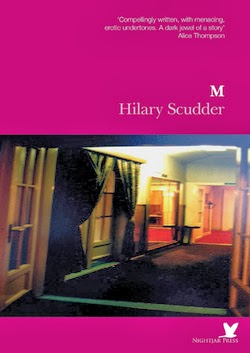
 The two new Nightjar stories exemplify for me this dichotomy. In Hilary Scudder's story, M, the first-person narrator flees from her husband, of whom she has been very afraid, to meet her lover, M. Before fleeing she leaves her husband a letter, daring (in her euphoria at escaping) to wish him as much unhappiness as he has caused her, indeed to wish him an agonising death. But as she approaches the place where she has arranged to meet her lover, things take a dark turn: it is not the cafe-bar scene she expected, but a dank and deserted docks... It's hard to say any more about the story because what counts in the story is what happens (and if I told you I'd spoil more or less everything about it). But what does happen happens to our protagonist. Rather than resulting from her psychology (either her idiosyncratic psychology, or the psychology we all share), the dangers she faces are out there, external to her. The final twist, while it does indeed provide a jolt of horror, is basically contingent: it could have happened, or it couldn't; chance is what determines that it does, rather than its being an inevitable consequence of the specific psychology of any of the characters or of human nature in general. There is an overall message - that it's hard to escape the horrors of sexist men - and the story is certainly vivid, with elements associated with the genre - a protagonist suddenly lost in a dark and threatening place, with lush glimpses of an erotic but sinister hidden world - guaranteed to give that bolt of thrill, and I'm sure lots of people will love it.
 M John Harrison's Getting Out of There is for me a story of a quite different order. It couldn't begin in any more ordinary setting or situation: a web designer moves from London back to the small seaside town in which he grew up, takes a room in a run-down house and sticks most of his belongings in a lockup 'with untreated breeze-block cubicles of different sizes, behind doors that were little more than plywood.' So far so quotidian, indeed seedy. But what's not ordinary is the prose. This is how it begins:
Genre-wise, the imprint is also devoted to the uncanny. I say genre, but of course the uncanny can be conveyed via a wide range of types of writing and, inevitably, I like some of it more than others. My narrative interest is above all psychological. By this I don't at all mean that I only like writing grounded in psychological realism, with complex and believable and 'identifiable-with' characters etc; no, no, I love a good surreal story, and am very ready to be lost in the uncanny. A good uncanny story operates of course by tugging on a reader's fear or uncertainty, and it seems to me that therefore the best uncanny stories are those that unsettle us by touching on serious existential fears rather than simply giving us a brief and therefore safe thrill of horror. (Others, I know feel differently, but quite frankly I've had far too many real-life scares to be interested in looking for a thrill of horror.) I'd say that stories grounded in psychology do the former, and those that hinge on circumstance and plot tend to do the latter.

Hampson came back after some years, to the seaside in the rain, to this town built around a small estuary where a river broke through the chalk downs. Everything - everything people knew about, anyway - came in through that gap, by road or rail; and that's the way Hampson came too, midweek, in a rental van, unsure of what he would find for himself after so long.and right there at the beginning you know, from the rhythm, from that description of the gap in the chalk and the river taking everything with it, hinting already at gaps in reality and a sense of inevitability - not to mention that phrase 'everything people knew about anyway' - that you're in the hands of a master. This is a story about alienation: Hampson's alienation and everyone's alienation. When strange things start to happen, which they do, there's the possibility that Hampson is going mad, but we can't simply pass it off as this: the evocation of the world around Hampson, seen through his perspective, draws us into his psyche, we share his psyche, and are drawn right into the experience. What's most unsettling for the reader as well as Hampson is the disruption of reality, the uncertainty as to whether or not the phenomena are out there or not. As I interpret it, this is is a story precisely about the horror of the ordinary, about our fear yet need for it. The horror is partly within ourselves, in how we can deal with the world, and for me this makes it a deeply resonant story, one which both comments on and transcends the genre.
Wednesday, November 06, 2013
Tuesday, November 05, 2013
Austen modernisations, really?
Is there anything that better illustrates literary fiction's contemporary enthralment to the market than HarperCollins' series of Jane Austen modernisations? As John Mullan points out in the Observer, Austen's novels are specifically about the manners, modes and social constructs of the time in which she was writing, all of which have now gone by the board. He outlines them all and shows how Austen's plots hinge on them entirely: the formality of naming which creates the crucial romantic misunderstanding in Sense and Sensibility, the rigid rules of sexual behaviour which, adhered to or breached, can create commitments and misunderstandings that would never happen now (Persuasion and Sense and Sensibility), the unbreakable trap that marriage was, the fact that a single woman had lost her chance of it by the age of 27, and so on...
I suppose people will object that it's the characters that can be replicated, that the interest is in seeing those same characters negotiate a different set of social circumstances. But this is to subscribe to a pretty naive concept of 'character' and, more crucially, of what a novel is. Most of us, I guess, have been told that we are like a certain older relative, that we share their character, and many of have us felt that indeed we are and do, and in that sense we can see character as something that is passed down through families, determined by our genes, and therefore given and constant. But we are not in fact those older relatives: we may share certain personality traits but we are also formed by the different things that happen to us and the different society in which we live. Change the circumstances and you change the way a person is going to a behave, and thus in turn their character. And what is a novel - that most social of forms - but a depiction of the way people behave (action) when a certain set of social circumstances is applied to them?
A novel and its characters, as I discussed in a previous post, are also, supremely, constructs of language: to change the language of a novel - an essential part of the project in any modernisation - is to destroy its soul. And as Mullan points out, when the Marianne of Austen's Sense and Sensibility is finally driven to swear it is a most dramatic moment, but Joanna Trollope has her 'using the F-word on page 6, so when things turn really bad what extreme words does she have left?' Swearing means something different nowadays: it doesn't indicate the same thing about situations or characters, and the fact that Trollope's Marianne swears does not make her the same character as Austen's.
I really can't see what's actually being replicated here. Except for one thing: the lovely glow that a best-selling classic lights in the heart and a publisher's bank balance.
I suppose people will object that it's the characters that can be replicated, that the interest is in seeing those same characters negotiate a different set of social circumstances. But this is to subscribe to a pretty naive concept of 'character' and, more crucially, of what a novel is. Most of us, I guess, have been told that we are like a certain older relative, that we share their character, and many of have us felt that indeed we are and do, and in that sense we can see character as something that is passed down through families, determined by our genes, and therefore given and constant. But we are not in fact those older relatives: we may share certain personality traits but we are also formed by the different things that happen to us and the different society in which we live. Change the circumstances and you change the way a person is going to a behave, and thus in turn their character. And what is a novel - that most social of forms - but a depiction of the way people behave (action) when a certain set of social circumstances is applied to them?
A novel and its characters, as I discussed in a previous post, are also, supremely, constructs of language: to change the language of a novel - an essential part of the project in any modernisation - is to destroy its soul. And as Mullan points out, when the Marianne of Austen's Sense and Sensibility is finally driven to swear it is a most dramatic moment, but Joanna Trollope has her 'using the F-word on page 6, so when things turn really bad what extreme words does she have left?' Swearing means something different nowadays: it doesn't indicate the same thing about situations or characters, and the fact that Trollope's Marianne swears does not make her the same character as Austen's.
I really can't see what's actually being replicated here. Except for one thing: the lovely glow that a best-selling classic lights in the heart and a publisher's bank balance.
Saturday, November 02, 2013
Single shorts
Philip Hensher hopes that Penguin's issue of a single short story by Zadie Smith as a hardback and ebook indicates that we are 'at the beginning of a golden age of possibility, where writers can write at whatever length they choose'. I'm not quite sure sure that, as one commenter on the Guardian site points out, Penguin putting out what amounts to a Christmas-market taster from a novelist with Smith's profile is an indication of this, but I do hope, like Hensher, that the rise of the ebook is causing a sea-change in our attitude to the short story.
I have complained before on this blog about the fact that the manner in which short stories have generally been published in this country militates against the kind of reading that many short stories require. Many short stories need to be read as what Hensher calls 'exquisite singularities', and not 'as a chapter between chapters' in a collection. In recent years of course, we have had the market-driven rise of collections of linked short stories, in which individual stories are most supremely subsumed to the whole. Such collections have their charms, but I think they have pushed out the kind of short stories that are off-the-wall original and can't be repeated - which indeed the greatest short stories often are. As Hensher says, due to economic considerations, 'we don't publish books in the way they were conceived,' and this has been especially true for the short story.
Thursday, October 31, 2013
Tuesday, October 29, 2013
Norman Geras
I am late in making a tribute to Norman Geras, author of Normblog, who died on 18th October. Partly this is because I haven't been blogging at all (I've been immersed in writing), but partly I have felt too affected to feel up to making any public statement. Norm was the husband and father of my dear long-time friends writers Adele Geras and Sophie Hannah. For many years I didn't in fact know Norm personally - whenever I went to Adele's he'd be at the university or up in his room working - but I got to know him somewhat after I started blogging in 2006. By the time I first talked to him at the Manchester blog awards (which he'd won the previous year) and for which we were both shortlisted, I was of course already entirely smitten with his blog, which as countless others have said, was an oasis of calm and reason in an internet world of increasingly knee-jerk reaction. He couldn't understand, when I first talked to him, why I had two blogs - my author blog as well as this critical commentary blog. I explained the kind of conflict that I and I think other authors feel between the need don a promotional hat for our work and the need to be free to challenge such market forces. He still thought I should have the courage to combine the two blogs. I didn't - I went on finding it politic not to - but I always felt that by not doing so I was falling short of the intellectual rigour that Norm personified. Norm was frankly an intellectual giant, and I always turned to his blog, as others have said they did, to see what he made of any issue. I am going to miss dreadfully his incisiveness and reason, his intellectually tough yet humane presence, and the online world is vastly poorer without him. Fortunately he will still be with us in the form of the Normblog archive which is being kept open, a vast repository of reason and enlightenment.
Subscribe to:
Posts (Atom)