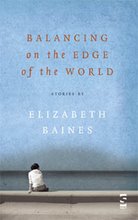
No one will be surprised to hear that I am thrilled that yet another short-story writer has won a major award, the wonderful Alice Munro being awarded the International Man Booker. On Sunday the Observer ran a profile, and two of the things she is quoted as saying struck me particularly.
Firstly, she says: "I never have a problem with finding material. I wait for it to turn up and it always turns up. It's dealing with the material I'm inundated with that poses the problem." Now maybe by this she meant that there is just too much material to cover or to choose from (that word 'inundated' is probably a big clue), but I wonder if she also means this: that it's not finding material that's the problem for writers, but deciding how to process it. In other words, it's not the subject matter that is important so much as the way it's dealt with, the insights you bring to it, the language and forms which it gives rise to in a particular writer's hands. This last is an important point to make, it seems to me. We are in an age when books marketing tends to focus on subject matter alone, while it is the treatment which makes for great writing. It is one way in which a market-led publishing industry can indeed end up suppressing good books and silencing good writers.
Secondly, Munro says: "I have all these disconnected realities in my own life and I see them in other people's lives. That was one of the problems - why I couldn't write novels, I never saw things hanging together any too well." This really stopped me short. It seems to me any great novel nowadays must do exactly that, encompass the disconnected realities which characterize life in the 21st century. Maybe Munro is simply saying that she never wanted to to do this - after all, her short stories taken together do it beautifully - but I wonder if she is subscribing to a view of novels as (inappropriately) holistic, one which again lends itself to marketing and again can lead thus to the suppression of innovation and subtlety.
Tuesday, June 02, 2009


Monday, June 01, 2009
Just One Book: the Debate
Just One Book: latest
Here's Chris Hamilton-Emery's latest Facebook bulletin on the Just One Book campaign:
Sunday, May 31 2009
It's been impossible to think. Just over a week ago we were facing oblivion, the backlist would have sold on, but the business as a going concern was all over. I was job hunting. Stress had left me deaf. We were about to lose our home and it seemed everything had fallen off some precipice and was hurtling down into the frozen dark. We began cancelling the list and preparing for the worst. Nearly a decade of effort was being lost.
Then our viral campaign led to an extraordinary sequence of events. Facebook, Twitter and hundreds of blogs all covered the story of Salt's Just One Book offer. The media picked up on the story and suddenly over a 1,000 orders poured in, supporters arrived in virtual droves and the goodwill and great ideas became emotionally overwhelming; we had support from Foyles and Waterstone's in the UK, from independent bookstores around the globe, The Bookseller and The Guardian covered the story, the BBC wanted to cover us. The office changed from its usual focus on editorial, marketing and publicity to become a non-stop postal service, sending thousands of books off around the globe.
Alex Pryce had arrived to do a week's work experience as a Salt intern (part of our widening programme to support those wanting careers in literary publishing), what began as a project surrounding audio developments was swamped as she was drawn in to picking, packing and despatching order after order. Beside Alex, the Salt team grafted away. Charlotte and Tom, Jen and I, still haven't caught up with it all. But we're working hard, all day, all night, and still the orders are coming in.
Last week was half term, and most of my days were spent at home with the kids, sometimes reassuring them that there was going to be a future and that we would get paid at some point. I was spending as much time as I could helping make those sales. Just over a week later and we've now raised £24,000 or our £55,000 target. There's still some climb ahead, a big climb, but the enormous support of our friends and customers has bought us all time; it's all about time. What we hope most of all, is that we can keep our new customers, and that we've shown them that there's something wonderful and fulfilling about our list and our site, something exceptional about our authors.
I need to keep it all going, I need your support for one more month. So here's an offer for everyone and we hope more customers will come and join the campaign to buy just one book:A THIRD OFF ALL SALT TITLES THROUGHOUT JUNE
We're now giving you a huge 33% off ALL books till the end of June. Use the coupon code G3SRT453 when in the checkout to benefit. Don't forget if you spend £30 or $30 you get free shipping too.
Please continue to spread the word, and spread news of this offer. Please don't let up. It's been extraordinary, but we're not out of danger yet. Every penny goes into developing Salt's books and services. We want to start a new children's list, and offer more resources to teachers and schools. We want to extend our publishing in new areas including our translations programme, we want to offer you more free magazines online. We want to help develop more support for debuts with the enhancement of our Crashaw and Scott prizes. We're planning audio books, ebooks and new videos for you. We only want to move forward, to develop and expand what we do and deliver great books in new ways to you and yours.
We need your support throughout June. We'll try and organise more readings and promotions with our authors. Virtual book tours. More launches. We'll work with bookstores to bring you short story and poety evenings. Stick with us throughout June and we can do something astonishing. That's the power of Just One Book — we want you to be a part of it. Follow us on Twitter look for #SaltBooks and #JustOneBook. Join our Facebook Group.
And have a giggle at the vid, too.
http://www.youtube.com/watch?v=ZdcTqXaOD2s
Oh, and one last special offer — Catherine Eisner’s magnificent crime novel, Sister Morphine for £7.50 plus P&P, simply enter coupon code EISNER in the UK checkout http://bit.ly/8rHDa
Watch out for more special offers throughout June.
Thank you.
Chris


Friday, May 29, 2009
Bookshops take up Just One Book Campaign
Latest news in the Salt Just One book campaign from the Bookseller blog:
Chris will be on BBC2 "Newsnight" tonight (29th May). Foyles will shortly be running a benefit to help raise funds for Salt for the summer. Bookshops around the country are putting on displays of Salt's latest titles. http://www.saltpublishing.com.The bookseller quotes Chris:
Over the past five days we've taken close on 1,000 direct orders and generated over £20,000 of sales: trade sales have tripled. For a little family business like ours this has been humbling and exhausting. No one likes being on the brink, now we've stepped back a few paces. We're not out of danger, but we've seen that linking a viral campaign to drive sales to bookshops and our own website can have dramatic effects. People are saving us one book at a time.
Wednesday, May 27, 2009
Salt Just One Book Campaign goes on apace
I'm up the mountain in Wales at the moment, so I may not be online much for the next few days - it's always worst in bad weather, and it took about 5 mins for this page to load!
I wanted to blog this, though: the Salt Just One book campaign goes on apace (Please scroll down to my previous posts for the link: it would take me no end of time to put it in here!). Apparently there were 800 orders in the first 4 days, bringing in 17,000 pounds. Today the campaign hit the Guardian books blog with an article by Shirley Dent (that's a link I prepared earlier!), and it seems that at this very moment director Chris Hamilton Emery is in London in an interview being recorded for BBC 2's Newsnight Review this Friday at 11pm!
Thank you so much to everybody who has bought Salt books. Salt isn't out of the woods yet, though, so if you fancy some more or if you haven't yet bought one, please do. Their website here.
Cross-posted with Elizabeth Baines.
I wanted to blog this, though: the Salt Just One book campaign goes on apace (Please scroll down to my previous posts for the link: it would take me no end of time to put it in here!). Apparently there were 800 orders in the first 4 days, bringing in 17,000 pounds. Today the campaign hit the Guardian books blog with an article by Shirley Dent (that's a link I prepared earlier!), and it seems that at this very moment director Chris Hamilton Emery is in London in an interview being recorded for BBC 2's Newsnight Review this Friday at 11pm!
Thank you so much to everybody who has bought Salt books. Salt isn't out of the woods yet, though, so if you fancy some more or if you haven't yet bought one, please do. Their website here.
Cross-posted with Elizabeth Baines.
Sunday, May 24, 2009
Salt Just One Book Campaign
I guess it won't have escaped many people's notice that last week my publisher Salt announced that they were in trouble. The ending of their Arts Council grant, designed to get them on their feet while they built up a market (which it seems they had been doing with some success) coincided with the economic turndown and the apparent loss of market for books generally in spite of hopes expressed elsewhere that literary books would weather the storm.
When this kind of thing happens to independent publishers, they usually fade away quietly - perhaps no one ever wants to announce the problems before the end actually comes: too bad for business while there's still hope of some miracle! So it was with a fair amount of amazement that I began to read Salt director Chris Hamilton Emery's Facebook announcement of the difficulties Salt was encountering. But the statement led up to another announcement, of an idea which may come to be seen in publishing history as a brilliant marketing stroke - well, I hope it does anyway! Chris announced the Just One Book campaign. If enough people bought just one book, Salt could pay off their debt and the troubles would only be temporary, and Salt would not have to end.
The result has been astounding and proved the power of the internet for publishers. As Chris says, the news went instantly 'global': it was facebooked and twittered and blogged (this is why I've been busier on my other blog than this one), it made the Bookseller, and the response in terms of orders has been huge. It seems the backlist is now secured, and the frontlist is getting on track.
Susan Hill, expressing her familiar and indeed reasonable view that publishing is above all a business not a charity, has commented in a Facebook thread that books requiring their publishers to beg people to buy them in this way should not be being published in the first place. If people don't want books, she says, ie if there isn't a market for them, then they shouldn't be being published. It's more complicated than that, though: as I've said so many times, people can't want books if they don't know about them, and the thing which large publishers have and which small publishers don't is huge marketing budgets to get the knowledge of them out there, to the punters and to the bookshops - a point poignantly protrayed in the latest of Chris's searingly honest and vivid bulletins.
What so many emails and Facebook messages have made clear to me this week is that Chris's campaign has indeed alerted to the presence of Salt and their books many people who were unaware of them, or only peripherally aware, and whose interest has now been aroused.
He's created a market, in other words.
When this kind of thing happens to independent publishers, they usually fade away quietly - perhaps no one ever wants to announce the problems before the end actually comes: too bad for business while there's still hope of some miracle! So it was with a fair amount of amazement that I began to read Salt director Chris Hamilton Emery's Facebook announcement of the difficulties Salt was encountering. But the statement led up to another announcement, of an idea which may come to be seen in publishing history as a brilliant marketing stroke - well, I hope it does anyway! Chris announced the Just One Book campaign. If enough people bought just one book, Salt could pay off their debt and the troubles would only be temporary, and Salt would not have to end.
The result has been astounding and proved the power of the internet for publishers. As Chris says, the news went instantly 'global': it was facebooked and twittered and blogged (this is why I've been busier on my other blog than this one), it made the Bookseller, and the response in terms of orders has been huge. It seems the backlist is now secured, and the frontlist is getting on track.
Susan Hill, expressing her familiar and indeed reasonable view that publishing is above all a business not a charity, has commented in a Facebook thread that books requiring their publishers to beg people to buy them in this way should not be being published in the first place. If people don't want books, she says, ie if there isn't a market for them, then they shouldn't be being published. It's more complicated than that, though: as I've said so many times, people can't want books if they don't know about them, and the thing which large publishers have and which small publishers don't is huge marketing budgets to get the knowledge of them out there, to the punters and to the bookshops - a point poignantly protrayed in the latest of Chris's searingly honest and vivid bulletins.
What so many emails and Facebook messages have made clear to me this week is that Chris's campaign has indeed alerted to the presence of Salt and their books many people who were unaware of them, or only peripherally aware, and whose interest has now been aroused.
He's created a market, in other words.
Monday, May 18, 2009
Writers and Commerce
Last week another writer and I were comparing notes, the way writers do over dinner, and we agreed that we find writing harder now than when we first began and were arrogant and first published. Much of it is to do with the fact that the more experienced you get, the harder you want to push yourself, the more new things you want to try, and the tougher your standards become for yourself - you just won't let things pass which once upon a time you would have done. After we parted, however, I mused that there is something else which makes it all so much harder nowadays, for me at any rate: the sense of the market breathing ever more fiercely over your shoulder.
Robert McCrum thinks it's a myth that there were more good or great novels published in the past, and the conclusion one might draw from this is that 'literary' writers are ultimately unaffected by the commercialization of our literary culture. And in today's Guardian Mark Ravenhill goes so far as to express an opinion that a market-aware theatre has opened up opportunities for new and innovative writing. In Saturday's Review Andy Beckett weighed up arguments for and against the case that serious non-fiction is in decline, noting that the commercialization of British literary culture is not exactly new but held sway before the introduction of the Net Book Agreement in 1900.
Beckett's article ends thus:
Oh, PS: an article I wrote about the rise of the short story for the Writers' Guild mag, UK Writer, has just gone online.
Robert McCrum thinks it's a myth that there were more good or great novels published in the past, and the conclusion one might draw from this is that 'literary' writers are ultimately unaffected by the commercialization of our literary culture. And in today's Guardian Mark Ravenhill goes so far as to express an opinion that a market-aware theatre has opened up opportunities for new and innovative writing. In Saturday's Review Andy Beckett weighed up arguments for and against the case that serious non-fiction is in decline, noting that the commercialization of British literary culture is not exactly new but held sway before the introduction of the Net Book Agreement in 1900.
Beckett's article ends thus:
In truth, it is too early to tell: serious non-fiction takes time to research and write and sell. But in the meantime, it may be a good idea for authors of such titles to be realistic about their place in the economic order. As John Feather writes in his history of British publishing, before Waterstone's, before agents and advances, before the invention of the modern book business: "The medieval author worked for himself, for God or for a patron, or indeed for all three." I'm not sure that career path would be so popular now.Well, you know what? I know this is heresy nowadays, but that's precisely how the serious writer does want to write even now (well, for himself or God anyway: funding bodies, like medieval patrons, can be poisoned chalices): with total regard to his or her own moral, emotional, psychological and linguistic insights, and just hoping that someone out there likes the result enough to pay for it. It's the way, I believe, that good literature happens. Maybe great literature comes from authors allowing the market to breathe ideas over their shoulders as they write, but I kind of doubt it, and trying to block out those siren whispers - and struggling with the question of whether or not you have done so - is becoming one of the hardest tasks for a writer, I reckon.
Oh, PS: an article I wrote about the rise of the short story for the Writers' Guild mag, UK Writer, has just gone online.
Friday, May 08, 2009
Passion or Product?
Russell Celyn Jones, course director of the Birkbeck writing programme, responds in the Guardian to Ian Jack's criticisms of Creative Writing courses (discussed below). As far as Celyn Jones is concerned, the job of writers in the academy is to 'preserve the world of writing and reading (an art too) on both old and new forms of production.'
You can't argue with such an aim, I reckon, but Celyn Jones's refutation of Jack's claim that all applicants want to be professional writers seems a bit weak. Apparently at Birbeck there are 'doctors, journalists, police, actors and lawyers ... clear-eyed about their expectations: they want to pursue a passion communally for a year', and he backs up his argument thus:
And at the end he gives the game away. Creative writing tutors have taken over the job of editors now, he says, honing the manuscripts of those students who will get published: 'We are guardians of the product now.'
Ah, so that's what's important: there's a product involved, provided by the 20% who will get published, and there is a professional point to it all!
You can't argue with such an aim, I reckon, but Celyn Jones's refutation of Jack's claim that all applicants want to be professional writers seems a bit weak. Apparently at Birbeck there are 'doctors, journalists, police, actors and lawyers ... clear-eyed about their expectations: they want to pursue a passion communally for a year', and he backs up his argument thus:
Any individual who expressed only a desire to become the next Zadie Smith would not get past my radar... If 80% of students do not progress beyond being the gifted amateur, I have yet to hear of anyone demanding their money back.'Disingenous, or what? He surely knows that anybody who thought fit to say such a thing in an interview would need their head examined, but it doesn't mean students aren't hoping that they will be the next ZS. It's actually that kind of arrogance and hope that keep one going as a writer. And of course no one ever asks for their money back, because to do so would be to admit defeat, to decide you are never going to be published, and how many people do that before the creative course is so far distant in the past you just wouldn't bother?
And at the end he gives the game away. Creative writing tutors have taken over the job of editors now, he says, honing the manuscripts of those students who will get published: 'We are guardians of the product now.'
Ah, so that's what's important: there's a product involved, provided by the 20% who will get published, and there is a professional point to it all!
Authors Marketing
I wrote recently on my other blog of my ambivalence about self-promotion as an author, and the necessity to get over the doubts in an age when authors must take active part in the marketing campaigns for their books. This week my fellow Salt author Tania Hershman writes on How Publishing Really Works about her own amazingly successful marketing campaign for her collection, The White Road and Other Stories, conducted on the web. There's an interesting discussion on the comments thread, and next week Salt's Jen Hamilton-Emery will guest and present her independent publisher's perspective.
Monday, May 04, 2009
Forget the Money, or Even the Publication
Two letters in today's Guardian defending 'creative writing' courses in response to the article by Ian Jack which I discussed below.
In fact, in doing so, they both strongly endorse Jack's case that the possibility of writing books for a living is becoming ever more a pipe dream. The first is from Neil Nixon, Pathway leader at NW Kent College who, he says, started the UK's first full-time HE course in professional writing in 1999. He asserts that his course 'require[s] students to back up career decisions with substantial research of the hard realities of the market' and that other degree courses are 'moving many undergraduates to understanding changing markets, concentrating less on declining areas of writing and more on the realities of turning ideas into money' [my italics]. He ends by sounding a death knell: 'This, put crudely, is where the future lies for those who, in Jack's day, saw themselves as writers.'
The second letter, from John Petherbridge, seems to me to offer a better defence: that creative writing is a discipline to be learnt for its own sake: 'Those same critics think there is nothing odd about the fact that most students, who study history, for example, don't become historians.' This has certainly been the principle behind those Creative Writing BA modules on which I have taught, and I'd add further that practice can be a useful element of a proper study of English Literature. But that first argument is weaker in a climate where universities are moving towards vocationalism (and the departments of 'pure' disciplines are being closed down or starved of money). And I have to say that of all the many people I know who have done Novel-Writing MAs I don't think there are any who didn't do it without hoping to become professional writers as a result (let me know, any of you, if I'm wrong!) and whenever I've talked to MA groups - or for that matter, any workshop groups - the thing they're always most keen to know is how to get published.
And the thought of paying those fees just to have the 'hard-headed agents and publishers' shipped in to the City Lit by John Petherbridge to be 'frank about the problems of getting work published'...
In fact, in doing so, they both strongly endorse Jack's case that the possibility of writing books for a living is becoming ever more a pipe dream. The first is from Neil Nixon, Pathway leader at NW Kent College who, he says, started the UK's first full-time HE course in professional writing in 1999. He asserts that his course 'require[s] students to back up career decisions with substantial research of the hard realities of the market' and that other degree courses are 'moving many undergraduates to understanding changing markets, concentrating less on declining areas of writing and more on the realities of turning ideas into money' [my italics]. He ends by sounding a death knell: 'This, put crudely, is where the future lies for those who, in Jack's day, saw themselves as writers.'
The second letter, from John Petherbridge, seems to me to offer a better defence: that creative writing is a discipline to be learnt for its own sake: 'Those same critics think there is nothing odd about the fact that most students, who study history, for example, don't become historians.' This has certainly been the principle behind those Creative Writing BA modules on which I have taught, and I'd add further that practice can be a useful element of a proper study of English Literature. But that first argument is weaker in a climate where universities are moving towards vocationalism (and the departments of 'pure' disciplines are being closed down or starved of money). And I have to say that of all the many people I know who have done Novel-Writing MAs I don't think there are any who didn't do it without hoping to become professional writers as a result (let me know, any of you, if I'm wrong!) and whenever I've talked to MA groups - or for that matter, any workshop groups - the thing they're always most keen to know is how to get published.
And the thought of paying those fees just to have the 'hard-headed agents and publishers' shipped in to the City Lit by John Petherbridge to be 'frank about the problems of getting work published'...
Sunday, May 03, 2009
Crumbling traditions
Interesting article by the ever-thoughtful Ian Jack in yesterday's Guardian, pointing out that the idea of making a living out of writing is historically a recent one, arising in the 19th century with the swelling of the middle classes, and that it's a historical bubble about to burst with the advent of the internet and a generation 'now growing up with the idea that words should be read electronically for free [as] a new human right'.
Imagine my feelings as I sit here at my kitchen table on a sunny Sunday morning and find myself agreeing with him! I, a member of the Writers' Guild, brought up on Trades Union principles of a fair (ie living) wage for fair sweat, even if it is at the typeface! I, who have argued passionately against those who assert that writers should be happy to write for love and use this as an excuse to remunerate everyone else whose job depends on the primary production (publishers, producers, sidekicks and secretaries to the same) but not the primary producers themselves!
Well, I still feel passionately about that, but let's face it, the far more important thing is to keep being published, since, as Jack says 'the moral and aesthetic case for writing' is to 'think, imagine and describe and then communicate the result to an audience'. And how many can keep doing that when the holy grail of huge riches for a book leads to mid-listers being dropped in their droves (what happens to their 'living' then?) and agents and publishers passing up any manuscript not thought likely to bring in those millions (no living in the first place for most, and, it could be argued, the best - in literary terms anyway)? Personally, I'm thanking my lucky stars to have found a publisher interested in literature above all else: inevitably with small literary publishers, there's no money, but your books don't need to be on the bestseller lists to stay in print for longer than it takes to whip around a bookstore, and if your next book doesn't get published it won't be because it's not likely to appear on Richard and Judy or whatever ra-ra platform is going replace them.
And if the worse came to the worst, I'd rather publish my books for free online than have no one read them at all. This is the kind of scenario Jack entertains, and which he says is going to lead to a new 'age of the gifted amateur'. He notes the irony that meanwhile, the 'professionalization' of literature continues apace, with British universities
Imagine my feelings as I sit here at my kitchen table on a sunny Sunday morning and find myself agreeing with him! I, a member of the Writers' Guild, brought up on Trades Union principles of a fair (ie living) wage for fair sweat, even if it is at the typeface! I, who have argued passionately against those who assert that writers should be happy to write for love and use this as an excuse to remunerate everyone else whose job depends on the primary production (publishers, producers, sidekicks and secretaries to the same) but not the primary producers themselves!
Well, I still feel passionately about that, but let's face it, the far more important thing is to keep being published, since, as Jack says 'the moral and aesthetic case for writing' is to 'think, imagine and describe and then communicate the result to an audience'. And how many can keep doing that when the holy grail of huge riches for a book leads to mid-listers being dropped in their droves (what happens to their 'living' then?) and agents and publishers passing up any manuscript not thought likely to bring in those millions (no living in the first place for most, and, it could be argued, the best - in literary terms anyway)? Personally, I'm thanking my lucky stars to have found a publisher interested in literature above all else: inevitably with small literary publishers, there's no money, but your books don't need to be on the bestseller lists to stay in print for longer than it takes to whip around a bookstore, and if your next book doesn't get published it won't be because it's not likely to appear on Richard and Judy or whatever ra-ra platform is going replace them.
And if the worse came to the worst, I'd rather publish my books for free online than have no one read them at all. This is the kind of scenario Jack entertains, and which he says is going to lead to a new 'age of the gifted amateur'. He notes the irony that meanwhile, the 'professionalization' of literature continues apace, with British universities
'turning out about 1,300 "creative writers" every year.Why do young people apply? Because they think they can be the next Zadie Smith. Why do universities encourage them? Because money can be made from fees. Is this responsible behaviour? We need to weigh the smashed hopes of creative writers against the financial needs of their tutors, who are themselves writers, and earning the kind of money that writing would never supply. A closed little dance: tutors teach students who in turn teach other students, like silversmiths in a medieval guild where a bangle is rarely bought though many are crafted, and everyone lives in a previous world.
Meanwhile, in the week that the first-ever women poet laureate is appointed, Robert McCrum salutes the Orange Prize. It's interesting and gratifying that he acknowledges that 'in 1996, no question, literary London was a boy's club', since it was a world in which he himself was of course a prominent figure:
The imprints were run by men. The books they published were mainly written by men and the critics who reviewed them would mostly pass in the catalogue as members of the male gender. Sex is a poor basis on which to evaluate a work of art, but the dominance of the male in the book world was hard to overlook.
Yet here was the puzzling thing. None of this bore any relationship to the truth about the reading public. Everyone in publishing knew it was women who were the devoted fiction buyers, women who avidly read and discussed novels and women who kept the business ticking over
and that he can refer to 'chauvinist troglodyte naysayers retir[ing] to their caves to growl angrily to themselves about gender politics'. I do like the way McCrum is prepared to re-examine things, a quality in short supply I think nowadays.
And as for Mark Lawson, well, I don't know whether he writes too much to have time to think or whether he's just too much in love with his own wordplay, but his statement yesterday that the appointment of Carol Ann Duffy and the death of U A Fanthorpe coinciding represents a 'changing of the guard amongst Britain's female poets' needs a bit of examination, I'm thinking...
Saturday, May 02, 2009
Reading Books Through their Authors
Anne Michaels tries to stick to her guns about staying invisible for the sake of the text, while being interviewed by Sarah Crown for The Guardian:
Honestly , if only we could return to that world (many light years across the universe) where books didn't have to be sold by their authors' personalities and lives, and texts were allowed to stand up for themselves. Michaels does a pretty good job in the interview of keeping quiet, revealing only one new fact, that in the intervening period since her last novel she has had two children, but one suspects that Sarah Crown was more respectful of her wishes than many journalists will be...
PS: More on my other blog about my own attitude an as author to this matter.
* As a result of the comment thread on this post, I've now found the reference: not a post, but a comment I made in the thread below a post describing my reading group discussion of Fugitive Pieces.
"I really believe we read differently when we know even the most banal facts of an author's life," she says, leaning across a cafe table, taut with the need to put her point across. "I'm not being naive; I realise there's no such thing as a pure reading. But I'd rather keep myself as far out of it as I can."Sarah Crown asks her about the time that a journalist asked her if she is Jewish, and she refused to answer:
"...yes, I did resist answering, because I really feel that to answer would be a cop-out... People would be able to say: 'Well of course she's interested in this, because she's Jewish, or her father was.' And it would diminish the enterprise. Because, you know, it's not about me. You spend your time when you're writing erasing yourself. The idea is to get out of the way of it."It's a tricky one, though. I've written before on one my blogs about the reading of hers I attended where this did indeed happen (can't find the post now, though)*: a member of the audience asked her if she were Jewish. I may be wrong, but I got the strong impression that the questioner felt that Michaels only had the right to write her novel if she were, and that he interpreted the fact that she refused to answer as indication that she wasn't, and that for him the novel was indeed thus invalidated, diminished.
Honestly , if only we could return to that world (many light years across the universe) where books didn't have to be sold by their authors' personalities and lives, and texts were allowed to stand up for themselves. Michaels does a pretty good job in the interview of keeping quiet, revealing only one new fact, that in the intervening period since her last novel she has had two children, but one suspects that Sarah Crown was more respectful of her wishes than many journalists will be...
PS: More on my other blog about my own attitude an as author to this matter.
* As a result of the comment thread on this post, I've now found the reference: not a post, but a comment I made in the thread below a post describing my reading group discussion of Fugitive Pieces.
Thursday, April 23, 2009
A Small Round-Up
Laura Elkin alerts us to The Millions on the future of book reviewing.
Meanwhile, today on my author blog I have my own review ( a rave one) of Dear Everybody by Michael Kimball.
And I must say I'm pretty thrilled that the Pulitzer Prize has gone to a book of short stories, Elizbeth Strout's Olive Kitteridge.
Meanwhile, today on my author blog I have my own review ( a rave one) of Dear Everybody by Michael Kimball.
And I must say I'm pretty thrilled that the Pulitzer Prize has gone to a book of short stories, Elizbeth Strout's Olive Kitteridge.
Sunday, April 19, 2009
You Can Censor Comics But You can't Stop the Comedy
Katy Evans-Bush on a cartoonist facing a two-year prison sentence in Cairo for writing the first graphic novel in Arabic. The trial was set for yesterday, but was adjourned for a reason providing some comic leavening:
the judge charged the vice officer who originally reported the novel a fine of 50 EGP for not showing up during the hearing session after being summoned by the court for testifying.
Monday, April 13, 2009
Kiddies' History
In her Observer TV review on Sunday Kathryn Flett echoed something Adrian Slatcher and I were saying recently over a drink:
It's more than interesting, this tendency to turn the past to sepia, as we've discussed before. There's a parallel paradoxical tendency to paint the past in brighter-than-suitable colours, which I feel however comes from the same, somewhat worrying cultural impulse, and which I found in the programme notes for the production of Macbeth I saw at the Royal Exchange last week:
Honestly, I know this play through and through - I've studied it, I've taught it in schools (even so, I'm not precious about it, I'm always up for new insights) - but I just couldn't follow, so distracted was I by working out the modern parallels, and the flashing lights (which as a migraine sufferer I had to close my eyes to, missing some crucial moments), and the weird experience of listening to apparently garbled (shouted) speeches ringing with phrases which were so familiar to me and the meaning of which I thought I knew...
Director Matthew Dunster made some interesting revelations to Kevin Bourke in the Manchester Evening News:
From Life on Mars to the recent Red Riding our screens are now regularly suffused with 1970s Hovis-coloured shades of greige ... where were the men in tightly fitting polycotton shirts repeat-patterened with drawings of vintage Rolls Royces? You never see them on TV, but they were all over men's backs like a virulent strain of psoriasis.Yes, and what about the pinks shirts too, and the purple trousers and the red-and-yellow tartans, the hippy multicolours, and, towards the end of the decade, the womens' orange jumpsuits?
It's more than interesting, this tendency to turn the past to sepia, as we've discussed before. There's a parallel paradoxical tendency to paint the past in brighter-than-suitable colours, which I feel however comes from the same, somewhat worrying cultural impulse, and which I found in the programme notes for the production of Macbeth I saw at the Royal Exchange last week:
In Britain we have a very clear idea of what childhood during wartime is like: the excitement of air raids and hiding in shelters; hearing and being able to identify a dozen different models of aeroplane as they pass by; playing around in the debris and finding souvenirs; proudly boasting about fathers and older brothers in the armed services, smart and heroic in uniforms; being herded off into the countryside as evacuees and finding imaginary countries in wardrobes.I got that far and I thought: 'Tell that to the seventy-odd-year-olds in the audience!' In fact, it seems on reading further that the author is agreeing with me: his point is that this is an illusion, and he goes on to state that 'writers in particular have given us a skewed picture of childhood during wartime' (and there is of course that dig at C S Lewis). But the piece here is sloppy and muddled and indeed colludes with that rosy picture of life for children in wartime Britain. As a point of fact, the falsely rosy view he describes is mainly derived from postwar children's comics, though he doesn't say so. He says: 'The softening filter of nostalgia has meant that whole generations of wartime children grew up remembering 'the good old days' and the Blitz spirit.' Who is he referring to here? There was only one generation of wartime children, after all, and it is 'whole generations' who have followed. He must therefore mean the latter: we generations who were brought up on the myths. But he muddies this by his use of the word 'remembering' (we can't remember what we haven't actually experienced) and of the phrase 'wartime children'. Thus a reader not seeing the flaws in this sentence (and indeed reading quickly at the theatre, as one does) will come away with the impression that wartime Britain was not so traumatic for children as to prevent them forgetting that it was bad at all - which was enough to make my companion, who was born during the war, throw down the programme in disgust and indeed some upset. But then perhaps that is indeed what the author of this piece is saying, since he then goes on to conclude:
Compare this to children living through wars elsewhere and... well, there's no comparison.Well, it's just a theatre programme, you might say, and the standard of those is often pretty dubious, but when you consider that this production would be aimed at the scores of schoolchildren studying Macbeth for exams, you'd think a little more responsibility was in order. And I'd say the same for the production itself. This was a production screaming RELEVANCE - to Iraq, Afghanistan and Bosnia, with the soldiers in modern combat gear and operating modern warfare technology, and to the schoolchildren themselves, with the witches transformed into the demonic wraiths of female children raped and murdered in war. This last, by which a subsidiary theme of the original, that of the effect of war on innocents, is made a central one, is not the only way that the production radically skews the play. I'm getting pretty sick of Shakespeare productions in which actors say their speeches as if they have no idea what they mean and simply can't wait to get to the end, and compensate by shouting them, and, with the exception of a beautifully judged performance by John MacMillan as Malcolm and a (less satisfactory) one by Hilary Maclean as Lady Macbeth, this happens here. But it's made much worse by the fact that the complex psychology of the main characters is subsumed in this production's pursuit of spectacle. Macbeth is a deeply psychological play about the pull between personal ambition and guilt, which both of the Macbeths suffer, but not here: the coke-sniffing Lady Macbeth takes one frenetic angry note throughout, and Macbeth's conversion from coward to tyrant to troubled soul is, well, laughable - and the audience did indeed laugh at him at one moment during the scene where Banquo's ghost appears at the feast.
Honestly, I know this play through and through - I've studied it, I've taught it in schools (even so, I'm not precious about it, I'm always up for new insights) - but I just couldn't follow, so distracted was I by working out the modern parallels, and the flashing lights (which as a migraine sufferer I had to close my eyes to, missing some crucial moments), and the weird experience of listening to apparently garbled (shouted) speeches ringing with phrases which were so familiar to me and the meaning of which I thought I knew...
Director Matthew Dunster made some interesting revelations to Kevin Bourke in the Manchester Evening News:
It’s not, I put to Matthew, a play any director undertakes lightly.“I probably did, actually,” he replies, confoundingly. “I was asked to do it and I said I’d love to do it, just because I wanted to have a go at it. I wanted to have a go at it in a very populist, contemporary, theatrical way ... one of the problems with Macbeth is that people do tend to come at it with this heavy weight and one of my bugbears with Shakespeare is it carries so much intellectual baggage with it. I thought, ‘I just want to make a really good show'.
"I’ve taken not scissors but a big pair of garden shears to it!,” he laughs... Where we think [Shakespeare] would benefit from our contemporary eyes saying ‘we don’t need that, that’s no use to us’, we’ve just got rid of it."
That would be the complex psychology of the tyrant, then. And, er, that's not relevant to Iraq...?
Not so much a case of teaching Granny to suck eggs, I'd say, but of teaching Granny to suck eggs when you don't even know what eggs are...
Amazon Censorship
On Thursday last week the ranking disappeared from my Amazon page for my story collection, Balancing on the Edge of the World. Well, no one can call me paranoid: I just decided that they must have removed the ranking facility altogether (and I was busy so I didn't bother to check anyone else's). Then on Saturday it appeared again and I decided it had just been a glitch.
But what do I discover today but that Amazon have apparently removed the ranking facility from all books with 'adult' content. Seems that in response to a massive protest Amazon are now saying that it was just a glitch but here's the reply which Mark Probst received from Amazon when he inquired:
It is of course a matter of extreme concern that an organization with the power of Amazon could practise such censorship, and I urge you to sign the petition set up to protest.
Here's a post by Anne Brooke on the Vulpes Libris blog, which supplies more details.
But what do I discover today but that Amazon have apparently removed the ranking facility from all books with 'adult' content. Seems that in response to a massive protest Amazon are now saying that it was just a glitch but here's the reply which Mark Probst received from Amazon when he inquired:
In consideration of our entire customer base, we exclude “adult” material from appearing in some searches and best seller lists. Since these lists are generated using sales ranks, adult materials must also be excluded from that feature. Hence, if you have further questions, kindly write back to us.The most outrageous aspect of this is that by 'adult' Amazon seems to mean 'gay and lesbian', so that classic gay and lesbian books without the inclusion of explicit sex have had their ranking removed while books including explicit hetereosexual sex have been left alone. (God knows what happened with mine: did they take another look at the one erotic story in my book and decide that because it was heterosexual sex it was OK after all?)
Best regards,
Ashlyn D
Member Services Amazon.com Advantage (Quoted from Mark Probst’s Blog)
It is of course a matter of extreme concern that an organization with the power of Amazon could practise such censorship, and I urge you to sign the petition set up to protest.
Here's a post by Anne Brooke on the Vulpes Libris blog, which supplies more details.
Friday, April 10, 2009
Short Stories on the Up
I was going to post about a couple of recent Guardian articles which seem to indicate a resurgence of interest in the short story, but Tania Hershman has beaten me to it with an excellent post on the Short Review blog, which I do recommend you read.
What she doesn't mention there is that this resurgence is reflected by the judges of the Orange New Writing prize, who have commended Tania herself for her wonderful collection, The White Road and Other Stories! Very many congratulations to Tania!
What she doesn't mention there is that this resurgence is reflected by the judges of the Orange New Writing prize, who have commended Tania herself for her wonderful collection, The White Road and Other Stories! Very many congratulations to Tania!
Thursday, April 09, 2009
A Different Kettle of Fish?
Sometimes, when there are other, more desperate things going on, one is tempted into thinking that writing about literary things is a little effete. But then the way we use language is at the root of everything, as Orwell taught us, and a letter to The Guardian yesterday from Professor John Veit-Wilson reminds us of an earlier use of the word 'kettling' for containing crowds:
The word was used in 1942 about the practice of the Nazi government in Warsaw when they "shut us [the Jews] up in a manageable area - the 'Kettle' - and combed through our helpless crowd", as John Hersey's fictionalised account of the Ringleblum archives reported in 1950.
Perhaps those who have little sense of history or political philosophy are unaware of the connotations of the term, but for the rest of us this police practice is one more sign that the government of covert forces behind it are putting into place, little by little, whatever would be needed at some future stage for totalitarian control.
Sunday, April 05, 2009
How to Dress for Safety
A PS to yesterday's post:
So, city workers were advised to dress down to avoid being targeted by G20 protesters. Perhaps others should have been advised to dress up to avoid being targeted by riot police.
So, city workers were advised to dress down to avoid being targeted by G20 protesters. Perhaps others should have been advised to dress up to avoid being targeted by riot police.
Saturday, April 04, 2009
Kettles, Cages and Clean-ups
I'm sorry to have been silent for a while. I got stuck inside my own head, the way you sometimes do as a writer, and got to that stage where I just needed to get out and away and look at the outside world instead. So I borrowed someone's London flat and went walking and here are some of the things I saw:
A clean-up operation on the River Lee:

Some very nice polite schoolboys:

Environmental protesters on a bus stop in Bishopsgate:

Lib Dem Shadow Climate Change Secretary Simon Hughes and an environmental campaigner:

Some dancing environmental campaigners:

The City of London police in formation across Bishopsgate:

A very nice polite policeman:

The kettle in Threadneedle St not yet steaming:

Every exit barred:

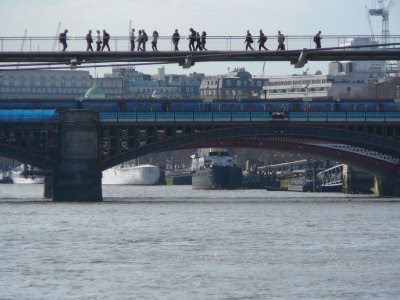
Business as usual on the Millennium Bridge:
Three hunched figures and beds like cages in the Tate Modern:

John Siddique launching his Salt poetry collection, Recital: An Almanac under a beautiful moon at the National Portrait Gallery:

A lovely part of the (I presume) cleaned-up Regent's Canal:

Some more caged creatures:

Some free birds in a cultivated park:

A clean-up operation on the River Lee:

Some very nice polite schoolboys:

Environmental protesters on a bus stop in Bishopsgate:

Lib Dem Shadow Climate Change Secretary Simon Hughes and an environmental campaigner:

Some dancing environmental campaigners:

The City of London police in formation across Bishopsgate:

A very nice polite policeman:

The kettle in Threadneedle St not yet steaming:

Every exit barred:

Business as usual on the Millennium Bridge:

Three hunched figures and beds like cages in the Tate Modern:

John Siddique launching his Salt poetry collection, Recital: An Almanac under a beautiful moon at the National Portrait Gallery:

A lovely part of the (I presume) cleaned-up Regent's Canal:

Some more caged creatures:

Some free birds in a cultivated park:

Sunday, March 22, 2009
The Low Concept of High Concept
Well, doh! I've only just found out what 'high concept' means, though I guess if I'd known it was a marketing term I'd have twigged: it doesn't mean, as I thought, subtle and sophisticated, but quite the opposite: it means clear and simple in concept, as well as recognizable (which means I guess I misunderstood some of the discussion at the Huddersfield Literature Festival last week, where the term was used.) Here's a Waxman Literary Agency blogger writing about the fact that books need to be 'high concept' to sell:
And we know where this can lead for fiction.
For writers who are drawn to the obscure and the un-covered, who think “but no one has ever written about this! why write about things people already know?” I hear you–this feels remarkably like commercial pandering. But I would encourage you to think about three things: 1. it is all in the execution but no one will ever see your execution if your premise doesn’t catch their attention; 2. it’s hard to be attentive to things we don’t recognize on at least some level; and 3. who do you write for? If it’s for readers, think about it not as selling out, but about seducing people into your world, giving them a point of entry that lets them feel comfortable. High concept is all about the touch of recognition that makes readers ready to go along on your ride.Well, this seems to me only sensible, as I've said on many an occasion, but there is one aspect of the Waxman blog post I find unsettling, which emerges in this sentence:
If the idea you're kicking around is really high concept, it should feel natural to come up with a one or two sentence affair that conveys the general premise of the work.Run that by me again: If the idea you’re kicking around is really high concept. Ah, so it's not after all the pitch that has to be high-concept, as the blogger has up to this point been implying, but the original idea in the first place. And there are ideas that are intrinsically 'high-concept' and there are ideas that are not. It's not after all, a matter of 'seducing people' or 'giving them a point of entry' into something more subtle. It's not that, as I'm always saying, with clever marketing you can sell anything. Some ideas are just too subtle after all.
And we know where this can lead for fiction.
Thursday, March 19, 2009
The Wrong Question
Here's a telling little snippet from an interview with Paulo Coelho by Hannah Pool in The Guardian. He is talking about his novel The Alchemist which has sold 35m copies:
It was published, it did not sell, and then the publisher said, "This book is never going to sell." ... However, I was so convinced that it was a great book that I started knocking on doors. [Now] The Alchemist is the most translated book by a living author.What do we conclude from this? Perhaps that whether a book 'will sell' is the wrong question. It is the one which publishers are of course always asking, but what it most often seems to mean is Will this book sell itself? This seems to me the great inconsistency in an industry which is supposed to have bought in wholesale to the concept of marketing. As any real marketer knows, nothing sells itself: customers have to be wooed; conversely, with clever marketing you can sell anything, as the 'door-knocking' snakeoil salesmen knew only too well. Perhaps the question should be rather: Do we believe in this book enough to bother to move hell and high water to sell it? But then for that to happen, the power in publishing houses would have to move back to the editors and away from the accounting - oh, sorry, so-called marketing departments...
Wednesday, March 18, 2009
Final Leg of my Virtual Book Tour
The final leg of my virtual book tour is up today on the blog of Tania Hershman, author of the inventive science-inspired collection of stories, The White Road . Promotion over, folks - though it has actually been more than just that, an opportunity for some in-depth discussion about the nature of fiction, the writing process and the writing life.
Sunday, March 15, 2009
Will Who?
I like what Robert McCrum says in relation to the Cobbe portrait of Shakespeare:
The speculation about the life will rage until the crack of doom. The work remains.
The Logic of Literary Agents
After last week's 'Queryfail' on Twitter, in which literary agents spilled the beans about the daft and desperate query letters they receive, The Guardian reported yesterday uber-agent Jonny Geller as saying this:
That's a bit daft, isn't it? Or maybe it's the desperate logic of agents who feel they need 'help' in discouraging authors from sending unsolicited stuff in the first place...
(Can't find the Guardian link, I'm afraid.)
'The fact is that publishers, and lots of agencies, have stopped accepting unsolicited manuscripts, so how is a writer meant to get into publishing? I can understand [authors'] frustration [with Queryfail], but I think the more help given the better.'Now let me get this straight. Prospective authors need help in writing the letters that 'lots of agencies' won't even consider nowadays?
That's a bit daft, isn't it? Or maybe it's the desperate logic of agents who feel they need 'help' in discouraging authors from sending unsolicited stuff in the first place...
(Can't find the Guardian link, I'm afraid.)
Thursday, March 12, 2009
Fact v Fiction and the Myersons
What to say about the gaping hole of pain which is the current Myerson family debacle? My stomach lurched when I read Jake Myerson's account in the Daily Mail, I cried when I watched Julie squirming under Paxman's unforgiving treatment, struggling to put her point across while clearly racked by both guilt and a frightened sense of injustice. My stomach turned over again when I read all the finger-pointing by journalists and the public alike: bad mother; spoilt brat.
How many of us can put up our hands and say we weren't troubled and troublesome teenagers? Not me, certainly. How many of those of us who have been parents can say we haven't made mistakes? Not I, mate. It's no coincidence that many of my radio plays and much of my prose are about the repercussions that adult behaviour can have on children's lives.
'I had to write about it,' Myerson told Paxman, and Paxman reacted with his trademark mix of regular-bloke disbelief and supercilious contempt, and the rest of the world threw up their hands in horror with accusations of selfishness (and Myerson retreated into her now familiar justification that she had to tell the world about skunk).
But the point is this: we writers have a constitutional urge to write about what moves and troubles us and seems to us of dire importance (and I'm betting that this is something Jake Myerson understood when he apparently assented to the book's publication, which makes it all a much greyer area than people seem to assume): without that urge, books would be dead things that moved no one and affected nothing.
But this is the problem: the people we are in the throes of such crises are not the people we will always be. We are not the incontrovertible 'fact' of ourselves. It seems to me that Myerson's biggest mistake was to write the book as fact and not as fiction. You can see why she did, if she felt an urgency to expose the problem of skunk, and given the supremacy of 'fact' over fiction in our culture. But it's hard not to see the tragedy for this family as the ultimate fallout from this pernicious contemporary cultural phenomenon.
How many of us can put up our hands and say we weren't troubled and troublesome teenagers? Not me, certainly. How many of those of us who have been parents can say we haven't made mistakes? Not I, mate. It's no coincidence that many of my radio plays and much of my prose are about the repercussions that adult behaviour can have on children's lives.
'I had to write about it,' Myerson told Paxman, and Paxman reacted with his trademark mix of regular-bloke disbelief and supercilious contempt, and the rest of the world threw up their hands in horror with accusations of selfishness (and Myerson retreated into her now familiar justification that she had to tell the world about skunk).
But the point is this: we writers have a constitutional urge to write about what moves and troubles us and seems to us of dire importance (and I'm betting that this is something Jake Myerson understood when he apparently assented to the book's publication, which makes it all a much greyer area than people seem to assume): without that urge, books would be dead things that moved no one and affected nothing.
But this is the problem: the people we are in the throes of such crises are not the people we will always be. We are not the incontrovertible 'fact' of ourselves. It seems to me that Myerson's biggest mistake was to write the book as fact and not as fiction. You can see why she did, if she felt an urgency to expose the problem of skunk, and given the supremacy of 'fact' over fiction in our culture. But it's hard not to see the tragedy for this family as the ultimate fallout from this pernicious contemporary cultural phenomenon.
Wednesday, March 11, 2009
Prose fiction v drama and adaptation: new leg of my virtual book tour
The penultimate leg of my virtual book tour, Around the Edges of the World, is now up. Crime-thriller writer Debi Alper asks me about the different processes in writing prose fiction and drama, and about the special problems of adapting one's own work from the first of these forms to the second.
Saturday, March 07, 2009
An Apology
My apologies: I took from Alexander Chancellor's article yesterday that Julie Myerson's new book The Lost Child was a novel. It's not in fact - it's even subtitled A True Story, I discover. This raises different and even more urgent issues, of course, about the morality of such memoirs, which, bogged down with script-reading, article-writing etc I'm afraid I don't have time to tackle just now. However there's a sensible-looking article about them in today's Guardian (which I also havent yet had time to read) by Ian Jack, once editor of the great journal of reportage, Granta.
Friday, March 06, 2009
Fact versus Fiction
As I have endlessly discussed on this blog, it's generally wise to resist public hunger to know the real-life sources of one's fiction, because for one thing, it can lead to mistaken biographical readings of the work as a whole, and for another, any sensible novelist is aware that once she has sent real life through the mangle of her own perceptions and the transformative process of fiction, it's become something else altogether and can no longer be claimed as factual truth. And such discussions do a great disservice to fiction, which is more than the sum of its parts - real life and imagination - and something more powerful altogether. Breaking it down into its 'components' is to reduce it and deny its transcendence.
It seems, however, that novelist Julie Myerson has not only admitted to the real-life trigger for her latest fiction, but is herself making the category error usually made by a naive public, and claiming that the troublesome drug-addicted boy in her latest novel is indeed her own son.
But one wonders what pressures she has been put under to do this (James Frey hovers virtually at my shoulder) with a public hungry for fact in fiction. She's getting plenty of publicity out of it, after all...
It seems, however, that novelist Julie Myerson has not only admitted to the real-life trigger for her latest fiction, but is herself making the category error usually made by a naive public, and claiming that the troublesome drug-addicted boy in her latest novel is indeed her own son.
But one wonders what pressures she has been put under to do this (James Frey hovers virtually at my shoulder) with a public hungry for fact in fiction. She's getting plenty of publicity out of it, after all...
Wednesday, March 04, 2009
Literary Friends and the Spectre of Nepotism
Virtual book tours. Great publicity tools (I think, or at least hope, after all the work I'm putting into mine!), and more: opportunities for in-depth literary discussions; certainly I'm finding my own to be. But from under my Fictionbitch hat I don't find them unproblematic.
Today my tour goes to the blog of novelist and short-story writer Charles Lambert (where he asks me about my political consciousness - with a small p - as a writer, the differences between writing for a radio and a short story audience, and the reasons for the variety of the stories in my collection). Charles Lambert, I am pretty thrilled to say, is complimentary about my work, and the reasons I'm so thrilled are that I admire his writing greatly in turn and see in it some resonances with my own, and also - perhaps because of those resonances - he pays me the particular compliment of understanding my work on such a level that he is able to invite me to discuss the issues that are most important to me as a writer.
But here is the problem. What does this look like from the outside? Especially if you know the other, extraneous circumstances: we are published by the same publisher; we became friends via our blogs (and more latterly FaceBook); we have met twice, if briefly, at our publisher's book launches. And last year I hosted his book tour, expressing my admiration for his collection, A Scent of Cinnamon, and on another occasion wrote very positively about his novel, Little Monsters. Isn't this just a question of literary buddies bulling each other up? How can the outside observer take seriously any positive critical comments? This is of course the time-honoured complaint against reviewers, but the situation here is even more potentially dubious, since - although, as I say, I have discovered they can be far more - virtual book tours are fundamentally promotional tools.
Here at Bitch Towers I have historically distanced myself from promotion, and for this reason I tend to host book tours on my other, 'cuddlier' blog, as one publisher recently called it, and to promote there the books of my friends.
But the fact that is often overlooked is that our good opinions of the books of our literary friends most often precede our real-life friendships with them, and that the friendships only arise precisely because of literary resonance. One's writing, after all, is an expression of one's personality, and more often than not if I have been moved or impressed by a person's writing, then the odds are that when we meet in the flesh we will get on together and consequently become friends. Yet once we are friends, others may suspect that our claims for each others' work are not to be trusted.
This whole problem rears its ugly head when it comes to seeking cover quotes for a book, which I'm currently doing and which I wrote about last year, charting my somewhat ridiculous bid to avoid all accusations by searching for a quote from someone I didn't know.
Today my tour goes to the blog of novelist and short-story writer Charles Lambert (where he asks me about my political consciousness - with a small p - as a writer, the differences between writing for a radio and a short story audience, and the reasons for the variety of the stories in my collection). Charles Lambert, I am pretty thrilled to say, is complimentary about my work, and the reasons I'm so thrilled are that I admire his writing greatly in turn and see in it some resonances with my own, and also - perhaps because of those resonances - he pays me the particular compliment of understanding my work on such a level that he is able to invite me to discuss the issues that are most important to me as a writer.
But here is the problem. What does this look like from the outside? Especially if you know the other, extraneous circumstances: we are published by the same publisher; we became friends via our blogs (and more latterly FaceBook); we have met twice, if briefly, at our publisher's book launches. And last year I hosted his book tour, expressing my admiration for his collection, A Scent of Cinnamon, and on another occasion wrote very positively about his novel, Little Monsters. Isn't this just a question of literary buddies bulling each other up? How can the outside observer take seriously any positive critical comments? This is of course the time-honoured complaint against reviewers, but the situation here is even more potentially dubious, since - although, as I say, I have discovered they can be far more - virtual book tours are fundamentally promotional tools.
Here at Bitch Towers I have historically distanced myself from promotion, and for this reason I tend to host book tours on my other, 'cuddlier' blog, as one publisher recently called it, and to promote there the books of my friends.
But the fact that is often overlooked is that our good opinions of the books of our literary friends most often precede our real-life friendships with them, and that the friendships only arise precisely because of literary resonance. One's writing, after all, is an expression of one's personality, and more often than not if I have been moved or impressed by a person's writing, then the odds are that when we meet in the flesh we will get on together and consequently become friends. Yet once we are friends, others may suspect that our claims for each others' work are not to be trusted.
This whole problem rears its ugly head when it comes to seeking cover quotes for a book, which I'm currently doing and which I wrote about last year, charting my somewhat ridiculous bid to avoid all accusations by searching for a quote from someone I didn't know.
Tuesday, March 03, 2009
Grim Rewards
In the second issue of the online Manchester Review from Manchester University, Colm Toibin reveals in an interview with M J Hyland that the best enjoyment he gets out of writing is the money. In a straw poll of authors conducted in response by The Guardian today (and which doesn't seem to be replicated in the online version of the Guardian article) most agree with his assessment that writing novels is actually pretty gruelling - Will Self is a notable exception - though Joyce Carol Oates points out pretty sharply that
Which is why, of course, the publishing industry has most of us over a ruddy barrel.
...most literary writers don't write for money. A prose fiction writer's hourly wage, broken down into units, would be in the modest range of the US minimum wage of the 1950s - approximately $1 dollar per hour.But then it's clear that even if it weren't for the money, Toibin would still be writing, like all of us unremunerated authors. He'd never quit, he says, writing is essentially a neurosis, an obsession.
Which is why, of course, the publishing industry has most of us over a ruddy barrel.
Rights versus Accessibilty
The rights versus accessibility debate, and fact that Amazon has caved in to the demands of the US Authors Guild to allow publishers to disable the text-to-speech function on the Kindle 2 here.
Wednesday, February 25, 2009
Literary Lenses, Writing Jumpers and a Prize Draw: my Virtual Book Tour
For someone so keen in theory on separating the work from the person of the writer, I am revealing a ridiculous amount of stuff on my virtual book tour: this week, on dovegreyreader scribbles, I even talk about my ruddy writing jumper! I'm beginning to think it's a joke, my having these principles...
We do also however talk about a more serious matter: whether short stories are 'miniatures' concentrating microscopically on the minute details of life, or whether they are something much more potentially dynamic and less cosy, capable of telescopically encompassing huge themes.
And this week there's a prize draw: a free copy of Balancing on the Edge of the World to each of three winners who leave their names in the comments section.
We do also however talk about a more serious matter: whether short stories are 'miniatures' concentrating microscopically on the minute details of life, or whether they are something much more potentially dynamic and less cosy, capable of telescopically encompassing huge themes.
And this week there's a prize draw: a free copy of Balancing on the Edge of the World to each of three winners who leave their names in the comments section.
Tuesday, February 24, 2009
Response Time
I've been feeling kind of silenced lately - blog-silenced, that is. First of all because my virtual book tour has been taking up that bit of my brain I leave open for logical thought when I'm trying really hard to get on with my own writing, but also because what seems (from the depths of my latest story) to have been the literary sensation of last week - the row over Geraldine Bedell's book and the Dubai literature festival - has left me pondering, pondering, pondering rather than commenting...
Thing is, this so often happens to me - I'm often late to the bone-picking feast and sometimes I never get there at all before it's too late. I read a piece in the paper or on the web, and I think, Well, I need to think about this. And when I've thought a bit I think, Ah, yes, but is that really the case? How do they know? Where's the evidence? Etc etc... And so I don't feel qualified to have a bracing clear-cut opinion.
And what I'm pondering now is: is this what happens - the embarrassing situation in which Margaret Atwood has been placed over this issue - when we put too much trust in journalistic reports and respond accordingly too fast? And is this something to which the web, with its culture of quick-fire response, is contributing?
Thing is, this so often happens to me - I'm often late to the bone-picking feast and sometimes I never get there at all before it's too late. I read a piece in the paper or on the web, and I think, Well, I need to think about this. And when I've thought a bit I think, Ah, yes, but is that really the case? How do they know? Where's the evidence? Etc etc... And so I don't feel qualified to have a bracing clear-cut opinion.
And what I'm pondering now is: is this what happens - the embarrassing situation in which Margaret Atwood has been placed over this issue - when we put too much trust in journalistic reports and respond accordingly too fast? And is this something to which the web, with its culture of quick-fire response, is contributing?
Wednesday, February 18, 2009
Fact versus Fiction
Today the Bitch abandons her principles. Regular readers of this blog will be familiar with my arguments against biographical readings of fiction, and as a writer in the past I've avoided discussions about the real-life triggers or 'components' of my fiction as reductive and leading to mistaken biographical readings of my work as a whole. Many of the questions of my virtual book tour, however, have centred on the writing process, so it's sometimes been hard to avoid.
This week the question has arisen: precisely HOW do I turn a real-life incident in to a fiction?, and I have had to bite the bullet.
This week the question has arisen: precisely HOW do I turn a real-life incident in to a fiction?, and I have had to bite the bullet.
Friday, February 13, 2009
Bad News, Old News
As if we didn't know it, the BBC Money Programme spells it out: literary writers, independent publishers and independent bookshops are suffering - although Will Self recommends cleaning Amanda Ross's stairs for her.
http://www.bbc.co.uk/iplayer/episode/b00hmbb2/Money_Programme_Media_Revolution_Title_Fight
http://www.bbc.co.uk/iplayer/episode/b00hmbb2/Money_Programme_Media_Revolution_Title_Fight
Wednesday, February 11, 2009
My Virtual Book Tour: Stealing Stories and the Literary Dinner from Hell.
 The latest leg of my virtual book tour is now up on the blog of novelist Sarah Salway, whose own excellent collection of stories, Leading the Dance, I wrote about here.
Discussed are the way so-called short stories can encompass huge themes, and whether or not stories can be 'stolen'. I also comment on our current literary climate by describing my idea of the literary dinner from hell.
You can get to it here.
Tuesday, February 10, 2009
Zadie Smith on Two Ways for the Novel
My friend and colleague, writer Sam Thorp, alerted me to this which to my shame I missed, an insightful article by Zadie Smith for the New York Review of Books, in which she compares Netherland by Joseph O’Neill and Remainder by Tom McCarthy, and the ways in which they represent two warring strands in what she calles 'our ailing literary culture':
From two recent novels, a story emerges about the future for the Anglophone novel. Both are the result of long journeys. Netherland, by Joseph O'Neill, took seven years to write; Remainder, by Tom McCarthy, took seven years to find a mainstream publisher. The two novels are antipodal—indeed one is the strong refusal of the other. The violence of the rejection Remainder represents to a novel like Netherland is, in part, a function of our ailing literary culture. All novels attempt to cut neural routes through the brain, to convince us that down this road the true future of the novel lies. In healthy times, we cut multiple roads, allowing for the possibility of a Jean Genet as surely as a Graham Greene.These aren't particularly healthy times. A breed of lyrical Realism has had the freedom of the highway for some time now, with most other exits blocked. For Netherland, our receptive pathways are so solidly established that to read this novel is to feel a powerful, somewhat dispiriting sense of recognition. It seems perfectly done—in a sense that's the problem. It's so precisely the image of what we have been taught to value in fiction that it throws that image into a kind of existential crisis, as the photograph gifts a nervous breakdown to the painted portrait. (More...)
To my mind this article is spot-on. Thanks to Mark Thwaite for the link.
Tuesday, February 03, 2009
The Reasons for Writing - My Virtual Book Tour
 This week on my virtual book tour I'm required to tackle the fundamental question: why do I write stories?
Friday, January 30, 2009
John Updike in My Headspace.
Apologies for not getting to this blog so much at the moment: just now my virtual book tour seems to have replaced it as the thing which takes up more (and the wrong kind of) head-space than is decent for someone who's supposed to be also immersed in a fiction project.
A quick thought instead: I've been less than positive about John Updike's novels now and then, but this week I have kept remembering how, when I was around fourteen, I kept getting Rabbit, Run out of the local library, and reading it over and over... As I've said already this week on my other blog (where I don't have to think so hard), you can be surprised sometimes about your own influences.
Meanwhile, Dan Green, who never lets up on the intellectual front, offers us two views of the future of fiction in the digital age, a pessimistic prophecy and his own more optimistic prediction.
A quick thought instead: I've been less than positive about John Updike's novels now and then, but this week I have kept remembering how, when I was around fourteen, I kept getting Rabbit, Run out of the local library, and reading it over and over... As I've said already this week on my other blog (where I don't have to think so hard), you can be surprised sometimes about your own influences.
Meanwhile, Dan Green, who never lets up on the intellectual front, offers us two views of the future of fiction in the digital age, a pessimistic prophecy and his own more optimistic prediction.
Wednesday, January 28, 2009
My Virtual Book Tour
 The latest leg of my Cyclone virtual book tour for Balancing on the Edge of the World is on Keeper of the Snails, the blog of novelist Clare Dudman. Discussed are my use of a child's perspective in my fiction and the possibilities of child narrators in fiction in general, the extent to which I use people and settings from life and the way in which acting relates to writing, among other things.
As a writer I'm finding this book tour an instructive and fulfilling process, because of the variety of response to my work and also the opportunity to talk about it in such depth, as I discuss in greater detail on my other blog today.
Monday, January 26, 2009
What Fiction Can Do
Here's a great piece by Jonathan Franzen on what fiction can still do in an era of competing media, which concludes thus:
Only written media, and maybe to some extent live theatre, can break down the wall between in and out. You’re not looking at your feeling from within. An Alice Munro story rushes you along in about 25 minutes to a point where you’re imaginatively going through a moment of deep crisis and significance in another person’s life. I know I’m expressing this in very vague terms, but I think these epiphanic moments have a social and political valence as well, because they’re what we mean when we talk about being a person, about being an individual, about having an identity. Identity is precisely not what consumer culture says it is. It’s not the playlist on your iPod. It’s not your personal preference in denim washes. The moment you become an individual is the moment when all that consumer stuff falls away and you’re left with the narrativity of your own life. All the things that would become impossible politically, emotionally, culturally, psychologically if people ever were to become simply the sum of their consumer choices: this is, indirectly, what the novel is trying to preserve and fight in favour of.Thanks to Daniel Green for the link.
Sunday, January 25, 2009
Wednesday, January 21, 2009
My Virtual Book Tour: Experiment Versus Saleability Discussed with Scott Pack
 Scott Pack, publisher and former chief fiction buyer for Waterstones, hosts my virtual book tour this week and gets me talking about experimentation versus the need to please readers, and about the effect the pressures of the market have had on my writing.
 Sunday, January 18, 2009
Don't Bother Getting Older
Robert McCrum seems intent to endorse the literary cult of youth by strangling logic and stretching points, listing 7 writers who published in later life as exceptions to his rule ('Let's face, it, after 40 you're past it') and overlooking the fact that of those 13 he says 'prove' it by blossoming young, some - most notably Philip Roth - have in fact gone on to produce major works in later life.
Thursday, January 15, 2009
Literary Luck
Read a sobering article on the Guardian books blog, showing how much luck is involved in the acknowledgement or neglect of literary genius.
And then have a laugh. (Thanks to The Guardian for the link.)
And then have a laugh. (Thanks to The Guardian for the link.)
Wednesday, January 14, 2009
My Virtual Book Tour: The Writing Process
 My virtual book tour kicks off today on Barbara's Bleeuugh, where, taking her cue from a comment by Anne Enright about her own writing process, Irish poet Barbara Smith asks me about mine.
Sunday, January 11, 2009
The Threat to Intellectual Freedom
This weekend the books pages of the Guardian and Observer are distinguished by examination of 'global thinking', the ways in which it operates in the current tensions between Islam and 'the West', and the ways in which this intersects with literature.
On one hand, Pankaj Mishara accuses literary so-called intellectuals of engaging with the unsubtle notion of 'Islamofascism' and justifying the notion of 'collateral damage' and 'the harassment of Muslims and other swarthy foreigners'. Rightly he praises David Grossman and Arundhati Roy as exceptions to this anti-intellectual trend, for eschewing such black-and-white thinking and challenging their own governments, even at risk to their own personal safety.
The flip-side of this coin is presented today in a meticulously-argued and terrifying article by Andrew Anthony on the legacy of the Rushdie fatwah and the British reaction to it. A similar intellectual conflation, in which to speak out against terrorism is to speak against Islam, has led to a horrifying destruction of our intellectual freedom. 'Chief among [our voluntary adoption of multicultural manners],' he says, 'is the duty not to offend', and quotes Kenan Malik: 'The fatwa has in effect become internalised'. Meanwhile, as he points out, there are legal changes which have actively restricted our right not just to speak out, but to think and read...
On one hand, Pankaj Mishara accuses literary so-called intellectuals of engaging with the unsubtle notion of 'Islamofascism' and justifying the notion of 'collateral damage' and 'the harassment of Muslims and other swarthy foreigners'. Rightly he praises David Grossman and Arundhati Roy as exceptions to this anti-intellectual trend, for eschewing such black-and-white thinking and challenging their own governments, even at risk to their own personal safety.
The flip-side of this coin is presented today in a meticulously-argued and terrifying article by Andrew Anthony on the legacy of the Rushdie fatwah and the British reaction to it. A similar intellectual conflation, in which to speak out against terrorism is to speak against Islam, has led to a horrifying destruction of our intellectual freedom. 'Chief among [our voluntary adoption of multicultural manners],' he says, 'is the duty not to offend', and quotes Kenan Malik: 'The fatwa has in effect become internalised'. Meanwhile, as he points out, there are legal changes which have actively restricted our right not just to speak out, but to think and read...
Monday, January 05, 2009
Writing to Demand
I was as shocked as anyone by the low standard of Caroline Aherne's Royal Family as anyone, but I shouldn't have been, and it doesn't in the end stop me considering her a comic genius.
I think what this disappointment shows is that a culture in which writers are expected to perform to order is thoroughly detrimental to those writers and their art. Creativity has its own rhythm; writers write best when they are ready, and not when the rhythms of the TV and publishing schedules require (which I'm pretty sure is what happened here).
I think what this disappointment shows is that a culture in which writers are expected to perform to order is thoroughly detrimental to those writers and their art. Creativity has its own rhythm; writers write best when they are ready, and not when the rhythms of the TV and publishing schedules require (which I'm pretty sure is what happened here).
Sunday, January 04, 2009
Recession Busters?
Here's a depressingly different view from that which some have expressed about the effect of the recession on publishing, and literary fiction.
Thanks to Angie Venezia for the link.
Thanks to Angie Venezia for the link.
Friday, January 02, 2009
Fame and the Recluse
An interesting article by Charles McGrath about the reclusiveness of JD Salinger, which includes an assessment of the contemporary relevance of his work. I'm finding it quite hard, though, to get my head around its concluding suggestions, ie that Salinger's main theme of 'phoniness v authenticity' has become outdated, and that this is intimately linked to his self-imposed silence in that, like his fictional character Seymour, Salinger may have felt that his work was too subtle for a crass audience.
Maybe I'm just too distracted by the thought that such reclusiveness would be pretty impossible to establish nowadays...
Maybe I'm just too distracted by the thought that such reclusiveness would be pretty impossible to establish nowadays...
Tuesday, December 30, 2008
Touch and Go
 I was thrilled to be sent the lovely diary which Faber has produced on its 80th birthday, designed in the style of those early Faber books. Inside, each double-page spread is beautifully adorned with a picture of the cover of the first edition of a classic Faber, or some other archival material, and the one for the second week of April particularly struck me. It's a photo or scan of a 1957 letter, typed in red ink and sent by a reader to poetry editor 'Mr Eliot'. The reader is unsure of his/her own opinion of the book on which he/she is reporting, since it's 'won the First Publication Award in a contest sponsored by the New York Poetry Centre and judged by Auden, Spender and Marianne Moore' but the poet is a 'young Englishman whose poems have been chiefly published in America' (one senses a prejudice here) and 'the quality seems to me very uneven.' On balance, the reader feels that while it might be 'worth while asking Spender informally for some more information about the Award' and about the judges' assessment of the poet's work, 'I don't feel we'd want to take him on yet.'
But at least the reader is honest about his/her lack of confidence in his/her own doubts. And fortunately, as a result, the American-born TS Eliot has no hesitation in scribbling across the bottom, 'I'm inclined to think we ought to take this man now. Let's discuss him. TSE.'
The poet and book in question? Ted Hughes and his first collection, The Hawk in the Rain.
Such an interesting insight into how the fate of writers can sometimes hang in the balance...
(I would scan the page for you, but I'm not sure about the copyright.)
Saturday, December 27, 2008
The Richard and Judy Bottleneck
In his review of the 100 top bestsellers for 2008, John Dugdale forecasts bad times ahead for literary fiction as a result of Richard and Judy's move from prominence:
Well, I don't know about you, but I have this weird hunch that it might not be such a bad world in which publishers can no longer bring home the (literary) bacon via a tiny selection of the literary titles published each year by relying on celebrity-based TV and a couple of dictators, as Dugdale calls them, and will maybe have to find some other way of upping their marketing game for literary fiction in general.
It's not just authors of commercial fiction who will miss the teatime taste dictators, as they regularly backed more ambitious writing.Others expressed similar thoughts in the wake of the loss of the Jonathan Ross show, the view being that commercial fiction once promenaded there will now be forced into the 'lower-level' publicity slots, ousting more literary fiction.
Well, I don't know about you, but I have this weird hunch that it might not be such a bad world in which publishers can no longer bring home the (literary) bacon via a tiny selection of the literary titles published each year by relying on celebrity-based TV and a couple of dictators, as Dugdale calls them, and will maybe have to find some other way of upping their marketing game for literary fiction in general.
Wednesday, December 24, 2008
21: A New Online Critical Journal
The launch yesterday of 21, a new online critical journal from Edge Hill University, edited by Ailsa Cox and Rob Spence and concerned with contemporary and innovative fiction. Among the articles I haven't yet read is one on post 9/11 fiction, and those I have are a revealing interview with writer Charles Lambert and an interesting piece on the issue of collecting short stories in volumes by Ailsa Cox (instigator of the Edge Hill Prize for short story collections), including a report on a recent linked conference. There's also an article by me on the critical response to Anne Enright's The Gathering and its implications for the way we read now and the contemporary status of fiction.
Sunday, December 21, 2008
One Person's Poison...
Robert McCrum is hopeful that the recession will actually be good for books, and for novels and poetry in particular.
Subscribe to:
Posts (Atom)