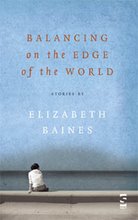
In March I read at the Huddersfield Literature Festival with two other Salt authors, story writer Carys Davies and poet Mike Barlow, at an event titled 'Salt of the Earth'. It's a strange thing, the way you get billed like this, almost as a representative of your publisher, rather than simply of your own writing. Although on this occasion that's how we offered ourselves, as a cohort of Salt authors, it is quite often the festival or independent events organizers who do this - decide to bill an event as a 'Salt' event: this has happened with an imminent Manchester Literature Festival event and another at Manchester Central Library in December (in both of which I'm taking part). My publisher has certainly made a splash as a small independent publisher of poetry and (so far) short fiction, and appears to have caught everyone's attention and imagination and the good thing about this is that it's a great publicity/marketing hook for events organizers and we, its authors, alike.
But at that Huddersfield reading, a question was asked by festival director Michael Stewart - who, indeed, I believe had given the event its name, 'Salt of the Earth' - a question that raised issues we three authors were unable to tackle fully at the time, and which I've only touched on since. What, he asked, did we think of the difference between Salt and Comma (Ra Page's Manchester independent, publishing chiefly short fiction), the difference as he saw it being that Comma was a 'high-concept' publisher and that Salt... Well, to be honest, I can't swear what he said Salt did, but at the time, perhaps influenced by the connotations of his title for our event and the fact that he referred as example to my having recently won a prize in the Raymond Carver competition, we interpreted him as saying that Salt published realist fiction, and swiftly stated the fact we know to be true: that Salt does not just publish realist writing, but is a broad church committed only to literary excellence (no one would call Carys's own contemporary fairy tales realist, or the science-inspired fantasies of Salt author Tania Hershman - and, as I put in, I wouldn't even call my Raymond Carver competition story realist but an attempt to critique the whole concept of realism).
The trouble was, we had failed to understand the term 'high-concept', or at any rate, speaking for myself, I had, taking it as a literary term meaning concerned with ideas and style rather than 'realist' notions of real life and character and story. It seems ridiculous now, because the term is now everywhere, but back then in March I hadn't understood that 'high-concept' is a marketing term denoting something almost opposite: a graphic notion which catches attention and is easily grasped, and is thus desirable for marketing any book. Ra Page's anthologies of short stories are indeed 'high-concept' in this sense, in that they are themed, usually around such a graphic notion, and I understand that some of his single-author collections, such as Tiny Deaths by Robert Shearman, are commissioned to be written around a unifying concept agreed beforehand. Salt, on the other hand, publish single author collections only and do not have that anthologist's need to shoe-horn diverse writers, and they don't commission collections to precalculated themes. However, contrary to what I think now was Michael's suggestion - which unfortunately I think our 'broad church' answer may have seemed to corroborate - Salt by no means eschew the high-concept marketing principle: director Chris-Hamilton Emery has made it clear that, while literary excellence is his touchstone, his books must be marketable with a clear, attractive concept (and fortunately for us Salt authors, when it comes to marketing matters like readings, we also have the Salt banner to wave).
But the big question arises: how do we market our books thus without reducing them? I have frequently railed against themed anthologies (although, succumbing to marketing pressures, I have published them) and the way in which they can force sometimes reductive readings on individual stories. By succumbing of necessity to the 'high-concept' sell, do we divert readers away from certain aspects of our work which are perhaps important to us? And does that matter? To be perfectly frank with you, as a writer the thing I'm really interested in, and would like my readers to share an interest in, is the ways we think, but tell that to the bookshop buyers and the Saturday browsers! Fortunately (or not) I come from a family in which you can soon get your leg pulled for sitting around and looking like you're thinking too much, so I learned early on the value of narrative and concrete detail for luring people into ideas, often by making them identify. But which do you stress when you're marketing? This is the stumbling block over which my first novel, The Birth Machine, (which wasn't originally called that), fell from being about logic and science and intuition and aimed more at men than women, into being sold and read as a feminist novel about childbirth aimed only at women. What I'm particularly interested in is the way we think in boxes, and a lot of my writing is about showing the falsity of those boxes. But you can't stop people reading in boxes, it seems, and one story of mine in which I tried to deconstruct concepts of class (and race) ended up in one critic's eyes as a depiction of a 'rolling working-class childhood' while in another's as being 'about a middle-class child'. I'm particularly keen to show the lack of dividing line between the 'ordinary' and the 'out-of-the-ordinary', but people seem reluctant to accept the fuzziness of this, and want to categorize. Several critics have stressed that my story collection is about 'ordinary lives' and, well, I'm just sitting here thinking: what, your dad beats you up and was a Jewish refugee; your next-door-neighbour is a famous opera singer; you're a mother with a newborn baby and you're losing it and you suddenly run away from a family outing across the sand dunes - these are ordinary? You take a stranger back to your hotel room for sex before you've hardly had time to speak to him? - well, I guess there's no accounting for what some people think of as ordinary, which rather proves my original literary point. And how much does 'high-concept' marketing exacerbate such simplifications? (How much is this reading of my stories influenced by my marketing blurb, which concentrated on the concrete and readily graspable?)
I've got a new novel out, so you can see why this matter is taxing me... (Luckily, it concerns a mystery, which is one 'high concept' that doesn't require things pinned down.)
Thursday, October 08, 2009


Tuesday, September 29, 2009
The Google Settlement
All summer, while I was firstly immersed in the short stories I'm writing for a new collection and then up a mountain in Wales and away from all things literary, I'd have a knot in my stomach as it suddenly surfaced: before September I was supposed to make a decision about the Google digitization deal: whether to opt out. But opt out of what exactly? And what would be the implications of doing that, of losing the chance of having my out-of-print works aired once more? But would failing to do so mean that I'd be losing the copyright I now owned and giving it away to Google? There was something I was supposed to do to prevent this happening... For some reason I just wasn't clear: a quick read of the sheet of information I'd had from the Writers' Guild didn't really seem to give me an answer. What was going on? I'm accustomed to being able to skim such things and quickly grasp the gist, but this time I couldn't - and a quick look on the internet left me no wiser. Was I losing it? I'd have to put some decent time aside to investigate the matter. And then I didn't have the time... and now the moment for opting out has gone.
Well, now the US Justice Department has come out against the settlement as proposed, and Nick Harkaway articulates precisely on his blog why we should be relieved. As he says now on the Guardian books blog, there are good things about Google's library plan, but what was worrying was the method. Most importantly, as he says on his blog:
Well, now the US Justice Department has come out against the settlement as proposed, and Nick Harkaway articulates precisely on his blog why we should be relieved. As he says now on the Guardian books blog, there are good things about Google's library plan, but what was worrying was the method. Most importantly, as he says on his blog:
Google’s actions here are a massive rights grab, but more than that, the structure of the agreement is opt-out. If you don’t, you’re in. That’s a massive change. The default position of copyright has always been that if you don’t have active permission, you can’t use the material...You come down from the mountain, and the law has changed on the plain...It’s true that copyright law is also a tool used by large companies to make large profits. It’s true that it is badly in need of reform. But short-circuiting the legislative process in a Class Action Settlement and creating an opt-out situation… that ain’t reform. That’s just kicking down the fences. It invites a situation where a powerful entity can flatten a small rightsholder
Thursday, September 24, 2009
The Truth About Publishing
From the horse's mouth, ie Daniel Menaker, ex Random House Senior Vice President and Executive Editor-in-Chief.
Some choice bits (which I know other blogs have quoted ):
Some choice bits (which I know other blogs have quoted ):
Genuine literary discernment is often a liability in editors. And it should be -- at least when it is unaccompanied by a broader, more popular sensibility it should be. When you are trying to acquire books that hundreds of thousands of people will buy, read, and like, you have to have some of the eclectic and demotic taste of the reading public....But read the whole thing if you haven't already. Thanks to my colleague Sam Thorp for nudging me about it.
Financial success in front-list publishing is very often random, but the media conglomerates that run most publishing houses act as if it were not...
It's my strong impression that most of the really profitable books for most publishers still come from the mid-list -- "surprise" big hits with small or medium advances, such as that memoir by a self-described racial "mutt" of a junior senator from Chicago. Somehow, by luck or word of mouth, these books navigate around the rocks and reefs upon which most of their fleet -- even sturdy vessels -- founder. This is an old story but one that media giants have not yet heard, or at least not heeded, or so it seems. Because let's say you publish a flukey blockbuster about rhinoviruses in Renaissance Italy -- "The DaVinci Cold" -- one year: the corporation will see a spike in your profit and sort of autistically, or at least automatically, raise the profit goal for your division by some corporately predetermined amount for the following year. (The sequel to or second book after that blockbuster will usually command an advance so large as to dim a publisher's profit hopes for it.) This is close to clinically insane business behavior and breeds desperation rather than pride and confidence in the people who work for you. Cut it out, I say, or get out of the business!...
Many of the most important decisions made in publishing are made outside the author's and agent's specific knowledge. Let's say your house publishes a comparatively modest number of original hardcovers every year -- forty. Twelve on the etymologically amusing "spring" list -- January through April; twelve in the summer; sixteen in the economically more active fall. Well, meetings are held to determine which of those books your company is going to emphasize -- talk about most, spend the most money on, and so forth. These are the so-called lead titles for those seasons. Most of the time, the books for which the company has paid the highest advances will be the lead titles, regardless of their quality. In many cases, their quality is a cipher at this planning stage, because their manuscripts haven't been delivered or even written or even begun yet. But why should the literary quality of writing figure heavily into this prioritizing? It's not as if the millions of readers being prayed for are necessarily looking for challenging and truly enlightening reading experiences.
Tuesday, September 15, 2009
Copyright, Open Rights and the Future of Publishing
Interesting article by Electric Literature's Andy Hunter on new media and the future for publishing, especially in the light of Peter Mandelson's proposed crackdown on internet file sharing and the protest against it.
Sunday, September 13, 2009
Looking Back to Look Forward
Some of the comment about the Booker shortlist last week seems to me symptomatic of our current obsession with time, as discussed recently by David Ulin in the Los Angeles Times, and of the 'global' and linear way we think about it. We see the world in terms of 'past' and 'present', it seems, and this as a bad/good opposition. I suspect that 'Degrus' 's comment on Sarah Crown's Guardian books blog that the list of six 'historical' novels is 'depressingly backward-looking' represents a common train of thought. As David Ulin points out, there's an obsession with contemporaneity, with the now. I confess I haven't read a single book on this shortlist (!), so I'm writing theoretically, but I'd like to pose the question: what is wrong with 'looking back'? Or to put it more strongly, isn't it damn well urgently important to look back? I hate to be cliched, but sometimes cliches seem to get forgotten, and wasn't there something someone said about remembering the mistakes of the past in order not to make them again...?! In other words, the present and future lie in the past, and as 'Hedgiecc', another Guardian blog commenter pointed out, what is important in historical fiction is to 'make the themes of the work relevant to contemporary concerns'.
Edited in: I wrote the above before I looked at today's Observer. While one article there reported on the fact that history is in danger of disappearing as a subject from our schools, another by Tim Adams bemoans our heritage culture as a retreat from the present and its concerns. I can't disagree with this last, and while there seems a paradox, I think in fact it's just the other side of the coin of our simplistic 'global' thinking, the one which alternatively holds the past as 'good' and the present as 'bad' (or at least, as he says, too difficult for contemplation). Adams acknowledges the respectable tradition of mining the past for 'stories that will illuminate the present', but believes that the 'current appetite for historical fiction' seems different, a part of this retreat from 'the here and now'. Well, it's true that you can't legislate for what people seek in books, but (while, as I say, I haven't yet read the current Booker shortlist) this seems in itself a bit of blanket/'global' condemnation of the shortlisted books.
Edited in: I wrote the above before I looked at today's Observer. While one article there reported on the fact that history is in danger of disappearing as a subject from our schools, another by Tim Adams bemoans our heritage culture as a retreat from the present and its concerns. I can't disagree with this last, and while there seems a paradox, I think in fact it's just the other side of the coin of our simplistic 'global' thinking, the one which alternatively holds the past as 'good' and the present as 'bad' (or at least, as he says, too difficult for contemplation). Adams acknowledges the respectable tradition of mining the past for 'stories that will illuminate the present', but believes that the 'current appetite for historical fiction' seems different, a part of this retreat from 'the here and now'. Well, it's true that you can't legislate for what people seek in books, but (while, as I say, I haven't yet read the current Booker shortlist) this seems in itself a bit of blanket/'global' condemnation of the shortlisted books.
Friday, August 28, 2009
The Face of the Author
An excellent article by the Guardian's Richard Lea, who reports that since the Guardian began a series of video author interviews on their website, some publishers have been pushing to them the 'personable' aspects of their literary authors.
The crucial point Lea makes is that literary fiction appeals to the intellect (among other things, presumably) (an interesting, and useful I think, definition of literary fiction), and implies that any reader with a modicum of intellect would be put off rather than attracted by such base and irrelevant marketing appeals. He acknowledges, though, that literary fiction is a 'hard sell' which explains why 'even literary fiction' comes to be sold in this way. Personally, I'd take this further, and strike the 'even literary fiction' and replace it with 'literary fiction, above all others'. I'll never forget when I was invited to Harrogate or York (I forget which) to a dinner of Women of the North (no they weren't all wearing viking helmets, they were wearing those spiky/curly things with flowers and nets etc - it was some kind of achievers thing), and was put on the writers' table. Every other woman on the table was a highly successful writer of romantic fiction, and every one was matronly, plump and over fifty, or at least looked it. That was the moment it occurred to me that popular fiction just doesn't need the kind of marketing in which the author must be some kind of soulful or smouldering beauty, and that the marketers realized that literary fiction did.
Perhaps we should just acknowledge that reading literary fiction, like thinking itself, is not exactly a mass pursuit, and stop trying to sell it as such. Yet independent publishers of literary fiction who do operate outside the mainstream are especially reliant, if not on authors' good looks, on authors' personalities: as Salt's Chris Hamilton-Emery has made clear to his authors, it's those authors with a profile on the web (and, I'd add, lots of friends there) who are most likely to sell books. May as well forget about hiding your suspect personality behind your brilliant prose, and too bad, eh, if revealing it puts people off even looking at your books...
The crucial point Lea makes is that literary fiction appeals to the intellect (among other things, presumably) (an interesting, and useful I think, definition of literary fiction), and implies that any reader with a modicum of intellect would be put off rather than attracted by such base and irrelevant marketing appeals. He acknowledges, though, that literary fiction is a 'hard sell' which explains why 'even literary fiction' comes to be sold in this way. Personally, I'd take this further, and strike the 'even literary fiction' and replace it with 'literary fiction, above all others'. I'll never forget when I was invited to Harrogate or York (I forget which) to a dinner of Women of the North (no they weren't all wearing viking helmets, they were wearing those spiky/curly things with flowers and nets etc - it was some kind of achievers thing), and was put on the writers' table. Every other woman on the table was a highly successful writer of romantic fiction, and every one was matronly, plump and over fifty, or at least looked it. That was the moment it occurred to me that popular fiction just doesn't need the kind of marketing in which the author must be some kind of soulful or smouldering beauty, and that the marketers realized that literary fiction did.
Perhaps we should just acknowledge that reading literary fiction, like thinking itself, is not exactly a mass pursuit, and stop trying to sell it as such. Yet independent publishers of literary fiction who do operate outside the mainstream are especially reliant, if not on authors' good looks, on authors' personalities: as Salt's Chris Hamilton-Emery has made clear to his authors, it's those authors with a profile on the web (and, I'd add, lots of friends there) who are most likely to sell books. May as well forget about hiding your suspect personality behind your brilliant prose, and too bad, eh, if revealing it puts people off even looking at your books...
Sunday, August 23, 2009
Way Up a Mountain
Sorry for the blackout on my blogs at the moment: I'm up the mountain again, this time to help out with decorating work: too busy to blog, and my head's gone dead anyway or rather has been taken over by thoughts about woodfiller and whitewash and paint and drying times and suitable surfaces and - oh you don't want to know. Suffice to say that I'm now on most friendly terms with the staff at Bangor B&Q (literary conversation: what's that?). And if I should ever get a literary inspiration, well, that'll usually be when the signal for the mobile internet goes blank instead: it's much worse when it's windy for some reason - which here, opposite the ridge by the sea, it nearly always is. It's as much as I can do to keep up with my emails (and then I have to use the very primitive server mail platform: can't send block emails, each email takes an age to load through, and the platform doesn't keep a copy of what I've sent). Twitter hardly works at all. (So much for getting all my mates to vote for my book on the new Salt Just One Book poll and keeping up my books's exposure - what this does expose, I guess, is something of a flaw in the blanket contemporary acceptance of a culture of internet-based author marketing). And some days I don't get out in time to get a newspaper, though yesterday evening on my way to a fabulous meal in Molly's restaurant in Caernarfon, I did manage to buy a Guardian, and read an article by Nick Laird bemoaning the need for authors to market their own work and describing all the feelings we all have to squash in order to do it (or I do anyway): 'For one thing, it seems the height of bad manners, like going on about your own children' - which is exactly what I said the other day on the Elizabeth Baines blog. Oh, and a profile of Fay Weldon, who always makes me laugh... No way I can give you all the links, sorry: it would take half an hour at least, and there's a door waiting to be painted.
As for reading, I got quite hooked on a book in ms by a friend, in the half-hour each day I read in bed in the morning - more hooked than by most published books by well-known writers, to be honest. And having left our next reading group book at home (Angela Carter's Nights at the Circus, which I bought years ago but for some reason never read) I sent off for a second-hand copy from Amazon (and that took half an hour!), but it never arrived, presumably due to the remoteness of this location...
Should be back in full swing again by the second week of September (and of course publicising my new book, Too Many Magpies). Meanwhile, I'll blog if I can...
Cross-posted with Elizabeth Baines.
As for reading, I got quite hooked on a book in ms by a friend, in the half-hour each day I read in bed in the morning - more hooked than by most published books by well-known writers, to be honest. And having left our next reading group book at home (Angela Carter's Nights at the Circus, which I bought years ago but for some reason never read) I sent off for a second-hand copy from Amazon (and that took half an hour!), but it never arrived, presumably due to the remoteness of this location...
Should be back in full swing again by the second week of September (and of course publicising my new book, Too Many Magpies). Meanwhile, I'll blog if I can...
Cross-posted with Elizabeth Baines.
Tuesday, August 11, 2009
How Can We Read?
John Siddique points us to an excellent article by David Ulin in the Los Angeles Times, in which LAT books editor Ulin confesses to the difficulty many of us share in settling to read books in these days of instant online networking. Ulin pinpoints the question of focus:
...the ability to still my mind long enough to inhabit someone else's world, and to let that someone else inhabit mine. Reading is an act of contemplation, perhaps the only act in which we allow ourselves to merge with the consciousness of another human being. We possess the books we read, animating the waiting stillness of their language, but they possess us also, filling us with thoughts and observations, asking us to make them part of ourselves... In order for this to work, however, we need a certain type of silence, an ability to filter out the noise.
Such a state is increasingly elusive in our over-networked culture, in which every rumor and mundanity is blogged and tweeted. Today, it seems it is not contemplation we seek but an odd sort of distraction masquerading as being in the know. Why? Because of the illusion that illumination is based on speed, that it is more important to react than to think, that we live in a culture in which something is attached to every bit of time.
Here we have my reading problem in a nutshell, for books insist we take the opposite position, that we immerse, slow down.
Rightly, I think, Ulin says this question of time is at the heart of the matter. Books may now seem too slow, too behind the times. Yet in such a fast-forward age, he points out, the thing which books provide, that slowing down for contemplation, becomes ever more necessary.
It's a problem which I think is behind the cultural resistance to the short story, which, being in my view closer to poetry than the novel, requires a particular kind of focused attention. (A discussion about this is currently taking place at The Rumpus.)
And whatever applies to reading applies to writing several times over, I'd say: writing books requires far more contemplation than reading them, and far more necessary withdrawal, yet, since nowadays writers are required to take part in the marketing of their own books, it becomes urgently necessary for us to immerse ourselves in online networking...
It's a problem which I think is behind the cultural resistance to the short story, which, being in my view closer to poetry than the novel, requires a particular kind of focused attention. (A discussion about this is currently taking place at The Rumpus.)
And whatever applies to reading applies to writing several times over, I'd say: writing books requires far more contemplation than reading them, and far more necessary withdrawal, yet, since nowadays writers are required to take part in the marketing of their own books, it becomes urgently necessary for us to immerse ourselves in online networking...
Friday, July 31, 2009
Boyd Tonkin on the Short Story
Boyd Tonkin writes in the Independent about the disjunction between our perceptions of the short story as lightweight and the reality of it as a vibrant, and indeed burgeoning, form. He points out interestingly that major figures of our literary canon could be studied via their short stories alone without any loss of impression of their stature, and, pointing to the irony that Alice Munro has won the International Booker but would not qualify for the yearly prize, asks if short stories should now be eligible for the Booker. With a dig at The New Yorker, he takes issue too with the 'template' attitude to short story length (which I've complained about on this blog, with regard to lit mags and competitions) and that other form of lengthism, the prejudice against what Henry James called 'the blessed nouvelle'. He says rightly: 'The only rule is to write originally and well - whether the result takes two, five or twenty thousand words'. Hear, hear.
My own recent article on the current state of the short story here.
My own recent article on the current state of the short story here.
Thursday, July 23, 2009
Writers and their Friends
Fiona Robyn writes about the delicate matter of promotion for present-day writers.
Saturday, July 18, 2009
Plagiarism: Proof and Power
OK, I was a bit rushed yesterday, so here today are some more detailed thoughts about the difficulties around plagiarism.
Many of the current blog discussions centre on internet writing forums, and I have nothing to add to the helpful guidelines in avoiding committing plagiarism offered to participants. But here are some thoughts on the vexed matter of situations where the power balance is more uneven, where professional writers with a platform are in a position to read the unpublished work of unknown, or less well-known, writers without a current platform.
Some blogs have been keen to insist that those with responsibility would be unlikely to filch ideas. But consider this: if you have ever been the editor of a literary magazine or a creative writing tutor, how often have you read a piece and thought, I wish I'd had that idea!? How often have you thought, What a pity that writer hasn't written that as well as they could have done, and: I could write it better! As a past editor and creative writing tutor I've had that response several times. I've never consciously filched someone else's ideas (I want my ideas to be my own) but how many times do you think people have had that response and then either cynically (come on, now, think about human nature!) or unconsciously (think about the subconscious workings of the human brain) gone on to write that idea for themselves?
What if you are on the judging panel of a competition with a well-known filmmaker who is arguing passionately for something whose subject matter really speaks to him and says he wants to make a film of it, but in the end it doesn't win and afterwards never sees the light of day. But then one day the filmmaker makes a film which is uncannily like that piece but doesn't bear the other author's name? Is this plagiarism, ie, did the filmmaker cynically use the idea, or was he so affected by the piece that it entered his subconscious - or did the piece indeed chime with obsessions that were already there? * How can you tell? How can you prove anything, especially if you are an unknown author with no voice and no status? How would you want to - it would all be so unpleasant, and yet maybe there was no malicious intent, so how would that make you look? How would that affect your potential career?
*Edited in: this is why there's no copyright on ideas (and why neither should there be) and why therefore it's so difficult to legislate on plagiarism.
What if you join a TV new writer scheme and the well-known tutor is so impressed by the idea you have entered that he wants to know exactly how you'd do it, and is impressed in turn by that. Your piece isn't chosen for production, but then next time you see the author's work there is your story - with some different trappings, but the important things, even down to the camera shots, identical to yours. Once again, what can you do? Nothing, beyond deciding to feel flattered, because you simply can't be sure it wasn't unconscious, and anyway YOU HAVE NO POWER. What's beyond dispute is that there's no way you can offer your idea to any other TV company, ever.
I don't want to be a damp blanket and scare new writers, but I don't think we should give anyone a false sense of security: these are real cases. Personally, I am very wary nowadays of where I show my unpublished work, and I no longer read unpublished work at readings unless they're going to be recorded or filmed.
Though as I said yesterday, I think the greater general awareness of the problem created by this debate can only be good.
Many of the current blog discussions centre on internet writing forums, and I have nothing to add to the helpful guidelines in avoiding committing plagiarism offered to participants. But here are some thoughts on the vexed matter of situations where the power balance is more uneven, where professional writers with a platform are in a position to read the unpublished work of unknown, or less well-known, writers without a current platform.
Some blogs have been keen to insist that those with responsibility would be unlikely to filch ideas. But consider this: if you have ever been the editor of a literary magazine or a creative writing tutor, how often have you read a piece and thought, I wish I'd had that idea!? How often have you thought, What a pity that writer hasn't written that as well as they could have done, and: I could write it better! As a past editor and creative writing tutor I've had that response several times. I've never consciously filched someone else's ideas (I want my ideas to be my own) but how many times do you think people have had that response and then either cynically (come on, now, think about human nature!) or unconsciously (think about the subconscious workings of the human brain) gone on to write that idea for themselves?
What if you are on the judging panel of a competition with a well-known filmmaker who is arguing passionately for something whose subject matter really speaks to him and says he wants to make a film of it, but in the end it doesn't win and afterwards never sees the light of day. But then one day the filmmaker makes a film which is uncannily like that piece but doesn't bear the other author's name? Is this plagiarism, ie, did the filmmaker cynically use the idea, or was he so affected by the piece that it entered his subconscious - or did the piece indeed chime with obsessions that were already there? * How can you tell? How can you prove anything, especially if you are an unknown author with no voice and no status? How would you want to - it would all be so unpleasant, and yet maybe there was no malicious intent, so how would that make you look? How would that affect your potential career?
*Edited in: this is why there's no copyright on ideas (and why neither should there be) and why therefore it's so difficult to legislate on plagiarism.
What if you join a TV new writer scheme and the well-known tutor is so impressed by the idea you have entered that he wants to know exactly how you'd do it, and is impressed in turn by that. Your piece isn't chosen for production, but then next time you see the author's work there is your story - with some different trappings, but the important things, even down to the camera shots, identical to yours. Once again, what can you do? Nothing, beyond deciding to feel flattered, because you simply can't be sure it wasn't unconscious, and anyway YOU HAVE NO POWER. What's beyond dispute is that there's no way you can offer your idea to any other TV company, ever.
I don't want to be a damp blanket and scare new writers, but I don't think we should give anyone a false sense of security: these are real cases. Personally, I am very wary nowadays of where I show my unpublished work, and I no longer read unpublished work at readings unless they're going to be recorded or filmed.
Though as I said yesterday, I think the greater general awareness of the problem created by this debate can only be good.
Friday, July 17, 2009
Anti-Plagiarism Day
I'm a bit late to this as I was travelling today. It's Anti-Plagiarism day for literary bloggers, and all the links can be found at How Publishing Really Works.
I'm not so sure there are many easy answers to the problem of plagiarism, since as many bloggers point out it's a matter of ethics, you can't copyright ideas, and it can be hard to prove that mimicry wasn't unconscious (the plagiarist's classic defence).
Some bloggers are keen to reassure people that it doesn't happen very often and not to deter people from taking part in web writing forums, but I have to say I feel somewhat more cynical, having had personal experience of professionals plagiarising the work of unpublished authors and new writing schemes operating as cynical ideas-gathering exercises for the media.
Still, I think that making a noise about it in this way is probably just about the best thing to do: plagiarism is made much easier when people generally aren't aware of the problem.
I'm not so sure there are many easy answers to the problem of plagiarism, since as many bloggers point out it's a matter of ethics, you can't copyright ideas, and it can be hard to prove that mimicry wasn't unconscious (the plagiarist's classic defence).
Some bloggers are keen to reassure people that it doesn't happen very often and not to deter people from taking part in web writing forums, but I have to say I feel somewhat more cynical, having had personal experience of professionals plagiarising the work of unpublished authors and new writing schemes operating as cynical ideas-gathering exercises for the media.
Still, I think that making a noise about it in this way is probably just about the best thing to do: plagiarism is made much easier when people generally aren't aware of the problem.
Sunday, July 12, 2009
Style Isn't Everything
I didn't catch Martin Amis's Guardian review of John Updike's posthumous collection of stories last weekend, but my curiosity was aroused when I saw the letters this week strongly disagreeing with his assessment that in this final book Updike had lost his ear.
Some readers of this blog will be aware of my own ambivalent feelings about Updike's writing. My repeated reading of Rabbit, Run at the age of fourteen was most surely one of the things which set me on the path of writing - I couldn't keep away from the book and its breathtaking prose, fluid yet concretely vivid; it was like stepping into a new way of being, which is of course what every teenager wants. Needless to say it is thus a fundamental part of my own mental/creative landscape, and if I have learnt anything as a writer, some of it I learnt from him. However, while I still cannot look at many of its paragraphs without, as Amis says, 'incredulous admiration', revisiting the book as an adult has been a troubling experience, and some of the reasons for this are unintentionally implicit in Amis's piece, which I've now read.
Amis begins his piece by quoting a small section from the new book and pointing out what he deems 'one infelicity and one howler' (which I'll discuss in more detail below), and goes on later to quote many apparently 'clunky' sentences and phrases. Dismayed for both Updike and himself (he says it's of 'increasingly urgent interest to the present reviewer, who is closing in on 60'), Amis calls this book and its apparent loss of form 'the portrait of the artist as an old man'. 'Age waters the writer down', says Amis, and his 'broad impression is that writers as they age lose energy (inspiration, musicality, imagistic serendipity)' but make up for this in craft. The loss of Updike's energy he accepts as given, therefore. The loss of craft he perceives puzzles him, and he wonders if this is due to Updike's increasing physical deafness - as if Updike, of all people, would ever lose his memory of verbal sound.
Well, now, excuse me while I put my face in my elbow and try not to laugh at the psychic precariousnes of literary machismo. If we do accept that this book represents a loss of form, why should it not be the result of illness rather than age per se - Updike died of lung cancer, with which he battled, and there must have been a period of loss of health before he was diagnosed? Amis does indeed refer to the need to copyedit and is aghast that the errors he sees in this book have slipped through this necessary stage. Personally, I'm getting a picture of Updike too ill to do that work (though one senses a deeper horror on the part of Amis at this indication that the superman writer may have ever needed to do it rather than having sprung fully-formed with cryptonite verbal immunity intact). But also why should it not have been the result of a lifetime of stratospheric literary success - getting written out (and it is maybe this which is worrying Martin). What about those older writers with no such ennui, whose lives have prevented them writing the stuff which, by the time they reach their sixties, they still have backed up? What about Marilynne Robinson? What about those who get older and madder and stronger, like Milton? It's true that old people get ill more often than the young, but Amis is wrong to conflate the two, infirmity and age, and in doing so he provides an unfortunate boost to the regrettable cult of youth and the dismissal of older writers which dominate our literary life.
But what if, as the first letter-writer suggests, the prose in this book of stories represents rather a deliberate change of style on Updike's part? When we experiment we often fail; was Updike merely failing in order to fail better? Indeed, as Amis points out, the stories in this collection are arranged chronologically, and the final story - towards which, in the writing process, Updike would have been working - is, according to Amis, 'quietly innovative'.
And what if, as all three Guardian letter-writers suggest, the prose in this collection is not, after all, bad?
Here is the first section Amis quotes
I find it very interesting that Amis finds that (woops, two 'finds!)
Style isn't everything, you know.
Some readers of this blog will be aware of my own ambivalent feelings about Updike's writing. My repeated reading of Rabbit, Run at the age of fourteen was most surely one of the things which set me on the path of writing - I couldn't keep away from the book and its breathtaking prose, fluid yet concretely vivid; it was like stepping into a new way of being, which is of course what every teenager wants. Needless to say it is thus a fundamental part of my own mental/creative landscape, and if I have learnt anything as a writer, some of it I learnt from him. However, while I still cannot look at many of its paragraphs without, as Amis says, 'incredulous admiration', revisiting the book as an adult has been a troubling experience, and some of the reasons for this are unintentionally implicit in Amis's piece, which I've now read.
Amis begins his piece by quoting a small section from the new book and pointing out what he deems 'one infelicity and one howler' (which I'll discuss in more detail below), and goes on later to quote many apparently 'clunky' sentences and phrases. Dismayed for both Updike and himself (he says it's of 'increasingly urgent interest to the present reviewer, who is closing in on 60'), Amis calls this book and its apparent loss of form 'the portrait of the artist as an old man'. 'Age waters the writer down', says Amis, and his 'broad impression is that writers as they age lose energy (inspiration, musicality, imagistic serendipity)' but make up for this in craft. The loss of Updike's energy he accepts as given, therefore. The loss of craft he perceives puzzles him, and he wonders if this is due to Updike's increasing physical deafness - as if Updike, of all people, would ever lose his memory of verbal sound.
Well, now, excuse me while I put my face in my elbow and try not to laugh at the psychic precariousnes of literary machismo. If we do accept that this book represents a loss of form, why should it not be the result of illness rather than age per se - Updike died of lung cancer, with which he battled, and there must have been a period of loss of health before he was diagnosed? Amis does indeed refer to the need to copyedit and is aghast that the errors he sees in this book have slipped through this necessary stage. Personally, I'm getting a picture of Updike too ill to do that work (though one senses a deeper horror on the part of Amis at this indication that the superman writer may have ever needed to do it rather than having sprung fully-formed with cryptonite verbal immunity intact). But also why should it not have been the result of a lifetime of stratospheric literary success - getting written out (and it is maybe this which is worrying Martin). What about those older writers with no such ennui, whose lives have prevented them writing the stuff which, by the time they reach their sixties, they still have backed up? What about Marilynne Robinson? What about those who get older and madder and stronger, like Milton? It's true that old people get ill more often than the young, but Amis is wrong to conflate the two, infirmity and age, and in doing so he provides an unfortunate boost to the regrettable cult of youth and the dismissal of older writers which dominate our literary life.
But what if, as the first letter-writer suggests, the prose in this book of stories represents rather a deliberate change of style on Updike's part? When we experiment we often fail; was Updike merely failing in order to fail better? Indeed, as Amis points out, the stories in this collection are arranged chronologically, and the final story - towards which, in the writing process, Updike would have been working - is, according to Amis, 'quietly innovative'.
And what if, as all three Guardian letter-writers suggest, the prose in this collection is not, after all, bad?
Here is the first section Amis quotes
... Craig Martin took an interest in the traces left by prior owners of his land. In the prime of his life, when he worked every weekday and socialised all weekend, he had pretty much ignored his landpointing out the rime riche of 'prior' and 'prime' and the clunkiness of both sentences ending with 'his land'. And here are some others, full of the rhymes and repetitions with which he charges Updike:
ants make mounds like coffee grounds ...Finally:
polished bright by sliding anthracite ...
my bride became allied in my mind ...
except for her bust, abruptly outthrust...
Let us end these painful quotes with what may be the most indolent period ever committed to paper by a major pen (and one so easy to fix: change the first "fall" to "autumn", or change the second "fall" to "drop"): "The grapes make a mess on the bricks in the fall; nobody ever thinks to pick them up when they fall." The most ridiculous thing about this sentence, somehow, is its stately semi-colon.Well, I must say that here, out of context, and in the context of Amis's criticism, these sentences do seem to me pretty dire, but if you haven't read the book (and I haven't) they are out of context. And what strikes me about Amis's criticism is that he is not allowing for context. To Amis, it seems, repetitions and rhymes must always be bad and must always be unintentional. Well, now, tell that to a poet. Tell that to a writer of lyrical prose rather than the kind of pared-down yet glittering, forward-thrusting prose Amis himself writes, and previously written by Updike (and which of course I admire). It's a matter of style, and of mood, and of the things you need to say. Sometimes you do need a moment of clunkiness, you need to pull the reader up short, create a sense of dissonance, upset the world of your own prose, sacrifice its musicality for something deeper. Sometimes you want to loop the reader back to a previous moment, to reassess an earlier meaning - the major function of rhyme and repetition. I don't agree with Amis that the mere sound of the repetition of 'prior' and 'prime' in the first piece he quotes is offensive. I agree that it doesn't work, but this is because the two concepts linked by sound here are opposite, the sound pattern therefore cutting across the logical meaning of the prose rather than strengthening it.
I find it very interesting that Amis finds that (woops, two 'finds!)
now, denuded of a vibrant verbal surface, [the stories] sometimes seem to be neither here nor there - products of nothing more than professional habit. Then, too, you notice a loss of organisational control and, in one case, a loss of any sense of propriety.Well, to get back to my earlier point, it's that lack of propriety that has latterly disturbed me about Updike's writing. Yes, I admire his prose, but I can't read this kind of thing in Rabbit, Run without wincing:
When confused, Janice is a frightening person. Her eyes dwindle in their frowning sockets and her little mouth hangs open in a dumb slotnot out of any knee-jerk feminism, but because of the way the beautiful, biting, wondrously precise prose (that 'dwindle', that 'slot'!) makes love to the mentality, Rabbit's, giving rise to this viewpoint.
Style isn't everything, you know.
Sunday, July 05, 2009
SF winner of Edge Hill Short Story Prize
 Congratulations to both SF author Chris Beckett and small publisher Elastic Press: last night Beckett's collection of stories The Turing Test won the prestigious Edge Hill Prize over shortlisted collections from mainstream publishers by Ali Smith, Anne Enright, Sheena Mckay and Gerard Donovan. The Turing Test is a book of 'fourteen stories featuring, among other things, robots, alien planets, genetic manipulation and virtual reality, but which focus on individuals rather than technology, and deal with love and loneliness, authenticity and illusion, and what it really means to be human'.
Anne Enright won second prize with her collection, Yesterday's Weather. Chris Beckett also won the Readers' Prize, voted for by local reading groups and MA Creative Writing Students.
The judges, who read the shortlist selected by Edge Hill staff, were James Walton, journalist and chair of BBC Radio 4’s The Write Stuff, author and 2008 winner Claire Keegan and Mark Flinn, Pro-Vice Chancellor of Edge Hill University.
James Walton commented: ‘I suspect Chris Beckett winning the Edge Hill Prize will be seen as a surprise in the world of books. In fact, though, it was also a bit of surprise to the judges, none of whom knew they were science fiction fans beforehand. Yet, once the judging process started, it soon became clear that The Turing Test was the book that we’d all been impressed by, and enjoyed, the most — and one by one we admitted it.
This was a very strong shortlist, including one Booker Prize winner in Anne Enright, and two authors who’ve been Booker shortlisted in Ali Smith and Shena Mackay. Even so, it was Beckett who seemed to us to have written the most imaginative and endlessly inventive stories, fizzing with ideas and complete with strong characters and big contemporary themes. We also appreciated the sheer zest of his story-telling and the obvious pleasure he had taken in creating his fiction.’
As I have commented previously, the stress of the Edge Hill Prize (which is the brainchild of my former co-editor Ailsa Cox), is on not only great writing but cohesive collections. At the award ceremony (which I attended) Mark Flinn said interestingly that the judging process had taught him that the short story collection takes us back to the song cycle of the past, in that it is more than a collection of narratives but involves an overall unity, and that Chris Beckett's collection in particular achieved this.
Tuesday, June 30, 2009
It's Not the Writing that Counts
And here's publisher Chris Hamilton-Emery's latest corrective for those who believe that good writing rises to the surface whatever: in another blog post advising authors on publicity he says this:
Most books have less than a minute to sell themselves to booksellers. A buyer in a store tends to ask a small range of vital questions. Have I heard of this writer? What’s special about this book? Why would anyone buy it? A sales rep will need some answers to these questions: ten second answers before they move on to the next title in the catalogue. Writers should spend time answering those questions, too. A ‘selling point’ is a compelling reason why a bookseller should stock your book against thousands of others. It’s rarely about the quality of the writing. (My bolds.)
Authors, Publicity and Privacy
Even so (see my last post), I can't help sounding a heartfelt agreement with Nicholas Lezard, who sends up three cheers for Jonathan Littell for refusing to appear in person to collect his Athens prize on the grounds that writing is too private a matter.
This is so true, for me at any rate, that writing is a private thing. Personally, I can only write well when I have managed to shut out all other voices from my head, to sink into a special, private mentality which is utterly divorced from the kind of mentality required for publicity, and very vulnerable to disruption so that it's often also necessary to remove oneself physically. (Anyone who reads my author blog will know I frequently complain about this problem.)
Maybe when you're winning major awards you can afford to take Littell's stand, but for most writers the need to be a publicist for one's work appears to be the cross we just have bear nowadays...
This is so true, for me at any rate, that writing is a private thing. Personally, I can only write well when I have managed to shut out all other voices from my head, to sink into a special, private mentality which is utterly divorced from the kind of mentality required for publicity, and very vulnerable to disruption so that it's often also necessary to remove oneself physically. (Anyone who reads my author blog will know I frequently complain about this problem.)
Maybe when you're winning major awards you can afford to take Littell's stand, but for most writers the need to be a publicist for one's work appears to be the cross we just have bear nowadays...
Sunday, June 28, 2009
Authors as Publicists
Here it is from a publisher (my own publisher, Chris Hamilton-Emery of Salt): in a blog post intended primarily, I think, to educate submitting authors, he says:
In another provocative and revealing blog post he advises:
Great writing doesn’t always make for great books.By 'great books' he means those which become recognized as great and don't sink without trace. Now Chris is passionately committed to great writing; by no means is he here subscribing to the (too horribly widespread) view that if a book doesn't sell either it can't be any good as literature or wanted by the public (two separate notions which are sometimes conflated). No, what Chris is saying here is that however great a book is as literature, it can't be recognized or even known as such if it isn't properly publicized, and in such a way that embeds the idea of the book in the public mind. Rhetoricians are of course committed to the magic number 3: provide a list of 3 linked points and the underlying notion will stick in the mind of the audience. A book will sell, says, Chris, if it has three 'hooks that people can remember' and 'knowing what they are is the key to getting published.' His implied advice is that submitting authors should know them, that this is how a book must be sold in the first place, by the author to a publisher, and the message is clear: publicity is everything, perhaps for literary writing more than anything.
In another provocative and revealing blog post he advises:
The best way to beat the slush pile is to avoid it in the first place. Unsolicited submissions are the worst way to reach an editor, less than 1% succeed. Most editors are receptive to recommendations (some ask their writers to be on the look out for talent). In a people business like publishing, who you know really matters. Writing is social. A couple of recommendations from the right people will open doors for your writing. It reveals two things: firstly, other published writers think you’re worth investing in, and secondly, you are already building your profile and finding readers.It goes right against the grain for me to admit it - I would love to think there were possibilities for good writing to rise on its own - but he is right. I got my own break at the start because my tutor on an Arvon course, Martin Booth, sent my work to his own agent. My second novel was published because I was talking to an editor in a bar after a reading and she suggested I send it in. So many published writers will tell you similar stories. And I have a big envelope stuffed with the form rejections I received from publishing houses when I was just sitting at home conscientiously honing my literary skills and in touch with no one else in the literary world...
Saturday, June 20, 2009
Jenny Diski: Not a Well-Behaved Guest
A very interesting article by Jenny Diski in today's Guardian, in which she recounts her recent 'sacking' as the guest editor of a student fiction anthology, for coming up with a different 8, out of the 15 pre-selected for her, from the ones the regular student editors wanted, and for her introduction, which failed to conform to the spirit of encouragement which, it turned out, the publication is intended to provide for 'new and developing student writers'.
This incident hinges on several important issues.
Firstly, the question of the guest editor. Students, anyone: never invite a guest editor unless you are going to hand over all editorial control to them for their issue! (This is why Ailsa Cox and I never had guest editors for the short story mag metropolitan, in spite of hints from our funders that it might be the politically correct or indeed exciting thing to do: we had our literary and aesthetic vision, indeed mission; on a marketing level we branded our mag with what I think was our distinctive vision; and we were NOT going to water any of that down.) It looks to me as if the student eds of this publication felt somewhat similarly, and indeed the editorship they handed Jenny Diski was a pretty toothless one, since they had already selected 15 from god knows how many, from which she was to reject only 7. One wonders: since Diski's views about this 15 were so very different from theirs, how many of those who didn't reach the final 15 might have found Diski's approval? (And this is a question which indeed arises every time you hear of the entries to major competitions being sifted beforehand, sometimes by less experienced sifters - as I'm always saying, ad nauseum.)
So why did they ask her? Looks like it was a marketing strategy, and I guess it usually is: a big name on the cover will sell more, full stop. But also the name of a serious literary novelist will create a halo of literary quality over the contributions to the book. But then Diski didn't play this last game: she said quite openly in the introduction that while all of the 8 stories in the anthology were competent, only a few met her standards for good, necessary writing. It's to Diski's credit and, if she's right about the stories, best for her reputation that she stuck to the guns of her own literary integrity. Personally I'd have balked somewhat earlier and bowed out, rather than lace these stories and their writers with this declaration of mediocrity in a publication which is presumably intended to sell (and you can absolutely see why the student editors wouldn't want to include it). Perhaps Diski doesn't expect the anthology to be on the open market, as her final statement in the Guardian article implies an inhouse circulation: 'I'm [sorry] that they thought a plea for serious writers to write seriously wasn't what new writers want to hear.'
But you know what? Diski has voiced the best-kept secret, the fact that there are lots of competent writers, but really good writers are quite rare. It's a fact which the funders of new writing, especially those with a community agenda, always deny, and which writers themselves collude in keeping quiet because it's just so scary (if it's true, how much smaller are my chances of being one of the great ones?). It's possible, too - as I think Diski may be implying - that encouraging merely competent writers to think they are good is a way of preventing them becoming good. Or are great writers great from the start anyway? Don't hit me for asking the question, please - it is a question which, as I've said before, occurred to me on the one or two occasions I came across school age literary geniuses.
This incident hinges on several important issues.
Firstly, the question of the guest editor. Students, anyone: never invite a guest editor unless you are going to hand over all editorial control to them for their issue! (This is why Ailsa Cox and I never had guest editors for the short story mag metropolitan, in spite of hints from our funders that it might be the politically correct or indeed exciting thing to do: we had our literary and aesthetic vision, indeed mission; on a marketing level we branded our mag with what I think was our distinctive vision; and we were NOT going to water any of that down.) It looks to me as if the student eds of this publication felt somewhat similarly, and indeed the editorship they handed Jenny Diski was a pretty toothless one, since they had already selected 15 from god knows how many, from which she was to reject only 7. One wonders: since Diski's views about this 15 were so very different from theirs, how many of those who didn't reach the final 15 might have found Diski's approval? (And this is a question which indeed arises every time you hear of the entries to major competitions being sifted beforehand, sometimes by less experienced sifters - as I'm always saying, ad nauseum.)
So why did they ask her? Looks like it was a marketing strategy, and I guess it usually is: a big name on the cover will sell more, full stop. But also the name of a serious literary novelist will create a halo of literary quality over the contributions to the book. But then Diski didn't play this last game: she said quite openly in the introduction that while all of the 8 stories in the anthology were competent, only a few met her standards for good, necessary writing. It's to Diski's credit and, if she's right about the stories, best for her reputation that she stuck to the guns of her own literary integrity. Personally I'd have balked somewhat earlier and bowed out, rather than lace these stories and their writers with this declaration of mediocrity in a publication which is presumably intended to sell (and you can absolutely see why the student editors wouldn't want to include it). Perhaps Diski doesn't expect the anthology to be on the open market, as her final statement in the Guardian article implies an inhouse circulation: 'I'm [sorry] that they thought a plea for serious writers to write seriously wasn't what new writers want to hear.'
But you know what? Diski has voiced the best-kept secret, the fact that there are lots of competent writers, but really good writers are quite rare. It's a fact which the funders of new writing, especially those with a community agenda, always deny, and which writers themselves collude in keeping quiet because it's just so scary (if it's true, how much smaller are my chances of being one of the great ones?). It's possible, too - as I think Diski may be implying - that encouraging merely competent writers to think they are good is a way of preventing them becoming good. Or are great writers great from the start anyway? Don't hit me for asking the question, please - it is a question which, as I've said before, occurred to me on the one or two occasions I came across school age literary geniuses.
Friday, June 19, 2009
Anonthology and Nemonymous
An interesting publication from Fourth Estate: Anonthology includes nine stories by nine of their authors, but readers are left to guess which story is by whom, and there is a competition to enter. Fourth Estate call it 'an experimental project to assess the importance placed on name and reputation over quality of writing'.
As some commenters have pointed out on Alison Flood's Guardian books blogs article, D F Lewis has been producing something similar - Nemonymous - since the late nineties *, with perhaps a little more prescience, since the cult of personality was only just then tightening its stranglehold on our literary culture, but perhaps also with greater freedom as a small magazine** publisher. Lewis's has been the purer experiment: while Fourth Estate provides us with the clues of the names of the contributing authors, Lewis publishes his issues initially without identifying the authors at all, and so readers are more truly focussed on the work itself. (As far as I am aware, the identities of contributors to each issue are revealed in the next.) The Fourth Estate experiment is predicated on the assumption that we know the contributors' writing: it's a 'recognition' exercise, and this is where it gets fuzzy: since the writers do have a reputation, is the thing we are being invited to recognize after all the writer, in which case you could argue that the ultimate effect here is once again to focus on the personality rather than the writing? Anything that draws critical attention to the issue of the cult of personality is a good thing, I reckon, but it does seem a little weird (if inevitable and maybe even necessary) to rely on personality and reputation to do it...
Edited in: * DF Lewis points out in the comments below that his first annual issue appeared in 2001.
** He also points out that his latest issues are large book anthologies.
And he adds that for the early issues he read the stories 'blind', which indeed made his experiment purer still. However, the last three issues have, like the Fourth Estate anthology, carried the randomized names of the authors on the cover (on the back, rather than the front, though) (to be matched with stories in the subsequent issue a year later).
As some commenters have pointed out on Alison Flood's Guardian books blogs article, D F Lewis has been producing something similar - Nemonymous - since the late nineties *, with perhaps a little more prescience, since the cult of personality was only just then tightening its stranglehold on our literary culture, but perhaps also with greater freedom as a small magazine** publisher. Lewis's has been the purer experiment: while Fourth Estate provides us with the clues of the names of the contributing authors, Lewis publishes his issues initially without identifying the authors at all, and so readers are more truly focussed on the work itself. (As far as I am aware, the identities of contributors to each issue are revealed in the next.) The Fourth Estate experiment is predicated on the assumption that we know the contributors' writing: it's a 'recognition' exercise, and this is where it gets fuzzy: since the writers do have a reputation, is the thing we are being invited to recognize after all the writer, in which case you could argue that the ultimate effect here is once again to focus on the personality rather than the writing? Anything that draws critical attention to the issue of the cult of personality is a good thing, I reckon, but it does seem a little weird (if inevitable and maybe even necessary) to rely on personality and reputation to do it...
Edited in: * DF Lewis points out in the comments below that his first annual issue appeared in 2001.
** He also points out that his latest issues are large book anthologies.
And he adds that for the early issues he read the stories 'blind', which indeed made his experiment purer still. However, the last three issues have, like the Fourth Estate anthology, carried the randomized names of the authors on the cover (on the back, rather than the front, though) (to be matched with stories in the subsequent issue a year later).
Tuesday, June 16, 2009
Short Stories Will Do It for You
Short stories have triumphed again, this time in the Wales Book of the Year Award 2009, which has been won by Deborah Kay Davies for her debut collection Grace, Tamar and Laszlo the Beautiful (Parthian).
And here's the latest on Facebook from Salt director Chris Hamilton-Emery on the amazingly successful Just One Book campaign:
Makes one wonder if, in spite of the recession - or maybe because of it? - short stories (and poetry!) are turning the corner...
And here's the latest on Facebook from Salt director Chris Hamilton-Emery on the amazingly successful Just One Book campaign:
A month [and] we’ve had 1,400 orders and taken over £30K (two months’ cash): it’s been extraordinary, exhausting and exhilarating.The ICA is now supporting the campaign, there's to be a new ad in the London Review of Books and Birminghan New Street Waterstone's is doing a Salt table display.
Makes one wonder if, in spite of the recession - or maybe because of it? - short stories (and poetry!) are turning the corner...
Sunday, June 07, 2009
Writers and Readers
Robert McCrum doesn't appear to agree with me: he says in today's Observer that novelists writing with a greater awareness of the market, as did their Victorian forbears, would only be a Good Thing. His argument seems unclear to me, however. Making a general accusation that contemporary literary novelists 'disdain readers', he names no one specifically, and refers only to a 'literary elite'. One might assume from his reference to a time 'when "story" was not a dirty word' that he has in mind here innovative writing or complex texts. In point of fact I can't disagree with his statement that a writer-reader relationship is essential, and I think it's the challenge, and indeed the duty of the innovative writer to find ways of preserving it. But McCrum seems to be implying that all such contemporary writing, and indeed all contemporary 'literary' or 'non-genre' writing generally fails to keep this contract, with his statement that 'if there is a genre where the old contract between writer and reader is still going strong it must be thrillers.' Inadvertent or not, there seems a real anti-literary sentiment here. And then again, he asks in evidence: 'How often have you come away from a literary festival with a sense of regret at the failure of the big name in the marquee to live up to your expectations?', a question which seems like a non sequiteur, revolving as it surely does around the issue of personality and performance and having little to do with the needs of the reading experience.
In a smaller column on the same page in the printed version of the paper, McCrum develops his theme of reader satisfaction by praising the Orange prize for invariably selecting winners that 'your average reader may actually want to read.' And says that this year the prize 'surpassed itself', and goes on to applaud this year's 'worthy winner', the surely highly literary Home by Marilynne Robinson, whose linked earlier novel Gilead was too literary, highbrow and arcane in its religious reference for many of my very literary friends.
But then one suspects that McCrum's twisted knickers are the result of a journalistic need to drum up controversy as our Sunday broadsheets abandon their serious literary agenda.
In a smaller column on the same page in the printed version of the paper, McCrum develops his theme of reader satisfaction by praising the Orange prize for invariably selecting winners that 'your average reader may actually want to read.' And says that this year the prize 'surpassed itself', and goes on to applaud this year's 'worthy winner', the surely highly literary Home by Marilynne Robinson, whose linked earlier novel Gilead was too literary, highbrow and arcane in its religious reference for many of my very literary friends.
But then one suspects that McCrum's twisted knickers are the result of a journalistic need to drum up controversy as our Sunday broadsheets abandon their serious literary agenda.
Saturday, June 06, 2009
From the Brink towards a Possible Future
Due to all the remarkable support for Salt's Just One Book, it is no longer a campaign to save Salt from immediate demise but has become a campaign to build a sustainable business. Here's Salt's latest announcement:
Crossposted with Elizabeth Baines.
We’ve been busy campaigning over the last two weeks to save Salt. The business has faced some serious financial difficulties as the recession hit us hard. I’m pleased to say we’ve stabilised the business, but we still need to build our cash reserves to secure our future. We’d like to thank all our customers for supporting us; but more than that, we thought we’d offer everyone a summer treat:—
A THIRD OFF ALL SALT TITLES THROUGHOUT JUNE
We’re now giving you a huge 33% off ALL books till the end of June. Use the coupon code G3SRT453 when in the checkout to benefit. Don't forget if you spend £30 or $30 you get free shipping too.
Please continue to spread the word, and spread news of this offer. Please don't let up. It's been extraordinary, but we're not out of danger yet. Every penny goes into developing Salt's books and services. We want to start a new children's list, and offer more resources to teachers and schools. We want to extend our publishing in new areas including our translations programme, we want to offer you more free magazines online. We want to help develop more support for debuts with the enhancement of our Crashaw and Scott prizes. We're planning audio books, ebooks and new videos for you. We only want to move forward, to develop and expand what we do and deliver great books in new ways to you and yours.
We need your support throughout June. We'll try and organise more readings and promotions with our authors. Virtual book tours. More launches. We'll work with bookstores to bring you short story and poety evenings. Stick with us throughout June and we can do something astonishing. That's the power of Just One Book — we want you to be a part of it. Follow us on Twitter look for #SaltBooks and #JustOneBook. Join our Facebook Group.
And have a giggle at the vid, too.
http://www.youtube.com/watch?v=ZdcTqXaOD2s
Oh, and one last special offer — Catherine Eisner’s magnificent crime novel, Sister Morphine for £7.50 plus P&P, simply enter coupon code EISNER in the UK checkout http://bit.ly/8rHDa
Watch out for more special offers throughout June.
Crossposted with Elizabeth Baines.
Tuesday, June 02, 2009
Alice Munro and the Nature of Fiction
No one will be surprised to hear that I am thrilled that yet another short-story writer has won a major award, the wonderful Alice Munro being awarded the International Man Booker. On Sunday the Observer ran a profile, and two of the things she is quoted as saying struck me particularly.
Firstly, she says: "I never have a problem with finding material. I wait for it to turn up and it always turns up. It's dealing with the material I'm inundated with that poses the problem." Now maybe by this she meant that there is just too much material to cover or to choose from (that word 'inundated' is probably a big clue), but I wonder if she also means this: that it's not finding material that's the problem for writers, but deciding how to process it. In other words, it's not the subject matter that is important so much as the way it's dealt with, the insights you bring to it, the language and forms which it gives rise to in a particular writer's hands. This last is an important point to make, it seems to me. We are in an age when books marketing tends to focus on subject matter alone, while it is the treatment which makes for great writing. It is one way in which a market-led publishing industry can indeed end up suppressing good books and silencing good writers.
Secondly, Munro says: "I have all these disconnected realities in my own life and I see them in other people's lives. That was one of the problems - why I couldn't write novels, I never saw things hanging together any too well." This really stopped me short. It seems to me any great novel nowadays must do exactly that, encompass the disconnected realities which characterize life in the 21st century. Maybe Munro is simply saying that she never wanted to to do this - after all, her short stories taken together do it beautifully - but I wonder if she is subscribing to a view of novels as (inappropriately) holistic, one which again lends itself to marketing and again can lead thus to the suppression of innovation and subtlety.
Firstly, she says: "I never have a problem with finding material. I wait for it to turn up and it always turns up. It's dealing with the material I'm inundated with that poses the problem." Now maybe by this she meant that there is just too much material to cover or to choose from (that word 'inundated' is probably a big clue), but I wonder if she also means this: that it's not finding material that's the problem for writers, but deciding how to process it. In other words, it's not the subject matter that is important so much as the way it's dealt with, the insights you bring to it, the language and forms which it gives rise to in a particular writer's hands. This last is an important point to make, it seems to me. We are in an age when books marketing tends to focus on subject matter alone, while it is the treatment which makes for great writing. It is one way in which a market-led publishing industry can indeed end up suppressing good books and silencing good writers.
Secondly, Munro says: "I have all these disconnected realities in my own life and I see them in other people's lives. That was one of the problems - why I couldn't write novels, I never saw things hanging together any too well." This really stopped me short. It seems to me any great novel nowadays must do exactly that, encompass the disconnected realities which characterize life in the 21st century. Maybe Munro is simply saying that she never wanted to to do this - after all, her short stories taken together do it beautifully - but I wonder if she is subscribing to a view of novels as (inappropriately) holistic, one which again lends itself to marketing and again can lead thus to the suppression of innovation and subtlety.
Monday, June 01, 2009
Just One Book: the Debate
Just One Book: latest
Here's Chris Hamilton-Emery's latest Facebook bulletin on the Just One Book campaign:
Sunday, May 31 2009
It's been impossible to think. Just over a week ago we were facing oblivion, the backlist would have sold on, but the business as a going concern was all over. I was job hunting. Stress had left me deaf. We were about to lose our home and it seemed everything had fallen off some precipice and was hurtling down into the frozen dark. We began cancelling the list and preparing for the worst. Nearly a decade of effort was being lost.
Then our viral campaign led to an extraordinary sequence of events. Facebook, Twitter and hundreds of blogs all covered the story of Salt's Just One Book offer. The media picked up on the story and suddenly over a 1,000 orders poured in, supporters arrived in virtual droves and the goodwill and great ideas became emotionally overwhelming; we had support from Foyles and Waterstone's in the UK, from independent bookstores around the globe, The Bookseller and The Guardian covered the story, the BBC wanted to cover us. The office changed from its usual focus on editorial, marketing and publicity to become a non-stop postal service, sending thousands of books off around the globe.
Alex Pryce had arrived to do a week's work experience as a Salt intern (part of our widening programme to support those wanting careers in literary publishing), what began as a project surrounding audio developments was swamped as she was drawn in to picking, packing and despatching order after order. Beside Alex, the Salt team grafted away. Charlotte and Tom, Jen and I, still haven't caught up with it all. But we're working hard, all day, all night, and still the orders are coming in.
Last week was half term, and most of my days were spent at home with the kids, sometimes reassuring them that there was going to be a future and that we would get paid at some point. I was spending as much time as I could helping make those sales. Just over a week later and we've now raised £24,000 or our £55,000 target. There's still some climb ahead, a big climb, but the enormous support of our friends and customers has bought us all time; it's all about time. What we hope most of all, is that we can keep our new customers, and that we've shown them that there's something wonderful and fulfilling about our list and our site, something exceptional about our authors.
I need to keep it all going, I need your support for one more month. So here's an offer for everyone and we hope more customers will come and join the campaign to buy just one book:A THIRD OFF ALL SALT TITLES THROUGHOUT JUNE
We're now giving you a huge 33% off ALL books till the end of June. Use the coupon code G3SRT453 when in the checkout to benefit. Don't forget if you spend £30 or $30 you get free shipping too.
Please continue to spread the word, and spread news of this offer. Please don't let up. It's been extraordinary, but we're not out of danger yet. Every penny goes into developing Salt's books and services. We want to start a new children's list, and offer more resources to teachers and schools. We want to extend our publishing in new areas including our translations programme, we want to offer you more free magazines online. We want to help develop more support for debuts with the enhancement of our Crashaw and Scott prizes. We're planning audio books, ebooks and new videos for you. We only want to move forward, to develop and expand what we do and deliver great books in new ways to you and yours.
We need your support throughout June. We'll try and organise more readings and promotions with our authors. Virtual book tours. More launches. We'll work with bookstores to bring you short story and poety evenings. Stick with us throughout June and we can do something astonishing. That's the power of Just One Book — we want you to be a part of it. Follow us on Twitter look for #SaltBooks and #JustOneBook. Join our Facebook Group.
And have a giggle at the vid, too.
http://www.youtube.com/watch?v=ZdcTqXaOD2s
Oh, and one last special offer — Catherine Eisner’s magnificent crime novel, Sister Morphine for £7.50 plus P&P, simply enter coupon code EISNER in the UK checkout http://bit.ly/8rHDa
Watch out for more special offers throughout June.
Thank you.
Chris


Friday, May 29, 2009
Bookshops take up Just One Book Campaign
Latest news in the Salt Just One book campaign from the Bookseller blog:
Chris will be on BBC2 "Newsnight" tonight (29th May). Foyles will shortly be running a benefit to help raise funds for Salt for the summer. Bookshops around the country are putting on displays of Salt's latest titles. http://www.saltpublishing.com.The bookseller quotes Chris:
Over the past five days we've taken close on 1,000 direct orders and generated over £20,000 of sales: trade sales have tripled. For a little family business like ours this has been humbling and exhausting. No one likes being on the brink, now we've stepped back a few paces. We're not out of danger, but we've seen that linking a viral campaign to drive sales to bookshops and our own website can have dramatic effects. People are saving us one book at a time.
Wednesday, May 27, 2009
Salt Just One Book Campaign goes on apace
I'm up the mountain in Wales at the moment, so I may not be online much for the next few days - it's always worst in bad weather, and it took about 5 mins for this page to load!
I wanted to blog this, though: the Salt Just One book campaign goes on apace (Please scroll down to my previous posts for the link: it would take me no end of time to put it in here!). Apparently there were 800 orders in the first 4 days, bringing in 17,000 pounds. Today the campaign hit the Guardian books blog with an article by Shirley Dent (that's a link I prepared earlier!), and it seems that at this very moment director Chris Hamilton Emery is in London in an interview being recorded for BBC 2's Newsnight Review this Friday at 11pm!
Thank you so much to everybody who has bought Salt books. Salt isn't out of the woods yet, though, so if you fancy some more or if you haven't yet bought one, please do. Their website here.
Cross-posted with Elizabeth Baines.
I wanted to blog this, though: the Salt Just One book campaign goes on apace (Please scroll down to my previous posts for the link: it would take me no end of time to put it in here!). Apparently there were 800 orders in the first 4 days, bringing in 17,000 pounds. Today the campaign hit the Guardian books blog with an article by Shirley Dent (that's a link I prepared earlier!), and it seems that at this very moment director Chris Hamilton Emery is in London in an interview being recorded for BBC 2's Newsnight Review this Friday at 11pm!
Thank you so much to everybody who has bought Salt books. Salt isn't out of the woods yet, though, so if you fancy some more or if you haven't yet bought one, please do. Their website here.
Cross-posted with Elizabeth Baines.
Sunday, May 24, 2009
Salt Just One Book Campaign
I guess it won't have escaped many people's notice that last week my publisher Salt announced that they were in trouble. The ending of their Arts Council grant, designed to get them on their feet while they built up a market (which it seems they had been doing with some success) coincided with the economic turndown and the apparent loss of market for books generally in spite of hopes expressed elsewhere that literary books would weather the storm.
When this kind of thing happens to independent publishers, they usually fade away quietly - perhaps no one ever wants to announce the problems before the end actually comes: too bad for business while there's still hope of some miracle! So it was with a fair amount of amazement that I began to read Salt director Chris Hamilton Emery's Facebook announcement of the difficulties Salt was encountering. But the statement led up to another announcement, of an idea which may come to be seen in publishing history as a brilliant marketing stroke - well, I hope it does anyway! Chris announced the Just One Book campaign. If enough people bought just one book, Salt could pay off their debt and the troubles would only be temporary, and Salt would not have to end.
The result has been astounding and proved the power of the internet for publishers. As Chris says, the news went instantly 'global': it was facebooked and twittered and blogged (this is why I've been busier on my other blog than this one), it made the Bookseller, and the response in terms of orders has been huge. It seems the backlist is now secured, and the frontlist is getting on track.
Susan Hill, expressing her familiar and indeed reasonable view that publishing is above all a business not a charity, has commented in a Facebook thread that books requiring their publishers to beg people to buy them in this way should not be being published in the first place. If people don't want books, she says, ie if there isn't a market for them, then they shouldn't be being published. It's more complicated than that, though: as I've said so many times, people can't want books if they don't know about them, and the thing which large publishers have and which small publishers don't is huge marketing budgets to get the knowledge of them out there, to the punters and to the bookshops - a point poignantly protrayed in the latest of Chris's searingly honest and vivid bulletins.
What so many emails and Facebook messages have made clear to me this week is that Chris's campaign has indeed alerted to the presence of Salt and their books many people who were unaware of them, or only peripherally aware, and whose interest has now been aroused.
He's created a market, in other words.
When this kind of thing happens to independent publishers, they usually fade away quietly - perhaps no one ever wants to announce the problems before the end actually comes: too bad for business while there's still hope of some miracle! So it was with a fair amount of amazement that I began to read Salt director Chris Hamilton Emery's Facebook announcement of the difficulties Salt was encountering. But the statement led up to another announcement, of an idea which may come to be seen in publishing history as a brilliant marketing stroke - well, I hope it does anyway! Chris announced the Just One Book campaign. If enough people bought just one book, Salt could pay off their debt and the troubles would only be temporary, and Salt would not have to end.
The result has been astounding and proved the power of the internet for publishers. As Chris says, the news went instantly 'global': it was facebooked and twittered and blogged (this is why I've been busier on my other blog than this one), it made the Bookseller, and the response in terms of orders has been huge. It seems the backlist is now secured, and the frontlist is getting on track.
Susan Hill, expressing her familiar and indeed reasonable view that publishing is above all a business not a charity, has commented in a Facebook thread that books requiring their publishers to beg people to buy them in this way should not be being published in the first place. If people don't want books, she says, ie if there isn't a market for them, then they shouldn't be being published. It's more complicated than that, though: as I've said so many times, people can't want books if they don't know about them, and the thing which large publishers have and which small publishers don't is huge marketing budgets to get the knowledge of them out there, to the punters and to the bookshops - a point poignantly protrayed in the latest of Chris's searingly honest and vivid bulletins.
What so many emails and Facebook messages have made clear to me this week is that Chris's campaign has indeed alerted to the presence of Salt and their books many people who were unaware of them, or only peripherally aware, and whose interest has now been aroused.
He's created a market, in other words.
Monday, May 18, 2009
Writers and Commerce
Last week another writer and I were comparing notes, the way writers do over dinner, and we agreed that we find writing harder now than when we first began and were arrogant and first published. Much of it is to do with the fact that the more experienced you get, the harder you want to push yourself, the more new things you want to try, and the tougher your standards become for yourself - you just won't let things pass which once upon a time you would have done. After we parted, however, I mused that there is something else which makes it all so much harder nowadays, for me at any rate: the sense of the market breathing ever more fiercely over your shoulder.
Robert McCrum thinks it's a myth that there were more good or great novels published in the past, and the conclusion one might draw from this is that 'literary' writers are ultimately unaffected by the commercialization of our literary culture. And in today's Guardian Mark Ravenhill goes so far as to express an opinion that a market-aware theatre has opened up opportunities for new and innovative writing. In Saturday's Review Andy Beckett weighed up arguments for and against the case that serious non-fiction is in decline, noting that the commercialization of British literary culture is not exactly new but held sway before the introduction of the Net Book Agreement in 1900.
Beckett's article ends thus:
Oh, PS: an article I wrote about the rise of the short story for the Writers' Guild mag, UK Writer, has just gone online.
Robert McCrum thinks it's a myth that there were more good or great novels published in the past, and the conclusion one might draw from this is that 'literary' writers are ultimately unaffected by the commercialization of our literary culture. And in today's Guardian Mark Ravenhill goes so far as to express an opinion that a market-aware theatre has opened up opportunities for new and innovative writing. In Saturday's Review Andy Beckett weighed up arguments for and against the case that serious non-fiction is in decline, noting that the commercialization of British literary culture is not exactly new but held sway before the introduction of the Net Book Agreement in 1900.
Beckett's article ends thus:
In truth, it is too early to tell: serious non-fiction takes time to research and write and sell. But in the meantime, it may be a good idea for authors of such titles to be realistic about their place in the economic order. As John Feather writes in his history of British publishing, before Waterstone's, before agents and advances, before the invention of the modern book business: "The medieval author worked for himself, for God or for a patron, or indeed for all three." I'm not sure that career path would be so popular now.Well, you know what? I know this is heresy nowadays, but that's precisely how the serious writer does want to write even now (well, for himself or God anyway: funding bodies, like medieval patrons, can be poisoned chalices): with total regard to his or her own moral, emotional, psychological and linguistic insights, and just hoping that someone out there likes the result enough to pay for it. It's the way, I believe, that good literature happens. Maybe great literature comes from authors allowing the market to breathe ideas over their shoulders as they write, but I kind of doubt it, and trying to block out those siren whispers - and struggling with the question of whether or not you have done so - is becoming one of the hardest tasks for a writer, I reckon.
Oh, PS: an article I wrote about the rise of the short story for the Writers' Guild mag, UK Writer, has just gone online.
Friday, May 08, 2009
Passion or Product?
Russell Celyn Jones, course director of the Birkbeck writing programme, responds in the Guardian to Ian Jack's criticisms of Creative Writing courses (discussed below). As far as Celyn Jones is concerned, the job of writers in the academy is to 'preserve the world of writing and reading (an art too) on both old and new forms of production.'
You can't argue with such an aim, I reckon, but Celyn Jones's refutation of Jack's claim that all applicants want to be professional writers seems a bit weak. Apparently at Birbeck there are 'doctors, journalists, police, actors and lawyers ... clear-eyed about their expectations: they want to pursue a passion communally for a year', and he backs up his argument thus:
And at the end he gives the game away. Creative writing tutors have taken over the job of editors now, he says, honing the manuscripts of those students who will get published: 'We are guardians of the product now.'
Ah, so that's what's important: there's a product involved, provided by the 20% who will get published, and there is a professional point to it all!
You can't argue with such an aim, I reckon, but Celyn Jones's refutation of Jack's claim that all applicants want to be professional writers seems a bit weak. Apparently at Birbeck there are 'doctors, journalists, police, actors and lawyers ... clear-eyed about their expectations: they want to pursue a passion communally for a year', and he backs up his argument thus:
Any individual who expressed only a desire to become the next Zadie Smith would not get past my radar... If 80% of students do not progress beyond being the gifted amateur, I have yet to hear of anyone demanding their money back.'Disingenous, or what? He surely knows that anybody who thought fit to say such a thing in an interview would need their head examined, but it doesn't mean students aren't hoping that they will be the next ZS. It's actually that kind of arrogance and hope that keep one going as a writer. And of course no one ever asks for their money back, because to do so would be to admit defeat, to decide you are never going to be published, and how many people do that before the creative course is so far distant in the past you just wouldn't bother?
And at the end he gives the game away. Creative writing tutors have taken over the job of editors now, he says, honing the manuscripts of those students who will get published: 'We are guardians of the product now.'
Ah, so that's what's important: there's a product involved, provided by the 20% who will get published, and there is a professional point to it all!
Authors Marketing
I wrote recently on my other blog of my ambivalence about self-promotion as an author, and the necessity to get over the doubts in an age when authors must take active part in the marketing campaigns for their books. This week my fellow Salt author Tania Hershman writes on How Publishing Really Works about her own amazingly successful marketing campaign for her collection, The White Road and Other Stories, conducted on the web. There's an interesting discussion on the comments thread, and next week Salt's Jen Hamilton-Emery will guest and present her independent publisher's perspective.
Monday, May 04, 2009
Forget the Money, or Even the Publication
Two letters in today's Guardian defending 'creative writing' courses in response to the article by Ian Jack which I discussed below.
In fact, in doing so, they both strongly endorse Jack's case that the possibility of writing books for a living is becoming ever more a pipe dream. The first is from Neil Nixon, Pathway leader at NW Kent College who, he says, started the UK's first full-time HE course in professional writing in 1999. He asserts that his course 'require[s] students to back up career decisions with substantial research of the hard realities of the market' and that other degree courses are 'moving many undergraduates to understanding changing markets, concentrating less on declining areas of writing and more on the realities of turning ideas into money' [my italics]. He ends by sounding a death knell: 'This, put crudely, is where the future lies for those who, in Jack's day, saw themselves as writers.'
The second letter, from John Petherbridge, seems to me to offer a better defence: that creative writing is a discipline to be learnt for its own sake: 'Those same critics think there is nothing odd about the fact that most students, who study history, for example, don't become historians.' This has certainly been the principle behind those Creative Writing BA modules on which I have taught, and I'd add further that practice can be a useful element of a proper study of English Literature. But that first argument is weaker in a climate where universities are moving towards vocationalism (and the departments of 'pure' disciplines are being closed down or starved of money). And I have to say that of all the many people I know who have done Novel-Writing MAs I don't think there are any who didn't do it without hoping to become professional writers as a result (let me know, any of you, if I'm wrong!) and whenever I've talked to MA groups - or for that matter, any workshop groups - the thing they're always most keen to know is how to get published.
And the thought of paying those fees just to have the 'hard-headed agents and publishers' shipped in to the City Lit by John Petherbridge to be 'frank about the problems of getting work published'...
In fact, in doing so, they both strongly endorse Jack's case that the possibility of writing books for a living is becoming ever more a pipe dream. The first is from Neil Nixon, Pathway leader at NW Kent College who, he says, started the UK's first full-time HE course in professional writing in 1999. He asserts that his course 'require[s] students to back up career decisions with substantial research of the hard realities of the market' and that other degree courses are 'moving many undergraduates to understanding changing markets, concentrating less on declining areas of writing and more on the realities of turning ideas into money' [my italics]. He ends by sounding a death knell: 'This, put crudely, is where the future lies for those who, in Jack's day, saw themselves as writers.'
The second letter, from John Petherbridge, seems to me to offer a better defence: that creative writing is a discipline to be learnt for its own sake: 'Those same critics think there is nothing odd about the fact that most students, who study history, for example, don't become historians.' This has certainly been the principle behind those Creative Writing BA modules on which I have taught, and I'd add further that practice can be a useful element of a proper study of English Literature. But that first argument is weaker in a climate where universities are moving towards vocationalism (and the departments of 'pure' disciplines are being closed down or starved of money). And I have to say that of all the many people I know who have done Novel-Writing MAs I don't think there are any who didn't do it without hoping to become professional writers as a result (let me know, any of you, if I'm wrong!) and whenever I've talked to MA groups - or for that matter, any workshop groups - the thing they're always most keen to know is how to get published.
And the thought of paying those fees just to have the 'hard-headed agents and publishers' shipped in to the City Lit by John Petherbridge to be 'frank about the problems of getting work published'...
Sunday, May 03, 2009
Crumbling traditions
Interesting article by the ever-thoughtful Ian Jack in yesterday's Guardian, pointing out that the idea of making a living out of writing is historically a recent one, arising in the 19th century with the swelling of the middle classes, and that it's a historical bubble about to burst with the advent of the internet and a generation 'now growing up with the idea that words should be read electronically for free [as] a new human right'.
Imagine my feelings as I sit here at my kitchen table on a sunny Sunday morning and find myself agreeing with him! I, a member of the Writers' Guild, brought up on Trades Union principles of a fair (ie living) wage for fair sweat, even if it is at the typeface! I, who have argued passionately against those who assert that writers should be happy to write for love and use this as an excuse to remunerate everyone else whose job depends on the primary production (publishers, producers, sidekicks and secretaries to the same) but not the primary producers themselves!
Well, I still feel passionately about that, but let's face it, the far more important thing is to keep being published, since, as Jack says 'the moral and aesthetic case for writing' is to 'think, imagine and describe and then communicate the result to an audience'. And how many can keep doing that when the holy grail of huge riches for a book leads to mid-listers being dropped in their droves (what happens to their 'living' then?) and agents and publishers passing up any manuscript not thought likely to bring in those millions (no living in the first place for most, and, it could be argued, the best - in literary terms anyway)? Personally, I'm thanking my lucky stars to have found a publisher interested in literature above all else: inevitably with small literary publishers, there's no money, but your books don't need to be on the bestseller lists to stay in print for longer than it takes to whip around a bookstore, and if your next book doesn't get published it won't be because it's not likely to appear on Richard and Judy or whatever ra-ra platform is going replace them.
And if the worse came to the worst, I'd rather publish my books for free online than have no one read them at all. This is the kind of scenario Jack entertains, and which he says is going to lead to a new 'age of the gifted amateur'. He notes the irony that meanwhile, the 'professionalization' of literature continues apace, with British universities
Imagine my feelings as I sit here at my kitchen table on a sunny Sunday morning and find myself agreeing with him! I, a member of the Writers' Guild, brought up on Trades Union principles of a fair (ie living) wage for fair sweat, even if it is at the typeface! I, who have argued passionately against those who assert that writers should be happy to write for love and use this as an excuse to remunerate everyone else whose job depends on the primary production (publishers, producers, sidekicks and secretaries to the same) but not the primary producers themselves!
Well, I still feel passionately about that, but let's face it, the far more important thing is to keep being published, since, as Jack says 'the moral and aesthetic case for writing' is to 'think, imagine and describe and then communicate the result to an audience'. And how many can keep doing that when the holy grail of huge riches for a book leads to mid-listers being dropped in their droves (what happens to their 'living' then?) and agents and publishers passing up any manuscript not thought likely to bring in those millions (no living in the first place for most, and, it could be argued, the best - in literary terms anyway)? Personally, I'm thanking my lucky stars to have found a publisher interested in literature above all else: inevitably with small literary publishers, there's no money, but your books don't need to be on the bestseller lists to stay in print for longer than it takes to whip around a bookstore, and if your next book doesn't get published it won't be because it's not likely to appear on Richard and Judy or whatever ra-ra platform is going replace them.
And if the worse came to the worst, I'd rather publish my books for free online than have no one read them at all. This is the kind of scenario Jack entertains, and which he says is going to lead to a new 'age of the gifted amateur'. He notes the irony that meanwhile, the 'professionalization' of literature continues apace, with British universities
'turning out about 1,300 "creative writers" every year.Why do young people apply? Because they think they can be the next Zadie Smith. Why do universities encourage them? Because money can be made from fees. Is this responsible behaviour? We need to weigh the smashed hopes of creative writers against the financial needs of their tutors, who are themselves writers, and earning the kind of money that writing would never supply. A closed little dance: tutors teach students who in turn teach other students, like silversmiths in a medieval guild where a bangle is rarely bought though many are crafted, and everyone lives in a previous world.
Meanwhile, in the week that the first-ever women poet laureate is appointed, Robert McCrum salutes the Orange Prize. It's interesting and gratifying that he acknowledges that 'in 1996, no question, literary London was a boy's club', since it was a world in which he himself was of course a prominent figure:
The imprints were run by men. The books they published were mainly written by men and the critics who reviewed them would mostly pass in the catalogue as members of the male gender. Sex is a poor basis on which to evaluate a work of art, but the dominance of the male in the book world was hard to overlook.
Yet here was the puzzling thing. None of this bore any relationship to the truth about the reading public. Everyone in publishing knew it was women who were the devoted fiction buyers, women who avidly read and discussed novels and women who kept the business ticking over
and that he can refer to 'chauvinist troglodyte naysayers retir[ing] to their caves to growl angrily to themselves about gender politics'. I do like the way McCrum is prepared to re-examine things, a quality in short supply I think nowadays.
And as for Mark Lawson, well, I don't know whether he writes too much to have time to think or whether he's just too much in love with his own wordplay, but his statement yesterday that the appointment of Carol Ann Duffy and the death of U A Fanthorpe coinciding represents a 'changing of the guard amongst Britain's female poets' needs a bit of examination, I'm thinking...
Saturday, May 02, 2009
Reading Books Through their Authors
Anne Michaels tries to stick to her guns about staying invisible for the sake of the text, while being interviewed by Sarah Crown for The Guardian:
Honestly , if only we could return to that world (many light years across the universe) where books didn't have to be sold by their authors' personalities and lives, and texts were allowed to stand up for themselves. Michaels does a pretty good job in the interview of keeping quiet, revealing only one new fact, that in the intervening period since her last novel she has had two children, but one suspects that Sarah Crown was more respectful of her wishes than many journalists will be...
PS: More on my other blog about my own attitude an as author to this matter.
* As a result of the comment thread on this post, I've now found the reference: not a post, but a comment I made in the thread below a post describing my reading group discussion of Fugitive Pieces.
"I really believe we read differently when we know even the most banal facts of an author's life," she says, leaning across a cafe table, taut with the need to put her point across. "I'm not being naive; I realise there's no such thing as a pure reading. But I'd rather keep myself as far out of it as I can."Sarah Crown asks her about the time that a journalist asked her if she is Jewish, and she refused to answer:
"...yes, I did resist answering, because I really feel that to answer would be a cop-out... People would be able to say: 'Well of course she's interested in this, because she's Jewish, or her father was.' And it would diminish the enterprise. Because, you know, it's not about me. You spend your time when you're writing erasing yourself. The idea is to get out of the way of it."It's a tricky one, though. I've written before on one my blogs about the reading of hers I attended where this did indeed happen (can't find the post now, though)*: a member of the audience asked her if she were Jewish. I may be wrong, but I got the strong impression that the questioner felt that Michaels only had the right to write her novel if she were, and that he interpreted the fact that she refused to answer as indication that she wasn't, and that for him the novel was indeed thus invalidated, diminished.
Honestly , if only we could return to that world (many light years across the universe) where books didn't have to be sold by their authors' personalities and lives, and texts were allowed to stand up for themselves. Michaels does a pretty good job in the interview of keeping quiet, revealing only one new fact, that in the intervening period since her last novel she has had two children, but one suspects that Sarah Crown was more respectful of her wishes than many journalists will be...
PS: More on my other blog about my own attitude an as author to this matter.
* As a result of the comment thread on this post, I've now found the reference: not a post, but a comment I made in the thread below a post describing my reading group discussion of Fugitive Pieces.
Thursday, April 23, 2009
A Small Round-Up
Laura Elkin alerts us to The Millions on the future of book reviewing.
Meanwhile, today on my author blog I have my own review ( a rave one) of Dear Everybody by Michael Kimball.
And I must say I'm pretty thrilled that the Pulitzer Prize has gone to a book of short stories, Elizbeth Strout's Olive Kitteridge.
Meanwhile, today on my author blog I have my own review ( a rave one) of Dear Everybody by Michael Kimball.
And I must say I'm pretty thrilled that the Pulitzer Prize has gone to a book of short stories, Elizbeth Strout's Olive Kitteridge.
Sunday, April 19, 2009
You Can Censor Comics But You can't Stop the Comedy
Katy Evans-Bush on a cartoonist facing a two-year prison sentence in Cairo for writing the first graphic novel in Arabic. The trial was set for yesterday, but was adjourned for a reason providing some comic leavening:
the judge charged the vice officer who originally reported the novel a fine of 50 EGP for not showing up during the hearing session after being summoned by the court for testifying.
Monday, April 13, 2009
Kiddies' History
In her Observer TV review on Sunday Kathryn Flett echoed something Adrian Slatcher and I were saying recently over a drink:
It's more than interesting, this tendency to turn the past to sepia, as we've discussed before. There's a parallel paradoxical tendency to paint the past in brighter-than-suitable colours, which I feel however comes from the same, somewhat worrying cultural impulse, and which I found in the programme notes for the production of Macbeth I saw at the Royal Exchange last week:
Honestly, I know this play through and through - I've studied it, I've taught it in schools (even so, I'm not precious about it, I'm always up for new insights) - but I just couldn't follow, so distracted was I by working out the modern parallels, and the flashing lights (which as a migraine sufferer I had to close my eyes to, missing some crucial moments), and the weird experience of listening to apparently garbled (shouted) speeches ringing with phrases which were so familiar to me and the meaning of which I thought I knew...
Director Matthew Dunster made some interesting revelations to Kevin Bourke in the Manchester Evening News:
From Life on Mars to the recent Red Riding our screens are now regularly suffused with 1970s Hovis-coloured shades of greige ... where were the men in tightly fitting polycotton shirts repeat-patterened with drawings of vintage Rolls Royces? You never see them on TV, but they were all over men's backs like a virulent strain of psoriasis.Yes, and what about the pinks shirts too, and the purple trousers and the red-and-yellow tartans, the hippy multicolours, and, towards the end of the decade, the womens' orange jumpsuits?
It's more than interesting, this tendency to turn the past to sepia, as we've discussed before. There's a parallel paradoxical tendency to paint the past in brighter-than-suitable colours, which I feel however comes from the same, somewhat worrying cultural impulse, and which I found in the programme notes for the production of Macbeth I saw at the Royal Exchange last week:
In Britain we have a very clear idea of what childhood during wartime is like: the excitement of air raids and hiding in shelters; hearing and being able to identify a dozen different models of aeroplane as they pass by; playing around in the debris and finding souvenirs; proudly boasting about fathers and older brothers in the armed services, smart and heroic in uniforms; being herded off into the countryside as evacuees and finding imaginary countries in wardrobes.I got that far and I thought: 'Tell that to the seventy-odd-year-olds in the audience!' In fact, it seems on reading further that the author is agreeing with me: his point is that this is an illusion, and he goes on to state that 'writers in particular have given us a skewed picture of childhood during wartime' (and there is of course that dig at C S Lewis). But the piece here is sloppy and muddled and indeed colludes with that rosy picture of life for children in wartime Britain. As a point of fact, the falsely rosy view he describes is mainly derived from postwar children's comics, though he doesn't say so. He says: 'The softening filter of nostalgia has meant that whole generations of wartime children grew up remembering 'the good old days' and the Blitz spirit.' Who is he referring to here? There was only one generation of wartime children, after all, and it is 'whole generations' who have followed. He must therefore mean the latter: we generations who were brought up on the myths. But he muddies this by his use of the word 'remembering' (we can't remember what we haven't actually experienced) and of the phrase 'wartime children'. Thus a reader not seeing the flaws in this sentence (and indeed reading quickly at the theatre, as one does) will come away with the impression that wartime Britain was not so traumatic for children as to prevent them forgetting that it was bad at all - which was enough to make my companion, who was born during the war, throw down the programme in disgust and indeed some upset. But then perhaps that is indeed what the author of this piece is saying, since he then goes on to conclude:
Compare this to children living through wars elsewhere and... well, there's no comparison.Well, it's just a theatre programme, you might say, and the standard of those is often pretty dubious, but when you consider that this production would be aimed at the scores of schoolchildren studying Macbeth for exams, you'd think a little more responsibility was in order. And I'd say the same for the production itself. This was a production screaming RELEVANCE - to Iraq, Afghanistan and Bosnia, with the soldiers in modern combat gear and operating modern warfare technology, and to the schoolchildren themselves, with the witches transformed into the demonic wraiths of female children raped and murdered in war. This last, by which a subsidiary theme of the original, that of the effect of war on innocents, is made a central one, is not the only way that the production radically skews the play. I'm getting pretty sick of Shakespeare productions in which actors say their speeches as if they have no idea what they mean and simply can't wait to get to the end, and compensate by shouting them, and, with the exception of a beautifully judged performance by John MacMillan as Malcolm and a (less satisfactory) one by Hilary Maclean as Lady Macbeth, this happens here. But it's made much worse by the fact that the complex psychology of the main characters is subsumed in this production's pursuit of spectacle. Macbeth is a deeply psychological play about the pull between personal ambition and guilt, which both of the Macbeths suffer, but not here: the coke-sniffing Lady Macbeth takes one frenetic angry note throughout, and Macbeth's conversion from coward to tyrant to troubled soul is, well, laughable - and the audience did indeed laugh at him at one moment during the scene where Banquo's ghost appears at the feast.
Honestly, I know this play through and through - I've studied it, I've taught it in schools (even so, I'm not precious about it, I'm always up for new insights) - but I just couldn't follow, so distracted was I by working out the modern parallels, and the flashing lights (which as a migraine sufferer I had to close my eyes to, missing some crucial moments), and the weird experience of listening to apparently garbled (shouted) speeches ringing with phrases which were so familiar to me and the meaning of which I thought I knew...
Director Matthew Dunster made some interesting revelations to Kevin Bourke in the Manchester Evening News:
It’s not, I put to Matthew, a play any director undertakes lightly.“I probably did, actually,” he replies, confoundingly. “I was asked to do it and I said I’d love to do it, just because I wanted to have a go at it. I wanted to have a go at it in a very populist, contemporary, theatrical way ... one of the problems with Macbeth is that people do tend to come at it with this heavy weight and one of my bugbears with Shakespeare is it carries so much intellectual baggage with it. I thought, ‘I just want to make a really good show'.
"I’ve taken not scissors but a big pair of garden shears to it!,” he laughs... Where we think [Shakespeare] would benefit from our contemporary eyes saying ‘we don’t need that, that’s no use to us’, we’ve just got rid of it."
That would be the complex psychology of the tyrant, then. And, er, that's not relevant to Iraq...?
Not so much a case of teaching Granny to suck eggs, I'd say, but of teaching Granny to suck eggs when you don't even know what eggs are...
Amazon Censorship
On Thursday last week the ranking disappeared from my Amazon page for my story collection, Balancing on the Edge of the World. Well, no one can call me paranoid: I just decided that they must have removed the ranking facility altogether (and I was busy so I didn't bother to check anyone else's). Then on Saturday it appeared again and I decided it had just been a glitch.
But what do I discover today but that Amazon have apparently removed the ranking facility from all books with 'adult' content. Seems that in response to a massive protest Amazon are now saying that it was just a glitch but here's the reply which Mark Probst received from Amazon when he inquired:
It is of course a matter of extreme concern that an organization with the power of Amazon could practise such censorship, and I urge you to sign the petition set up to protest.
Here's a post by Anne Brooke on the Vulpes Libris blog, which supplies more details.
But what do I discover today but that Amazon have apparently removed the ranking facility from all books with 'adult' content. Seems that in response to a massive protest Amazon are now saying that it was just a glitch but here's the reply which Mark Probst received from Amazon when he inquired:
In consideration of our entire customer base, we exclude “adult” material from appearing in some searches and best seller lists. Since these lists are generated using sales ranks, adult materials must also be excluded from that feature. Hence, if you have further questions, kindly write back to us.The most outrageous aspect of this is that by 'adult' Amazon seems to mean 'gay and lesbian', so that classic gay and lesbian books without the inclusion of explicit sex have had their ranking removed while books including explicit hetereosexual sex have been left alone. (God knows what happened with mine: did they take another look at the one erotic story in my book and decide that because it was heterosexual sex it was OK after all?)
Best regards,
Ashlyn D
Member Services Amazon.com Advantage (Quoted from Mark Probst’s Blog)
It is of course a matter of extreme concern that an organization with the power of Amazon could practise such censorship, and I urge you to sign the petition set up to protest.
Here's a post by Anne Brooke on the Vulpes Libris blog, which supplies more details.
Friday, April 10, 2009
Short Stories on the Up
I was going to post about a couple of recent Guardian articles which seem to indicate a resurgence of interest in the short story, but Tania Hershman has beaten me to it with an excellent post on the Short Review blog, which I do recommend you read.
What she doesn't mention there is that this resurgence is reflected by the judges of the Orange New Writing prize, who have commended Tania herself for her wonderful collection, The White Road and Other Stories! Very many congratulations to Tania!
What she doesn't mention there is that this resurgence is reflected by the judges of the Orange New Writing prize, who have commended Tania herself for her wonderful collection, The White Road and Other Stories! Very many congratulations to Tania!
Thursday, April 09, 2009
A Different Kettle of Fish?
Sometimes, when there are other, more desperate things going on, one is tempted into thinking that writing about literary things is a little effete. But then the way we use language is at the root of everything, as Orwell taught us, and a letter to The Guardian yesterday from Professor John Veit-Wilson reminds us of an earlier use of the word 'kettling' for containing crowds:
The word was used in 1942 about the practice of the Nazi government in Warsaw when they "shut us [the Jews] up in a manageable area - the 'Kettle' - and combed through our helpless crowd", as John Hersey's fictionalised account of the Ringleblum archives reported in 1950.
Perhaps those who have little sense of history or political philosophy are unaware of the connotations of the term, but for the rest of us this police practice is one more sign that the government of covert forces behind it are putting into place, little by little, whatever would be needed at some future stage for totalitarian control.
Sunday, April 05, 2009
How to Dress for Safety
A PS to yesterday's post:
So, city workers were advised to dress down to avoid being targeted by G20 protesters. Perhaps others should have been advised to dress up to avoid being targeted by riot police.
So, city workers were advised to dress down to avoid being targeted by G20 protesters. Perhaps others should have been advised to dress up to avoid being targeted by riot police.
Subscribe to:
Posts (Atom)